


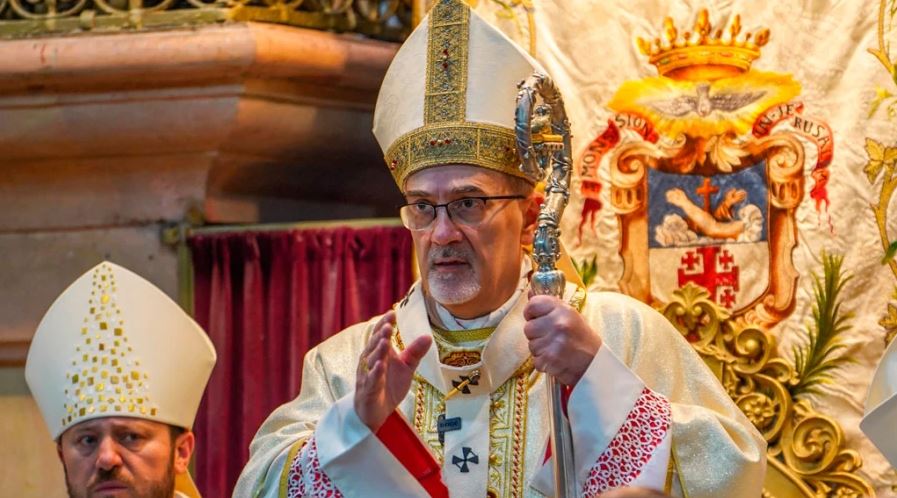
Following the restrictions imposed by Israel on access to the Basilica of the Holy Sepulcher—which provoked international criticism—the celebrations of the Easter Triduum in Jerusalem have taken place this year with the presence of a very reduced group of faithful and broadcast via streaming. In that exceptional context, Cardinal Pierbattista Pizzaballa, Latin Patriarch of Jerusalem, centered his Holy Thursday homily on a direct warning: without accepting Christ’s way of loving—a love that humbles itself and serves—there is no communion with Him.
A Holy Sepulcher Closed Amid the Conflict
The liturgy was celebrated in the very place where Christ conquered death, but with an unusual image: restricted access, doors practically closed, and a community gathered amid the tension sweeping through the Holy Land.
“We are here as in a womb of peace, while around us the world is tearing apart,” the Patriarch affirmed at the beginning of his homily, clearly describing the fracture between the interior of the basilica and the surrounding context of war.
Christ Does Not Flee: He Humbles Himself
The core of the preaching revolved around the washing of the feet, which Pizzaballa presented not as a simple exemplary gesture, but as the concrete form of Christ’s Passover.
Recalling the parallel with the book of Exodus, he explained that “girding” one’s waist is the gesture of one preparing to depart. However, in Jesus, that gesture takes on a radically different meaning: He does not gird Himself to leave, but to kneel.
“Jesus transforms the gesture of one who departs into the gesture of one who serves,” he emphasized. The true exodus, in God’s logic, does not consist in escaping the world, but in entering it to the extreme, even assuming the condition of a servant.
Peter’s Rejection: Not Accepting a God Who Humbles Himself
Peter’s reaction occupies a central place in the homily. His refusal—“You shall never wash my feet”—is not just discomfort, but rejection in the face of a love that humbles itself.
Christ’s response is blunt: “If I do not wash you, you have no part with me.” For the Patriarch, here lies the decisive point: it is not enough to follow Jesus or admire Him; it is necessary to accept His way of loving.
“There is no communion without allowing oneself to be served,” he insisted.
Eucharist and Service: Inseparable
Pizzaballa recalled that the Eucharist and the washing of the feet are not two distinct realities, but two expressions of the same mystery. The body that is given on the altar is the same one that bends down before the disciples.
Separating worship from service means emptying both realities of content. Therefore, the liturgy is not limited to being contemplated: it demands a concrete response in life.
A Small Church, Called Not to Defend Itself
The Patriarch applied this message to the situation of the Church in the Holy Land: a reduced, weary community constantly put to the test.
“We are not a strong or numerous Church,” he acknowledged, but he made it clear that the key is not in strength, but in “having part with Christ.”
This implies renouncing the temptation to protect oneself and accepting to share His humiliation, remaining faithful amid fragility and without pretending to dominate history.
The Question That Reaches Us
The homily concluded with a direct challenge that also affects us: whether we are willing to accept a love that humbles itself, that touches our wounds, and that holds nothing back.
“Only one who has allowed himself to be washed can learn to wash,” the Patriarch recalled.
In an almost empty basilica and a Holy Land marked by war, the message of Holy Thursday takes on particular clarity: the Christian is not called to impose himself, but to remain alongside Christ in His way of loving, even when that path passes through humiliation and service.