


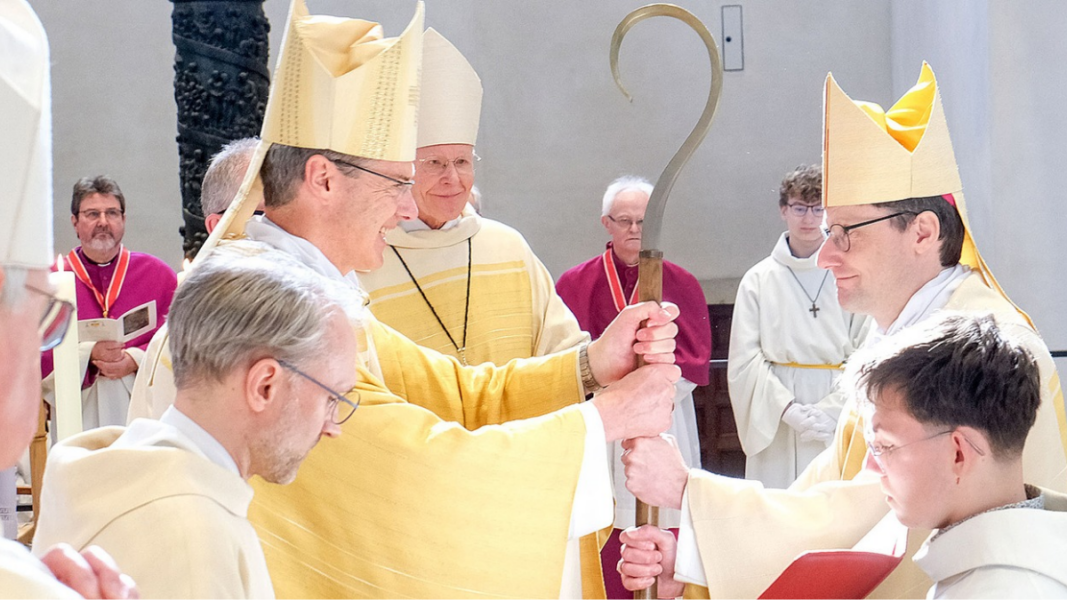
The recent appointment of Heiner Wilmer to the diocese of Münster once again highlights a common practice in Germany: the designation of bishops with prior experience in other dioceses, in a context marked by the decreasing number of available priests.
According to Katholisch.de, this dynamic is not new. In the large German dioceses, it is common to turn to bishops who have already served in smaller sees. Recent examples include the archbishop of Munich, Reinhard Marx, who was previously bishop of Trier, or the archbishop of Cologne, Rainer Maria Woelki, who came from Berlin.
A consolidated practice in canon law
The transfer of bishops from one diocese to another, which was prohibited in the early centuries of Christianity, has become an ordinary practice in the Church. The current Code of Canon Law regulates this procedure and establishes, among other provisions, that the bishop must take possession of his new diocese within a specified period, after which his previous see becomes vacant.
During the transition period, the bishop maintains limited functions in his former diocese, similar to those of a diocesan administrator, without being able to introduce significant changes in its governance.
A problem that goes beyond appointments
Beyond the practice of transfers, the background is the progressive reduction in the number of priests in Germany. In 2024, only 25 new presbyters were ordained throughout the country, which represents, for the first time, an average of less than one per diocese.
This decline not only affects the pastoral coverage of increasingly large parishes but also the number of candidates available for the episcopate.
A priestly profile less oriented toward governance
In addition to this quantitative limitation, there is a change in the profile of new priests. According to a study by the Pastoral Research Center at the University of Bochum, many of the presbyters ordained in recent years do not see themselves as organizational leaders.
“Many want to be pastors, but not bosses or managers,” the report states, highlighting a certain distance between vocational motivations and the administrative demands of current ecclesial structures.
An episcopal succession in perspective
The situation is further complicated by demographic factors. In the coming years, several bishops will reach retirement age, which will require filling numerous episcopal sees in a context of limited human resources.
Despite some solutions adopted in other countries—such as the unification of dioceses under a single bishop—this option does not seem viable in Germany, due both to the territorial extent and the number of faithful.
A horizon marked by scarcity
Currently, two German dioceses are vacant, and a new wave of replacements is expected in the coming years. The combination of vocational decline, aging clergy, and increasing pastoral responsibilities paints a scenario in which the selection of bishops becomes increasingly complex.
In this context, the Church in Germany faces the challenge of ensuring succession in the governance of dioceses in an environment of growing scarcity of candidates.