


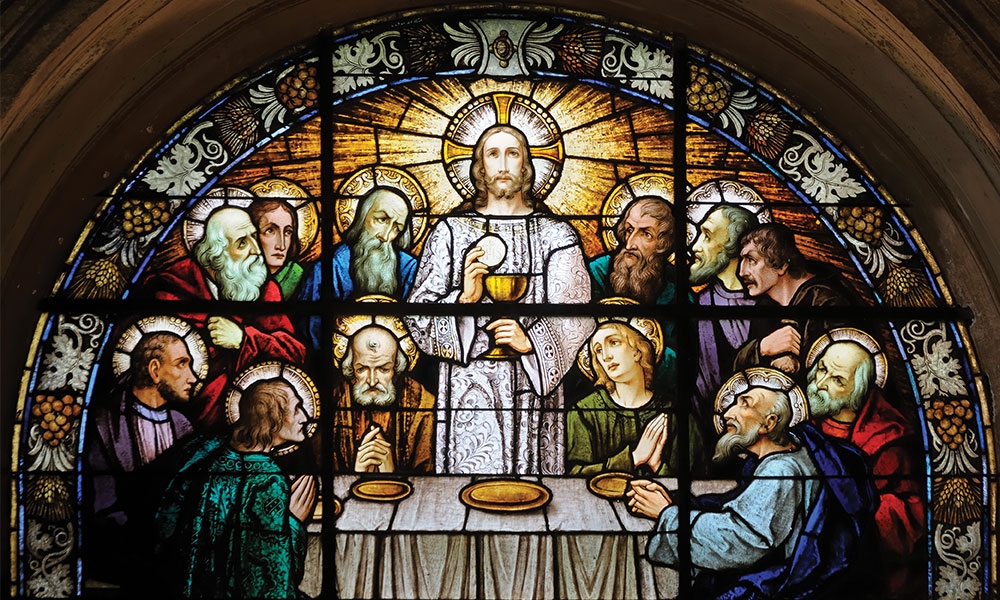
Not a few Catholic homes have taken up the custom of turning to modern cinema to commemorate our religious holidays in some way. In this manner, for example, at Christmas they gather to watch Natividad. La historia (Catherine Hardwicke, 2006), a film that, without being any wonder, serves as a gentle prelude to such celebrations; on Good Friday, they congregate to relive that day with the already mythical La pasión de Cristo (Mel Gibson, 2004), perhaps the best approach to the work of our redemption, and at Easter, Resucitado (Kevin Reynolds, 2016), which functions as a spiritual sequel to that one. But of course, there was a missing film that would open the doors to the events of Holy Thursday. Well then, to fill that gap, La última cena (Mauro Borrelli, 2025) has arrived in our theaters.
To begin with, it is surprising that this filmmaker, known for such strange titles as Los invasores (2017) or Jaula mental (2022), has ventured to tackle a film of this kind. However, he himself has addressed this issue in various interviews: as he defends, as a Catholic, he missed a feature film that would narrate, precisely, the events prior to the passion of our Lord; likewise, he assures that he did not intend to show only an exhaustive recreation of that last supper—with this objective, we recommend a forgotten Spanish work titled La espina de Dios (Óscar Parra, 2015)—, but rather to impel the viewer to question their own attitude toward Jesus.
Thus, this film is born, first of all, with a clear vocation of vindication (of a cinematic nature, of course), and secondly, with an enormous catechetical responsibility.
As for the first, that is, its intention to show the aspects concerning the last supper, we must say that the movie exceeds the best expectations. Certainly, and despite not pretending to be a faithful recreation of it, it knows how to immerse us like no other in those moments prior to the martyrdom of our Lord.
In this way, without being prolix, it intersperses the rites proper to the Jewish Passover supper with those that Jesus introduced in order to institute the Eucharist (pay attention to the reaction of the apostles when, in fact, they discover that his words about the bread and wine have nothing to do with those handed down by Moses). This results in an excellent sacramental context that, from that scene onward, conditions the rest of the footage.
As for its catechetical purpose, the film also passes with flying colors. Three figures stand out that aim to challenge the viewer at all times: Jesus, Saint Peter, and Judas Iscariot.
Jesus, of course, is the axis around which the other two pivot, for his message of love and unconditional surrender serves them as an intense revulsive; but not only them, but, as we say, also the audience, who may see themselves reflected in the attitudes, either of the prince of the apostles, or of the traitor.
Watch out for this: the film is not at all Manichean, but rather seeks to objectively point out the doubts and prejudices of both protagonists, with the firm commitment to show that each one of us can fall into the two extremes that they represent.
For these reasons, we can say that La última cena is an appropriate film to watch this Holy Week, and specifically, this Holy Thursday. That said, the viewer should not expect to find a work of technical quality like La pasión de Cristo, for it is infinitely more modest (know that it is a made-for-TV movie that has managed to reach the big screen).
Nor should one try to look for three feet on the cat, for one will find them (for example, the surprising absence of the Virgin Mary or the abrupt ellipsis that precipitates the end). On the contrary, approach it according to the clues we have provided here, and you will find that it is a bold bet, worthy of belonging to that video library with which many Catholic homes already commemorate (cinematographically speaking) our religious holidays.