


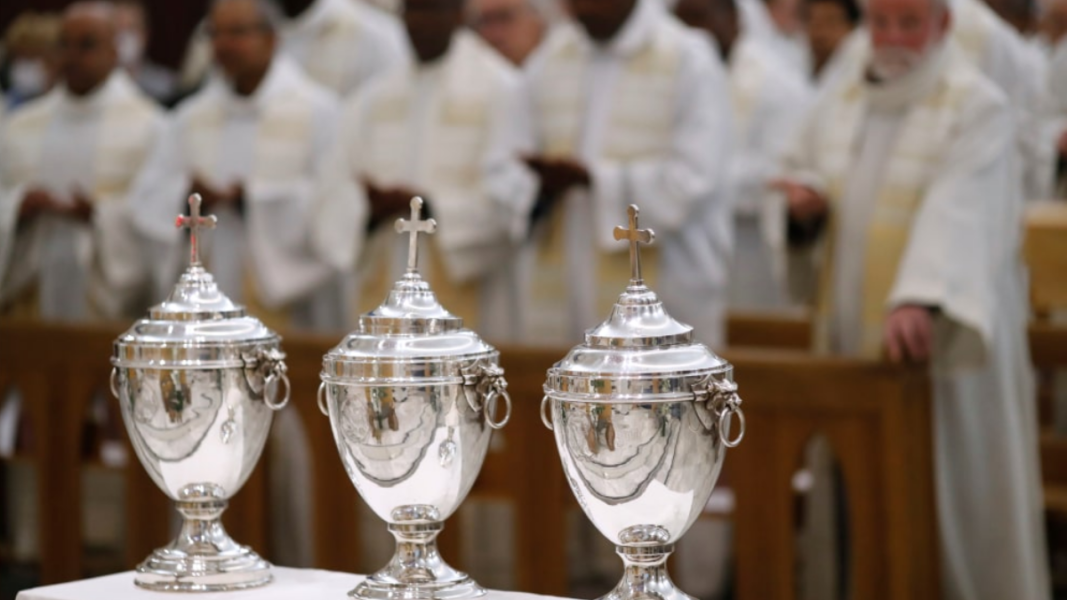
One of the most discussed issues since the publication of Traditionis custodes, promulgated by Francis on July 16, 2021, is whether bishops can use the concelebration of the Chrismal Mass in the reformed rite as a test of communion for priests linked to the 1962 missal. The short answer is that Rome did not dictate a universal obligation worded in those terms, but it did offer bishops a disciplinary criterion that, in practice, has served in not a few places as a tool to detect resistances, measure adhesions, and, if necessary, withdraw permissions.
The so-called Responsa ad dubia on Traditionis custodes were not presented publicly by a cardinal, a group of bishops, or an episcopal conference identified by name. The official text of the Holy See states only that “some questions” had arrived “from various quarters” and “with greater frequency,” and that, after examining them and informing the Roman Pontiff, the most recurrent responses were being published. In other words: the Holy See did not make public the identity of those who raised those doubts. The document is dated December 4, 2021, but it was published by the Holy See Press Office on December 18, 2021. Later, a rescriptum ex audientia of February 20, 2023, disseminated on February 21, further reinforced its practical authority by confirming that dispensations regarding the use of parish churches and the erection of personal parishes were reserved to the Dicastery for Divine Worship.
The key to the matter lies in one of those responses. The official text of the dicastery expressly addresses the case of priests who are granted permission to celebrate with the 1962 missal, but who, according to the dicastery, “do not recognize the validity and legitimacy of concelebration” and therefore refuse to concelebrate the Chrismal Mass with the bishop on Holy Thursday. The response is negative and adds that, before revoking that concession, the bishop must engage in fraternal dialogue and accompany the priest toward an understanding of the value of concelebration, “particularly in the Chrismal Mass.” The official text can be read on the Vatican website: “Responsa ad dubia on certain provisions of the Apostolic Letter Traditionis custodes”. There it is, in essence, the foundation that many bishops have since wielded.
The formulation is not trivial. Rome did not merely recall that the Chrismal Mass expresses the unity of the presbyterate with the bishop, something known for decades, but effectively linked the refusal to concelebrate with a deeper suspicion: the possible non-acceptance of the legitimacy of the liturgical reform and the post-conciliar magisterium. Media with very different sensitivities thus understood the scope of the response. America Magazine, for example, summarized at the time that, according to the Vatican, refusal to concelebrate the Chrismal Mass could lead to the withdrawal of permission to celebrate the traditional liturgy. From a more critical canonical perspective, Vaticanist Edward Pentin would later recall in the National Catholic Register that, outside of a few cases provided for by liturgical law, requiring concelebration affects the freedom of priests recognized in canon 902.
The clearest and best-documented case in France was that of Dijon. Even before the Responsa, a head-on clash had already occurred there between Archbishop Roland Minnerath and the Priestly Fraternity of Saint Peter. In June 2021, CNA/EWTN reported that the fraternity’s priests would be removed from Fontaine-lès-Dijon after years of tensions. Father Hubert Perrel explained at the time that the archbishop wanted them to concelebrate the Chrismal Mass during Holy Week, something they had not done for years due to their charism and their way of living the liturgy. The same idea reappeared later in the National Catholic Register, which directly cited that dispute over Chrismal concelebration as one of the triggers of the conflict. It was no longer a theoretical discussion about rubrics or liturgical sensitivity, but a concrete disciplinary collision between a diocesan ordinary and an institute born precisely under the protection of Ecclesia Dei.
Dijon was not an isolated episode or a mere local eccentricity. In 2024, the same National Catholic Register returned to that precedent and presented it as a consolidated example of the new praxis: Archbishop Minnerath, the article said, expelled members of the Priestly Fraternity of Saint Peter because they did not want to concelebrate Masses, “specifically the Chrismal Mass in the ordinary form,” and had not done so for years. The importance of this point lies in showing how the concelebration of the Chrismal Mass has ceased to be perceived in certain episcopal circles as a recommended gesture to become, in practice, a disciplinary boundary between the priest considered fully aligned and the priest under suspicion.
Soon after came another decisive piece of data, this time from Rome and with a clearly more general scope. After Francis’s audience with members of the French episcopate on April 21, 2022, several media outlets reported that the Pope had insisted that all priests accept concelebration, at least in the Chrismal Mass. The formulation was attributed to the Archbishop of Reims and President of the French Episcopal Conference, Monsignor Éric de Moulins-Beaufort. It was reported, among others, by Famille Chrétienne, which cited that papal insistence as part of the message transmitted to the French bishops. Although it was not a normative document with legislative value, it did have an evident effect: it confirmed that the Roman line did not see the issue as a secondary detail, but as a relevant sign of visible communion.
The Priestly Fraternity of Saint Peter, for its part, obtained in February 2022 a singular papal decree that confirmed for its members the use of the 1962 liturgical books, in their own churches or oratories and, outside of them, with the consent of the local ordinary. The text can be consulted on the fraternity’s own website: “Decree of Pope Francis confirming the use of the 1962 liturgical books”. That decree was presented by the fraternity as a confirmation of its charism, but it did not fully resolve the issue of concelebration. In fact, precisely because the Pope reaffirmed their right to use the 1962 books without derogating from the general architecture of Traditionis custodes, the tension remained open between the recognition of a proper liturgical identity and the episcopal pressure for that identity to manifest itself as compatible with certain gestures of the reformed rite, especially in the diocesan framework.
That tension has continued to surface. In 2025, the Valence conflict brought the issue back to the forefront. The National Catholic Register reported that Bishop François Durand was withdrawing the Priestly Fraternity of Saint Peter from its apostolate in Valence and Montélimar, and emphasized that one of the points of friction was the FSSP’s refusal to concelebrate, “including the Chrismal Mass.” According to that information, for the diocesan authorities, such refusal was a sign of lack of ecclesial communion. Once again, the same pattern emerges: the Chrismal Mass ceases to be simply a great annual celebration of the diocesan clergy and begins to function as a visible test of adhesion to the post-conciliar liturgical and ecclesial framework.
From a strictly legal point of view, exaggerations must be avoided. There is no universal law that says, with that literalness, that “priests from ex Ecclesia Dei communities are obliged to concelebrate the Novus Ordo in the Chrismal Mass under penalty of automatically losing their ministries.” That would be inaccurate. What does exist is something more complex and, in a certain sense, more effective: a chain of texts and decisions that has allowed bishops to interpret refusal to concelebrate as an indication of a supposed deeper doctrinal or ecclesiological problem. First came Traditionis custodes; then, the Responsa of December 2021, with its explicit reference to the Chrismal Mass; later, the disciplinary reinforcement of the February 2023 rescriptum. On that basis, several ordinaries have acted very harshly, taking advantage of the framework to seek out suspects.
The real debate, therefore, does not revolve solely around a rubric or presbyteral courtesy toward the bishop. What is being discussed is whether the ecclesial communion of a traditional priest can legitimately be measured through a liturgical act that, for him, is not incidental but problematic for reasons of liturgical conscience, the history of his institute, and understanding of the priesthood. The more restrictive bishops respond yes, because the Chrismal Mass sacramentally expresses the unity of the presbyterate and because anyone who rejects even that minimal gesture places himself, in fact, in an anomalous ecclesial position. The sectors most linked to tradition respond that this demand turns a sign of communion into an ideological test, and that the pressure to concelebrate the Novus Ordo precisely in the Chrismal Mass has ended up operating as a detector of “rebels” within the traditional clergy.
This explains why the expression does not sound disproportionate to many of those affected. In light of the Roman texts and the cases of Dijon and Valence, it can be argued with foundation that the concelebration of the Chrismal Mass has been used in certain dioceses as a touchstone to separate traditional priests considered integrable from those considered reluctant.