


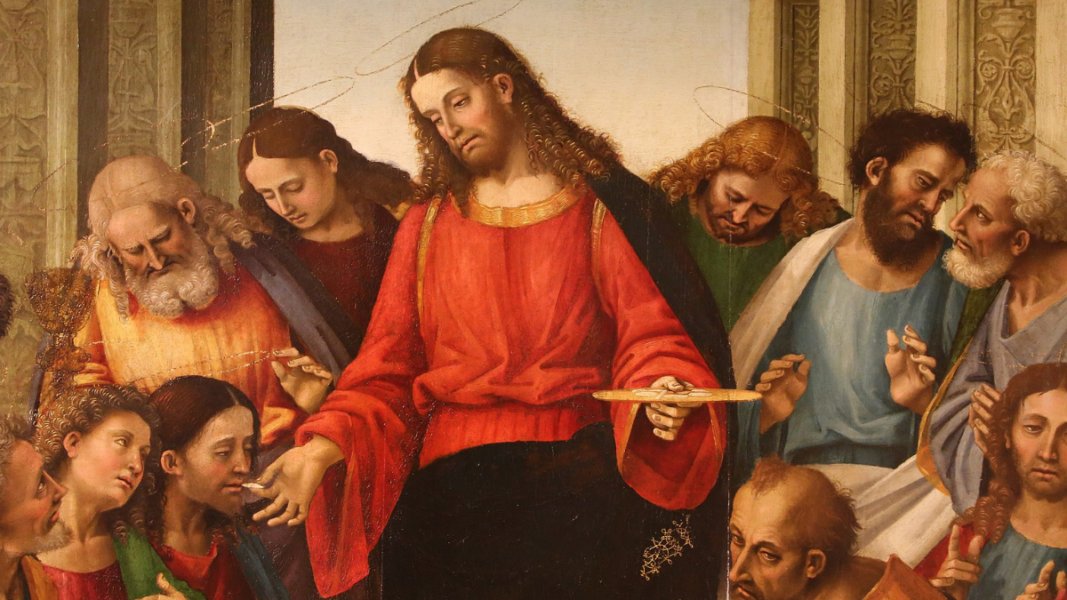
In the liturgy of Holy Thursday, the exhortation of Saint Paul to the Corinthians falls upon the soul like a thunderclap. Upon the Church re-entering the Upper Room, the tone of the Apostle is not one of mawkish pietism, of a guitar-strumming ditty and effeminate, unfit for adults, but of the bullfighter’s shame in the moment of killing: «Convenientibus vobis in unum, iam non est Dominicam coenam manducare». You gather, yes, but it is no longer eating the Lord’s Supper. Tremendous, everyday, and absurd possibility: to be externally in the Church, to participate in the rite, and not to truly live the mystery. To hold the bread in one’s hands… and not receive the Bread.
Saul describes a divided, superficial community, where each goes their own way: some have more than enough, others are in need; some are satisfied, others are forgotten. And then he launches a question like a poisoned dart: «Ecclesiam Dei contemnitis?» Do you despise the Church of God? Because the Eucharist is not an individual act: it is the sacrament of unity; one cannot receive the Body of Christ while despising his Body, which is the Church.
And after this shake-up, the Apostle gives the key to Holy Thursday: «Ego enim accepi a Domino quod et tradidi vobis…». And he transmits, word for word, the gesture of Christ on the night he was to be handed over: «Hoc est corpus meum, quod pro vobis tradetur… Hic calix novum Testamentum est in meo sanguine…». The Bread that is broken, the Chalice that is offered, are the surrender that is sacramentally anticipated before being consummated on the Cross: the Supper and Calvary are a single mystery.
And precisely for that reason, Paul introduces a serious warning, extremely serious, where the liturgy wants us to pause, with sacred fear: «Qui enim manducat et bibit indigne, iudicium sibi manducat et bibit: non diiudicans corpus Domini». Whoever eats and drinks unworthily, eats and drinks his own condemnation, for not discerning the Lord’s Body.
It is not just about “not being well disposed” in a vague sense; it is about not recognizing, not discerning, not realizing that this Bread is truly the Body of Christ. And not just recognizing it with the intellect, but living accordingly. Because “discerning the Body” also means recognizing it in the Church, in the brethren, in one’s own life. It means not separating what God has joined: the Sacrament and charity, worship and life, the altar and concrete existence.
And that has shuddering consequences: «Ideo inter vos multi infirmi et imbecilles, et dormiunt multi». For that reason, there are among you many who are weak and ill, and many who sleep. The lack of reverence before the Eucharist, Communion received without living faith, without conversion, without love, is not something neutral: it weakens the soul, sickens it, lulls it to sleep. It introduces a kind of spiritual anemia that ends up extinguishing the life of grace.
How painfully relevant this is! How many times the Holy Communion is banalized, how many times it is received without preparation, without being in a state of grace, without frequent and contrite confession, without interior silence, without proper attire, without awareness of what one is doing, touching the sacramental species without a shred of reverence after a distracted and frivolous procession… Then the soul becomes ill and imbecilic; that is, it cools, weakens, languishes, and becomes—contrary to what it seems to do—incapable of God.
And finally, «dormiunt multi». If we read it literally: there are too many Catholics of the sleeping Church, as Pius XII said. If we translate from the original Greek: “many die”… from communing! The Angelic Doctor also warned of this in his Sequence for Corpus Christi: «Sumunt boni, sumunt mali: sorte tamen inæquali, vitæ vel intéritus. Mors est malis, vita bonis: vide paris sumptiónis quam sit dispar exitus». The good receive it, the bad receive it: yet with unequal outcomes, life or destruction. Death for the bad, life for the good: see how different the end is from equal reception.
For that reason, this Bread of the children «non mittendus canibus»: is not to be given to dogs. And for that reason, the Apostle gives a recipe for life or death: «Probet autem seipsum homo». Let a man examine himself. Not to withdraw, but to approach well; not to flee from the Sacrament, but to dispose himself to receive it in truth.
Holy Thursday, the day of the institution of the Eucharist, calls for a worthy, conscious, adoring, and transformative Communion; to receive the Lord’s Body as what it is: an immense gift, a fire that purifies, a presence that converts and renews. Because to commune with the Lord is to enter into his Passion, to allow oneself to be affected by his surrender, to recognize him also in the neighbor.
Beside the altar, silent, adoring, is the Virgin Mary. She, who gave flesh to the Word, is the first to understand what that «Hoc est corpus meum» means. She does not need to “discern” as we do: she knows, loves, adores. And she teaches us to commune. Not to receive the Bread of Life as something ordinary, forgetting the Apostle’s warning.
Not to be “weak, imbecilic, or sleeping”: so that our soul does not weaken and cool until it dies, but rather, nourished by this Sacrament, strengthens, purifies, and ignites itself. Because only one who discerns the Lord’s Body—in the altar, on the Cross, in the brethren, in the Catholic Church—truly participates in the Supper… and enters, with Christ, into the mystery of his surrender.