


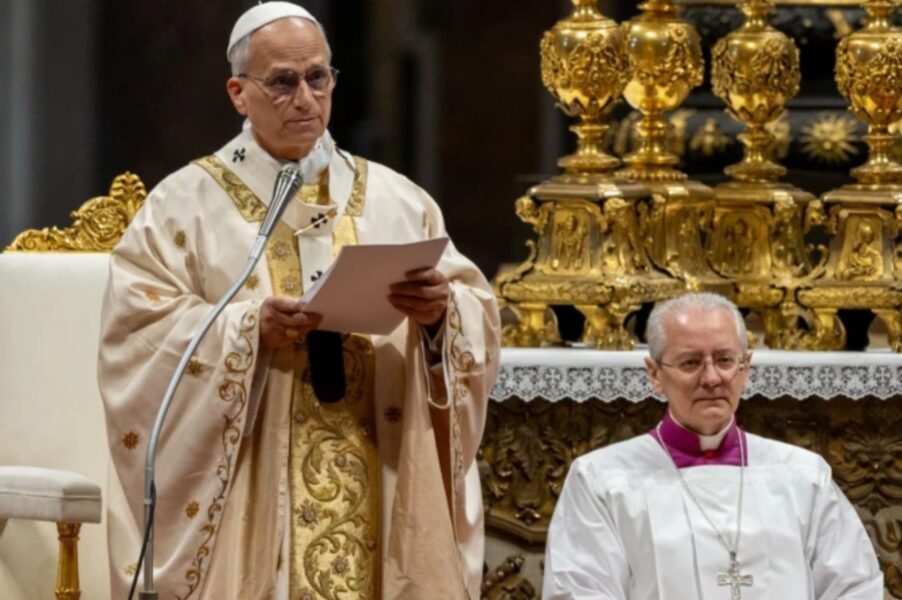
Pope Leo XIV has presided over this Holy Thursday his first Chrism Mass as Bishop of Rome, in St. Peter’s Basilica, marking the immediate start of the Paschal Triduum with a homily of a markedly programmatic tone. Before the Roman clergy, the Pontiff has outlined a demanding conception of the Christian mission, centered on detachment, encounter, and acceptance of the cross.
In a dense discourse, Leo XIV has warned against deviations from the mission when it is contaminated by logics of power or domination, insisting that the Gospel can only be proclaimed from poverty, respect, and communion. Below is the full text of the homily:
Dear brothers and sisters:
We are already at the threshold of the Paschal Triduum. Once again, the Lord will lead us to the summit of his mission, so that his passion, death, and resurrection become the heart of our mission. What we are about to relive, in fact, has within it the power to transform what human pride tends to harden: our identity, our place in the world. Jesus’ freedom changes the heart, heals wounds, perfumes and makes our faces shine, reconciles and gathers, forgives and resurrects.
In this first year in which I preside over the Chrism Mass as Bishop of Rome, I wish to reflect with you on the mission to which God consecrates us as his people. It is the Christian mission, the same as Jesus’, no other. Each one participates in it according to their own vocation and in a very personal obedience to the voice of the Spirit, but never without the others, never neglecting or breaking communion! Bishops and presbyters, in renewing our promises, we are at the service of a missionary people.
We are, together with all the baptized, the Body of Christ, anointed by his Spirit of freedom and consolation, Spirit of prophecy and unity. What Jesus lives in the culminating moments of his mission is already anticipated in the passage from Isaiah, which He himself pointed out in the synagogue of Nazareth as the Word that «today» is fulfilled (cf. Lk 4:21). In the hour of Easter, in fact, it becomes definitively clear that God consecrates to send. He «sent me» (Lk 4:18), says Jesus, describing that movement that unites his Body to the poor, to the prisoners, to those who walk groping in the darkness, and to those who are oppressed. And we, members of his Body, call «apostolic» a Church that is sent, not static, driven beyond itself, consecrated to God in service to his creatures: «As the Father has sent me, so I send you» (Jn 20:21).
We know that being sent implies, first of all, a detachment, that is, the risk of leaving what is familiar and safe, to venture into the new. It is interesting that «with the power of the Spirit» (Lk 4:14), descended upon Him after the Baptism in the Jordan, Jesus returns to Galilee and goes «to Nazareth, where he had been brought up» (v. 16). It is the place that he now must leave. He moves «as was his custom» (ibid.), but to inaugurate a new time. Now he will have to leave that town definitively, so that what has germinated there, Sabbath after Sabbath, in the faithful listening to the Word of God, may mature.
Likewise, he will call others to set out, to take risks, so that no place becomes a cell, no identity a lair. Dear brothers, we follow Jesus, who «did not regard equality with God as something to be exploited: rather, he emptied himself» (Phil 2:6-7). Every mission begins with that kind of emptying in which everything is reborn. Our dignity as sons and daughters of God cannot be taken away from us, nor lost, but neither can the affections, places, and experiences that are at the origin of our life be erased.
We are heirs to so much good and, at the same time, to the limits of a history in which the Gospel must bring light and salvation, forgiveness and healing. Thus, the mission begins with reconciliation with our origins, with the gifts and limits of the formation received; at the same time, there is no peace without the courage to set out, no conscience without the boldness of detachment, no joy without risking.
We are the Body of Christ if we set out in motion, coming out of ourselves, making peace with the past without remaining prisoners of it: everything is recovered and multiplied if it is first let go, without fear. It is the first secret of the mission. And it is not experienced only once, but in every new beginning, in every further sending.
Jesus’ path reveals to us that the willingness to lose, to empty oneself, is not an end in itself, but a condition for encounter and intimacy. Love is only true if it is disarmed, needs few things, no ostentation, and tenderly guards weakness and nakedness. It costs us to launch ourselves into such an exposed mission, and yet there is no «good news to the poor» (cf. Lk 4:18) if we go to them with signs of power, nor is there authentic liberation if we do not free ourselves from possession.
Here we touch a second secret of the Christian mission. After detachment is the law of encounter. We know that, throughout history, the mission has not infrequently been distorted by logics of domination, totally foreign to the path of Jesus Christ. St. John Paul II had the lucidity and courage to recognize that «by the bond that unites us in the Mystical Body, and even without personal responsibility or eluding God’s judgment, the only one who knows hearts, we bear the weight of the errors and faults of those who preceded us.»
Therefore, it is now a priority to remember that neither in the pastoral sphere, nor in the social and political sphere, can good come from arrogance. The great missionaries are witnesses to careful approaches, whose method consists in sharing life, disinterested service, renunciation of any calculating strategy, dialogue, and respect. It is the path of incarnation, which always and anew takes the form of inculturation. Salvation, in fact, can only be welcomed by each one in their mother tongue.
«How is it that each of us hears them in our own native language?» (Acts 2:8). The surprise of Pentecost is repeated when we do not pretend to dominate God’s times, but trust in the Holy Spirit, who is present also today, as in the times of Jesus and the apostles, is present and active, arrives before us, works more and better than we do; it is not for us to sow or awaken it, but above all to recognize it, welcome it, follow it, clear the way for it, and go after it.
To establish this attunement with the invisible, it is necessary to arrive with simplicity at the place to which we are sent, honoring the mystery that each person and each community carries with them: a sacredness that transcends us everywhere and that is violated when we behave as owners of places and of others’ lives. We are guests: we are as bishops, as priests, as religious sisters and brothers, as Christians. In fact, to welcome, we must learn to let ourselves be welcomed.
Even the places where secularization seems most advanced are not lands of conquest, nor of reconquest. New cultures continue to gestate in these enormous human geographies in which the Christian is no longer usually a promoter of meaning, but receives from them other languages, symbols, and paradigms that offer new orientations of life, often in contrast with the Gospel of Jesus. It is necessary to reach where the new narratives and paradigms are gestating, to reach with the Word of Jesus the deepest cores of the soul of the cities.
This only happens if in the Church we walk together, if the mission is not an individual adventure, but the living witness of a Body with many members. There is also a third dimension, perhaps the most radical, of the Christian mission.
Already in the violent reaction of the inhabitants of Nazareth to Jesus’ words, the possibility of misunderstanding and rejection is manifested. What we are about to celebrate starting this afternoon commits us not to flee, but to go through the trial, like Jesus, who continued his way even when he was led to the edge of the precipice.
The cross is part of the mission; the sending becomes more bitter and frightening, but also more gratuitous and revolutionary. Violence is unmasked. The poor Messiah enters the darkness of death and thus opens a new creation.
We can go through situations in which it seems that everything has ended. Then doubt arises about the fruitfulness of the mission. It is true that we too experience failures, but hope remains alive in the witnesses who preceded us.
The Pope recalled the witness of St. Óscar Arnulfo Romero, who shortly before dying wrote his trust in God even in the face of danger, and that of Cardinal Joseph Bernardin, who at the end of his life confessed to having lost fear thanks to faith and prayer.
The saints make history. In this hour, God continues to send his Church to carry the perfume of Christ where the smell of death dominates. In the face of a world in conflict, a new people is born, not of victims, but of witnesses.
Let us renew our «yes» to this mission that demands unity and brings peace. We proclaim your death, O Lord, we proclaim your resurrection, in the expectation of your coming.