


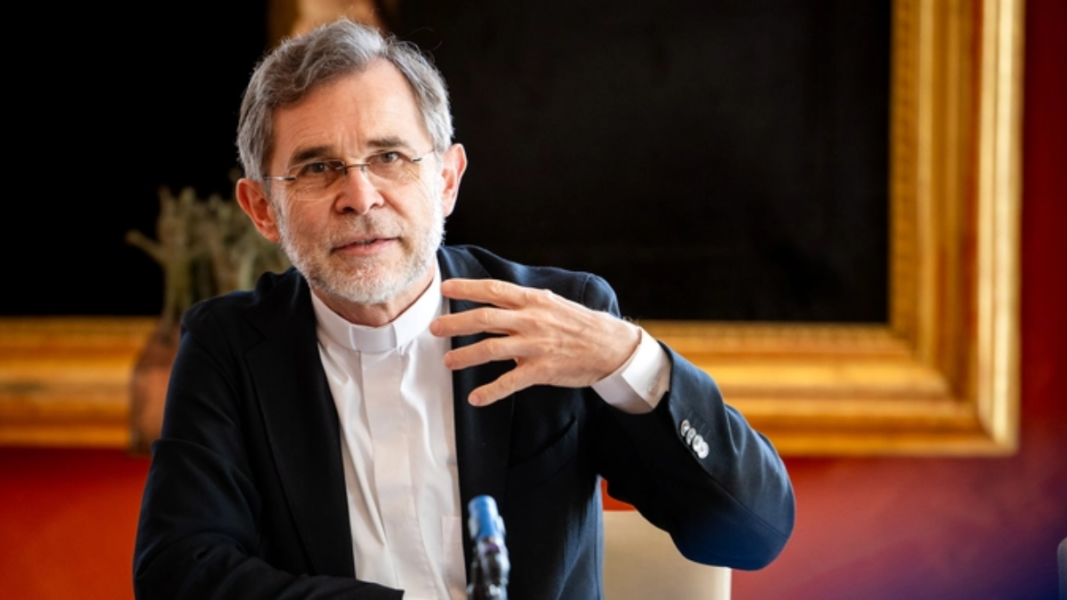
The Archbishop of Vienna, Josef Grünwidl, has tried to nuance his recent statements on the role of canon law in the Church, but his new assertions not only do not correct the substance, but reinforce it. In an interview granted to the Austrian media Der Sonntag, the prelate insists that if something comes from the Holy Spirit, it will end up imposing itself in the Church as well, even in areas regulated by norms and traditions.
His words come weeks after the controversy generated by statements in which he claimed that “what comes from the Holy Spirit cannot be stopped by canon law”. Now, Grünwidl maintains that perhaps he did not express himself precisely, but he keeps the central idea.
A “correction” that reaffirms the substance
The archbishop explains that he was inspired by a passage from the Acts of the Apostles to emphasize that what comes from God cannot be stopped by human structures. However, far from limiting the scope of his words, he adds that if certain issues—like the role of women in the Church—respond to an impulse from the Holy Spirit or to “signs of the times,” they will end up developing at the ecclesial level as well.
In this sense, he explicitly links these possible evolutions to recent synodal processes, pointing out that their conclusions should translate into concrete changes in the life of the Church. Among them, he mentions the need to review the composition of consultative bodies to include not only clerics, but also laity and women.
Structural changes in the name of synodality
Grünwidl does not limit himself to theoretical reflection. He proposes practical measures that point to greater participation of the laity—and especially women—in decision-making instances. In his view, the current structure must adapt if one wants to effectively apply the synodal path promoted in recent years.
This approach reinforces the perception that it is not a simple nuance of his previous words, but a reformulation that keeps the underlying idea intact: that ecclesial norms can change if what he interprets as the action of the Holy Spirit demands it.
Good Friday and the comparison with Protestants
In another moment of the interview, the archbishop addresses the situation of Good Friday in Austria, which ceased to be a specific holiday for Protestants after a legal reform in 2019. Grünwidl states that this day has a “more identity-based” relevance for Protestants than for Catholics, in reference to the claim of those communities to recover the festive character of the day.
The statement is striking, given that Good Friday commemorates the Passion of Christ and holds a central place in the Catholic liturgy. Although the prelate shows understanding toward the demands of the Protestant churches, his comparison introduces a questionable nuance about the weight of this celebration in Catholic life.
Confession, a pending task
Asked about the practice of confession in the context of Holy Week, Grünwidl acknowledged that this year he has not been able to dedicate time to the ministry of the sacrament of penance due to the intensity of his agenda. The archbishop noted that, unlike his predecessor, who used to hear confessions in the cathedral during the days prior to Easter, he has not managed to do so on this occasion.
Nevertheless, he stated that it is an aspect he wishes to incorporate in the future, expressing his intention to personally involve himself in the administration of this sacrament in upcoming celebrations.
Between pastoral management and the vision of the Church
In the interview, the Archbishop of Vienna also offered various reflections on Christian life and his pastoral work. Grünwidl emphasized the centrality of Easter as the axis of faith, recalling that every Sunday constitutes “a little Easter” that invites the faithful to live with hope the resurrection of Christ throughout the year.
On the doctrinal plane, he explained the difference between Christian hope and reincarnation, insisting that life is unique and that salvation does not depend on human effort, but on the redemptive action of Jesus Christ and the mercy of God.
Beyond these points, Grünwidl defends the institutional structure of the Church against criticisms, justifying the need for economic resources, personnel, and organization to fulfill its evangelizing mission. At the same time, he insists on a non-individualistic vision of governance, emphasizing the importance of consultative bodies and joint work.
However, it is his reflections on the possible change of norms in the Church and his interpretation of the action of the Holy Spirit that once again place him at the center of the debate, in continuity with his previous statements.