


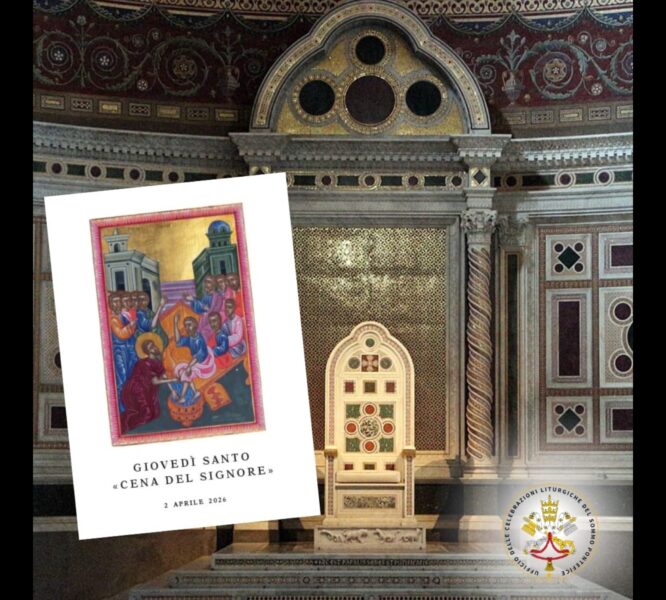
The Mass in Coena Domini that opens the Paschal Triduum in the Basilica of St. John Lateran, presided over this year by Pope Leo XIV, presents some elements of interest, according to the official libretto published by the Holy See, both for its liturgical content and for its fit within the pontifical agenda of these days.
The text confirms that the celebration will follow the proper scheme of Holy Thursday, with the proclamation of the Gospel of the washing of the feet—“he loved them to the end”—and the corresponding rite, which visualizes the new commandment of charity. The liturgy thus maintains its own character: memory of the institution of the Eucharist, of the priesthood, and of service.
One of the less frequent details in recent pontifical celebrations is the choice of Eucharistic Prayer I, the Roman Canon, expressly indicated in the libretto. It is the oldest prayer of the Latin rite, of traditional use, although in recent decades it has been less common compared to other shorter options. Its presence in this celebration does not change the development of the Mass, but it does give it a more classical tone in the central moment of the liturgy.
The preface also incorporates the accents proper to the day, emphasizing the institution of the Eucharistic sacrifice and Christ’s self-giving as the foundation of the rite that the Church celebrates. In continuity with this, the structure of the Canon preserves its usual features, including the intercessions and the commemoration of the saints.
The celebration is also inserted into an especially intense agenda for Pope Leo XIV. After the Chrism Mass in the morning, Holy Thursday culminates with this evening liturgy in the cathedral of Rome. Good Friday will be marked by the celebration of the Lord’s Passion and the Way of the Cross, while the Easter Vigil on Saturday will constitute the center of the annual liturgical calendar.
The libretto also reflects other traditional elements, such as the singing of Ubi caritas in the offertory and the reposition of the Most Blessed Sacrament at the end of the celebration, accompanied by the Pange lingua. All of this configures a fully recognizable liturgy, in which ritual continuity and some less habitual choices coexist within the recent pontifical context.