


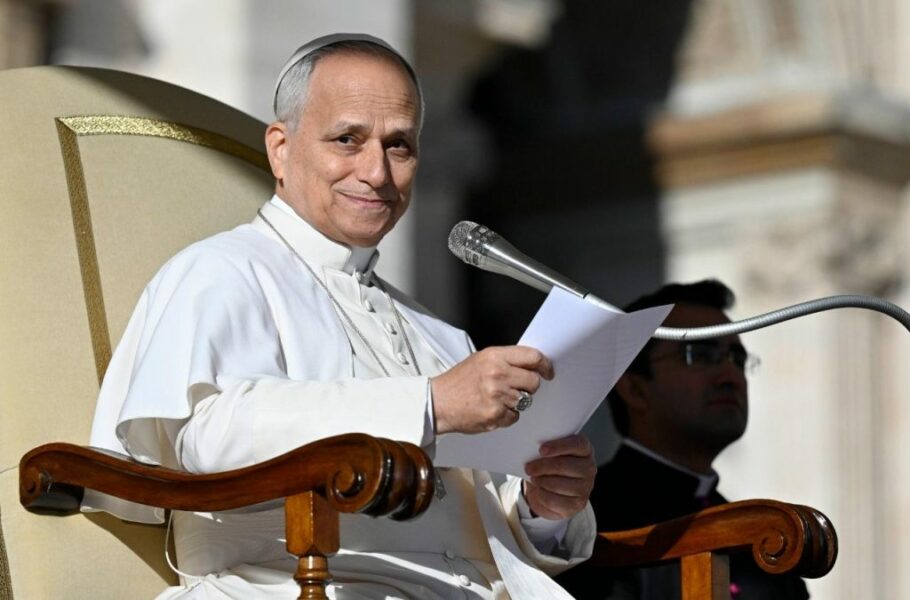
Pope Leo XIV focused his catechesis at this Wednesday’s General Audience on the role of the laity in the Church, as part of the cycle dedicated to the documents of the Second Vatican Council. Before the faithful gathered in St. Peter’s Square, the Pontiff reflected on the constitution Lumen gentium, emphasizing the common dignity of all the baptized and their mission in the life of the Church and in the world.
In his address, Leo XIV recalled that the laity do not constitute a secondary group, but rather “the immense majority of the people of God,” called to participate actively in the evangelizing mission from their own condition, in everyday life, in society, and in all human spheres.
We now leave below the complete catechesis of Leo XIV:
Brothers and sisters, good morning!
We continue our journey of reflection on the Church as presented to us in the conciliar Constitution Lumen gentium (LG). Today we address the fourth chapter, which deals with the laity. We all remember what Pope Francis liked to repeat: “The laity are simply the immense majority of the People of God. At their service is the minority of ordained ministers” (Exhort. ap. Evangelii gaudium, 102).
This section of the Document is concerned with explaining in a positive way the nature and mission of the laity, after centuries in which they had been defined simply as those who do not form part of the clergy or the consecrated. For this reason, I like to reread with you a very beautiful passage that speaks of the greatness of the Christian condition: “Therefore, the People of God, chosen by Him, is one: ‘one Lord, one faith, one baptism’ (Eph 4:5). Common is the dignity of the members, deriving from their regeneration in Christ; common is the grace of sonship; common is the call to perfection: one salvation, unique hope, and undivided charity” (LG, 32).
Before any difference in ministry or state of life, the Council affirms the equality of all the baptized. The Constitution does not want it to be forgotten what it had already affirmed in the chapter on the people of God, namely that the condition of the messianic people is the dignity and freedom of the children of God (cf. LG, 9).
Naturally, the greater the gift, the greater also the commitment. For this reason, the Council, along with dignity, also emphasizes the mission of the laity in the Church and in the world. But where does this mission find its foundation and what does it consist of? The very description of the laity that the Council proposes tells us: “By the name of laity are here designated all the Christian faithful […] who, being incorporated into Christ by baptism, integrated into the People of God and made partakers, in their own way, of the priestly, prophetic, and kingly function of Christ, exercise in the Church and in the world the mission of the entire Christian people in the part that corresponds to them” (LG, 31).
The holy people of God, therefore, is never an amorphous mass, but the body of Christ or, as St. Augustine said, the Christus totus: it is the organically structured community, by virtue of the fruitful relationship between its forms of participation in the priesthood of Christ: the common priesthood of the faithful and the ministerial priesthood (cf. LG, 10). By virtue of Baptism, the lay faithful participate in the same priesthood of Christ. In fact, “Christ Jesus, supreme and eternal Priest, wishes to continue his witness and service through the laity, he vivifies them with his Spirit and impels them ceaselessly to every good and perfect work” (LG, 34).
How can we not recall, in this sense, St. John Paul II and his apostolic exhortation Christifideles laici (December 30, 1988)? In it, he emphasized that “the Council, with its richest doctrinal, spiritual, and pastoral heritage, has reserved truly splendid pages on the nature, dignity, spirituality, mission, and responsibility of the lay faithful. And the conciliar Fathers, echoing the call of Christ, have summoned all the lay faithful, men and women, to work in the vineyard” (n. 2). In this way, my venerable predecessor relaunched the apostolate of the laity, to whom the Council had dedicated a specific Document, which we will speak about later. [1]
The broad field of the lay apostolate is not limited to the space of the Church, but extends to the world. The Church, in fact, is present in all places where its children profess and bear witness to the Gospel: in work environments, in civil society, and in all human relationships, wherever they, with their choices, show the beauty of Christian life, which anticipates here and now the justice and peace that will be full in the Kingdom of God. The world needs to “be imbued with the spirit of Christ and attain its end more effectively in justice, in charity, and in peace” (LG, 36). And this is possible only with the contribution, service, and witness of the laity!
It is the invitation to be that Church “on the move” of which Pope Francis has spoken to us: a Church incarnated in history, always open to mission, in which we are all called to be disciple-missionaries, apostles of the Gospel, witnesses to the Kingdom of God, bearers of the joy of the Christ we have encountered!
Brothers and sisters, may the Easter we prepare to celebrate renew in us the grace of being, like Mary Magdalene, like Peter and John, witnesses to the Risen One!
_________________________
[1] Cf. Conc. Ecum. Vat. II, Decr. Apostolicam actuositatem (November 18, 1965).