


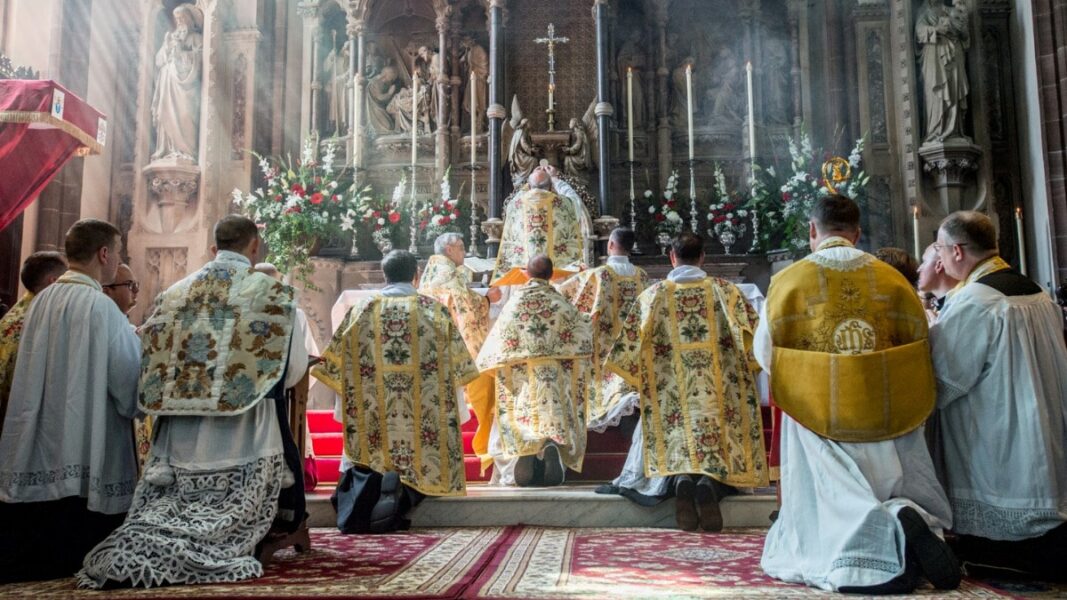
The issue of the traditional Mass has been the focus of part of the work of the Plenary Assembly of the French Episcopal Conference held in Lourdes at the end of March, in a context marked by Pope Leo XIV’s interest in advancing toward a solution that preserves the unity of the Church.
According to La Croix, in the January consistory, the Pontiff had entrusted Cardinal Jean-Marc Aveline with the task of studying possible ways to address the tensions surrounding the Tridentine liturgy. “Leo XIV is concerned about unity. He is extremely interested in the topic and has asked us to reflect on it”, states one of the bishops quoted.
Rome’s interest is focused especially on France, where the presence of communities linked to the traditional liturgy has been significant. “For the Pope, what is being done in France is a model ”, affirms another bishop who has dealt with this matter directly with Leo XIV.
A debate addressed from theology
During the Assembly, the bishops dedicated a specific session to the topic “Liturgy and tradition”, with the intention of delving deeper into the nature of the debate. “There is a shared desire to really get to the bottom of things”, explained Monsignor Olivier de Cagny, Bishop of Évreux and responsible for liturgical issues in the French Episcopal Conference.
The same prelate emphasized the change in approach to handling this issue:
“This is the first time I hear it stated so clearly that the topic must be addressed from a theological perspective, and not merely pastoral and emotional”.
Beyond liturgy: doctrinal issues
Several bishops agreed that the issue of the traditional Mass cannot be reduced to a ritual preference. “Behind the liturgy there are problems of doctrine and ecclesiology, particularly the question of acceptance of the Second Vatican Council”, stated one of them.
At the same time, some prelates acknowledged that the liturgical reform may have been accompanied by excesses in its application, and emphasized the need to understand what elements —such as silence, sacrality, or the vertical dimension of worship— currently attract the faithful to the traditional liturgy.
Read also: One more on the list: Roche also nuances his speech on the Traditional Mass
Pastoral tensions and proposed solutions
According to La Croix, the positions within the French episcopate are not uniform. Some bishops defend maintaining the restrictive line set by the motu proprio Traditionis Custodes, while others are in favor of introducing adjustments under certain conditions.
Among these proposals are the use of a common lectionary and liturgical calendar, the celebration of the other sacraments according to the reformed rite, and the rejection of any form of exclusivity in the use of the previous missal, considered “unacceptable”.
Specific tensions have also been pointed out, such as the refusal of some priests from traditional communities to concelebrate in diocesan celebrations, as well as criticisms of what some bishops describe as ambiguous attitudes.
In this context, the reflection initiated by the French episcopate, at the request of Pope Leo XIV, is shaping up as a relevant step in a broader process of discernment. Rome’s eventual intervention —possibly in the next consistory— will need to offer clearer and deeper criteria that allow addressing the existing tensions without reducing the issue to merely practical solutions.