


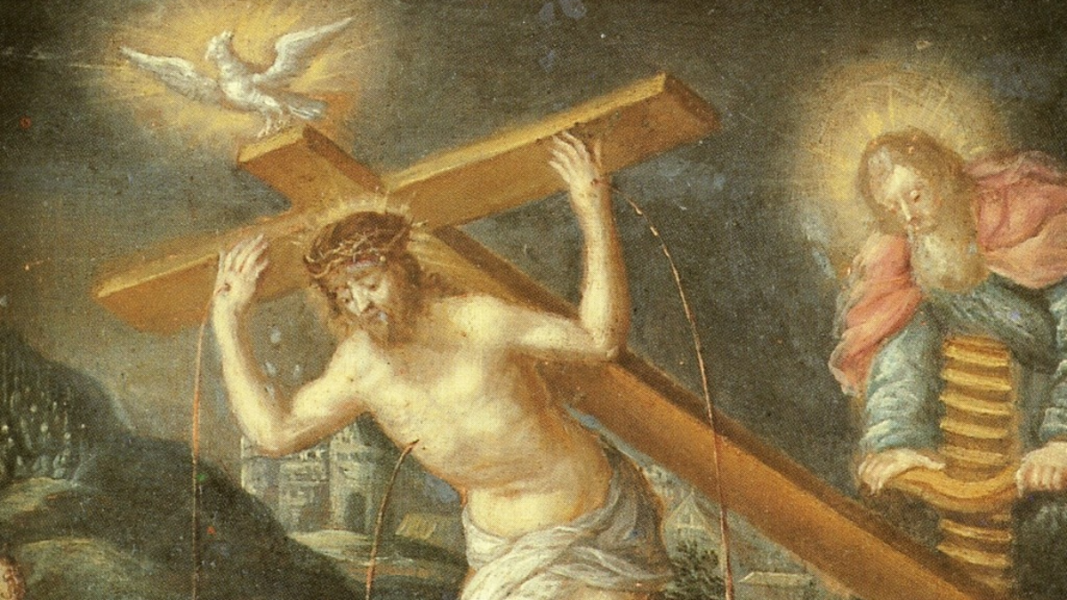
Proclaimed in the Mass of Holy Wednesday, a vision from Isaiah gains overwhelming force: a mysterious figure advances, majestic and terrible, with garments dyed red, like one who comes from treading the winepress. And the question arises spontaneously: «Quis est iste?» «Who is this?» The Church does not hesitate to respond: it is Christ. But not the sweetened Christ that we sometimes imagine, but ¡Christ!, the one who enters His Passion with all the gravity of the Redeemer. «Quare rubrum est indumentum tuum?» «Why are your garments red? Why do you look like a winepresser?» And the response is tremendous: «Torcular calcavi solus»: «I have trodden the winepress alone».
The winepress is the place where the grape is crushed to make wine. Isaiah contemplates someone who has been crushed, pressed, undone… and whose blood—because here it is no longer just wine—has splattered his garments. It is an image of judgment, yes, but the liturgy places it in these days so that we understand something deeper: that winepress is the Passion. Christ enters the winepress of pain, of abandonment, of the sin of the world. And He treads it alone. «De gentibus non est vir mecum»: there is no one with Him. The disciples flee, the friends disappear, no one from that humanity for which He suffers accompanies Him in that hour. Holy Wednesday is the antechamber of solitude. Judas has already decided, the circle tightens, the night is about to fall upon the soul of the world. And Christ, knowing all this, advances.
But a decisive nuance completely transforms the scene: that winepress is not one of wrath but of redemption. «Annus redemptionis meae venit»: «The year of my redemption has come.» Here is the heart of the mystery: Christ is not crushed by forces that overpower Him; He Himself enters the winepress. He is not a passive victim; He is the Redeemer who offers Himself. The blood that soaks His garments is not only a sign of punishment, but the price of ransom. Then we hear the background music, like a sweetly Eucharistic motet: the winepress and the chalice are united. The wine that is squeezed in the winepress is the same that will be offered at the Last Supper as the Blood of the new covenant. What Isaiah sees in a terrible scene, the Church contemplates, confesses, and adores in the Mass in a sacramental way: Christ has been pressed to become our drink of salvation.
St. John of the Cross said that two things serve the soul as wings to rise to union with God: the affective compassion for the death of Christ and for that of our neighbors. And he added that «when the soul stops in the compassion of the Cross and Passion of the Lord, let it remember that in it Christ was alone working our redemption, as it is written: ‘Torcular calcavi solus’ (Is 63, 3); from which it will draw and be offered most profitable considerations and thoughts.» That is, it is not enough to look at the Passion: one must stop in it, let it affect us, enter into that solitude of Christ. Because only in this way does the Cross cease to be an external fact and become an interior, experiential path of union with God.
There is another phrase that we cannot overlook: «Circumspexi, et non erat auxiliator»: «I looked, and there was no helper.» God made man seeking a gaze, a companionship, a consolation… and finding no one. We are there too. Because the drama of Holy Wednesday is not only that of Judas, who betrays; it is also that of those who are not there, of those who do not watch, of those who leave Christ alone. And that is not only history: it is an always current possibility. Every time our faith cools, every time we leave God on the margins of our life, every time we do not want to enter into His mystery of the Cross, we repeat that abandonment.
But Isaiah does not end in darkness but with an act of grateful memory: «Miserationum Domini recordabor». «I will remember the mercies of the Lord.» This is the step that the Church invites us to take: contemplate the winepress, yes; do not avert our gaze from the blood, from the pain, from the solitude of Christ… but to discover in all of it the mercy. Not a mercy of alms, which is almost a blasphemous caricature of itself, but a mercy that costs blood.
In this contemplation we are not alone: at the foot of the winepress of the Cross is the Sorrowful Virgin. If He treads the winepress alone in the work of redemption, She remains in perfect compassion, united without confusion, firm without noise, faithful without faltering. She does not redeem, but accompanies; she does not substitute, but participates with a pierced heart that makes His own, in a unique way, the solitude of the Son.
This Holy Wednesday, at the gates of the Sacred Triduum, asks us not to leave Christ alone, but to accompany Him in His winepress, to watch with Him, to enter trembling into the mystery of His Passion, and to do so hand in hand with Mary. Because only one who enters the winepress with Christ, and remains beside the Co-Redemptrix Mother, will be able to drink the new wine of redemption.