


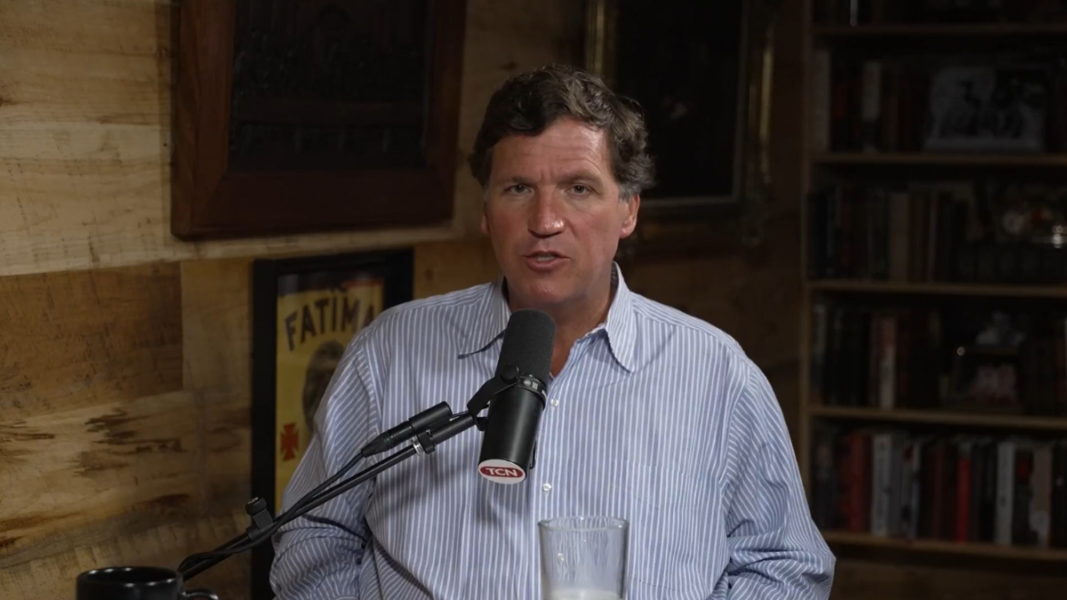
Tucker Carlson, one of the most influential voices in the American conservative media space and a key figure in the MAGA environment, continues to deepen his critical line toward Israeli policy.
In a context where his positioning has placed him at the center of tensions within the conservative field itself, the journalist has decided to interview emeritus Bishop Joseph Strickland, thus incorporating an episcopal voice into a debate that transcends the political and enters fully into the moral and religious terrain.
The conversation takes as its starting point the closure of the Holy Sepulcher in Jerusalem during Palm Sunday, but quickly becomes more than the analysis of a specific episode. From the beginning, Strickland shies away from technical or circumstantial explanations and places the event within a much broader framework, linked to the global moral situation and the context of violence in the Middle East.
“For me, this really boils down to a consequence of the evil we’re seeing, that we’re witnessing. I think we have to pay attention in that context. As we’ve already discussed, the large-scale destruction of civilian lives is never morally justifiable by any nation, by any entity, for any reason. Simply not.”
That initial idea immediately extends to his interpretation of the temple’s closure itself, which he does not attribute so much to an isolated decision as to a symptom of the historical moment.
“The closure of the Holy Sepulcher, this holy place for us, and not allowing the Palm Sunday procession, is a tragic consequence of how far the world is right now, in so many ways.”
However, Strickland himself introduces a relevant nuance: the difficulty of knowing for certain what has really happened. In an environment he describes as saturated with contradictory versions, the problem is not only what happens, but the impossibility of accessing a clear truth about the facts.
“I really don’t know what the motivation for the closure is. Part of the problem is that there’s so much disinformation, so many false messages, that it’s very hard to know what’s true.”
From that point, the conversation shifts from the concrete to the structural. Carlson introduces recent political decisions and international scenarios, and Strickland responds by constantly returning to the same principle, which acts as the axis of the entire interview: the impossibility of morally justifying the destruction of civilians.
“We have to keep coming back to that principle: the large-scale destruction of civilian life can never be morally justifiable. We can’t allow it.”
That criterion is not limited to military actions, but also extends to the language used to describe them. For the bishop, expressions like “collateral damage” are not neutral, but contribute to normalizing what is actually happening.
“When we talk about ‘collateral damage,’ we’re really saying that we’re planning for innocents to die. And that should make us stop.”
The same logic applies to broader strategic decisions that directly affect civilian populations.
“Destroying civilian infrastructure directly is wrong, it’s immoral. Whenever civilian life is devastated, it’s not moral.”
At this point, Carlson introduces a fundamental question: why certain positions are uncomfortable or even unacceptable in public debate. Strickland’s response shifts the focus to a central category in the entire interview: truth. Not as an abstract concept, but as an active element that generates rejection.
“Truth is what is threatening. If you think about the drama of Holy Week, when Christ is before Pilate and he asks ‘what is truth?’, everyone was threatened by that truth.”
From there, the bishop establishes a direct link between that idea and the figure of Christ, presenting him as the ultimate reference for any moral judgment.
“Christ is the truth, and those who do not live in the truth feel threatened by it. Not by propaganda, but by real truth.”
The reference to Holy Week is not casual, but allows Strickland to connect the current context with the core of the Christian message.
“There’s something in Holy Week that calls us back to that question: who is Jesus Christ? Do we believe him or not? If we believe him, we must be morally guided by his light.”
On that basis, Carlson asks him to specify how that vision translates into doctrinal terms, introducing the issue of just war. Strickland’s response insists on its restrictive and exceptional character.
“War, if it can be avoided, must be avoided. To be justifiable, it has to be proportional, it can’t be preemptive, it has to respond to a real threat, not a future or perceived one.”
“It has to avoid harm to innocents and there must be a reasonable expectation that it will bring more peace and protection. And honestly, very few wars meet those criteria.”
The interview then moves into more controversial territory: the use of Christianity to justify violence. Carlson posits that there is an open dispute about the meaning of faith, and Strickland responds by again placing Christ as the decisive criterion.
“If we say we are Christians, we must look to Christ. He accepted violence upon himself, but did not use it as an instrument. We cannot justify what we’re seeing if we really look at Jesus Christ.”
“Using Christianity as a weapon against others is a distortion of Christ’s message. It’s offensive to Him.”
In the face of those who appeal to biblical precedents to legitimize violence, he insists on a reading centered on the new covenant.
“You can go back to the Old Testament, but if you believe Christ is the new covenant, then you have to look to Him. And you won’t find justification there for the violence we’re seeing.”
The focus then shifts to the American context with the case of Carrie Prejean Boller, which Carlson presents as an example of censorship of certain positions. Strickland interprets her expulsion in continuity with the rest of the interview: as a rejection of an uncomfortable truth.
“She was sidelined because she was telling the truth. The truth about Gaza, which many consider unacceptable, and the truth in questioning that Christianity has to align with political Zionism.”
In that sense, he introduces an additional element about the mechanisms of discreditation.
“When people don’t want to hear the truth, they often attack the tone. But the problem isn’t the tone, it’s the content.”
The conversation thus converges in a constant tension between truth and power, which Strickland formulates in general terms.
“When someone or a group speaks the truth, trying to silence them usually backfires. Truth remains. Truth prevails.”
“There’s a kind of ‘complicity club’ where everyone decides to ignore certain truths and move forward as if they didn’t exist.”
In the final stretch, Carlson asks if this dynamic points toward greater persecution of Christianity. Strickland responds affirmatively, though he introduces a relevant nuance about the attitude that must be adopted in the face of that scenario.
“Truth is being persecuted. And yes, I think that persecution is growing.”
However, he rejects any violent or reactive response, insisting on a different logic.
“Our response must not be violence or hatred. We must remain in the truth, without compromising it, and love even those who persecute us.”
The conclusion picks up the thread that runs through the entire interview: the idea that, despite the pressure, truth will ultimately prevail.
“If the time comes when we must lose our lives for the truth, then we’re in good company. But truth will continue to prevail.”