


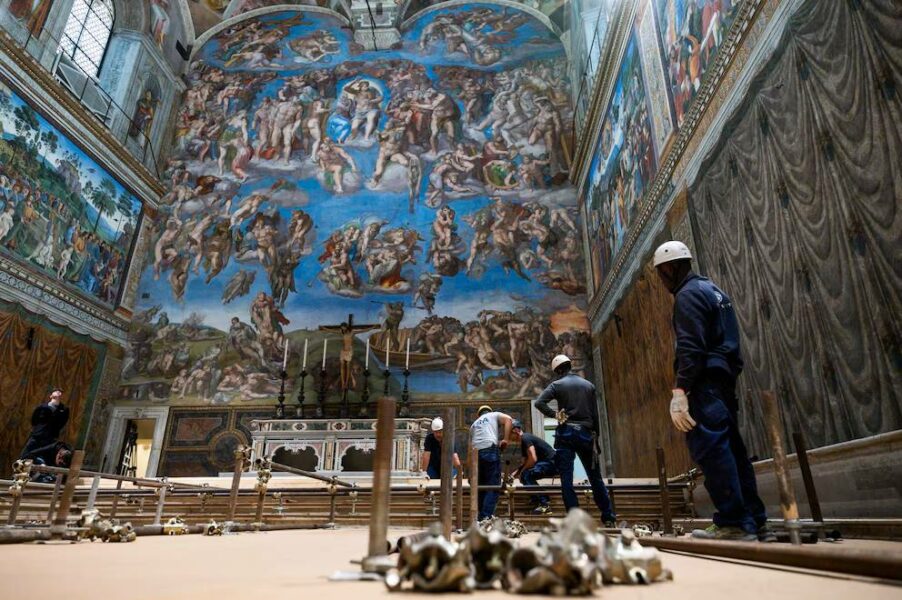
Visitors to Rome can once again contemplate in all its splendor Michelangelo’s Last Judgment in the Sistine Chapel. The famous fresco has been restored and cleaned in just five weeks, a slightly shorter timeframe than initially planned by the Vatican Museums.
The intervention has allowed the removal of the whitish patina that for years had dulled the vibrant colors and strong chiaroscuro of one of the most impressive works of Western sacred art.
The Vatican restores shine to one of its great jewels
The restoration began in early February with the installation of scaffolding, although throughout the process the Sistine Chapel remained open to the public. The work was carried out behind a canvas that reproduced the image of the fresco.
As explained by the chief restorer, Paolo Violini, the veil that partially covered the painting was caused by microparticles accumulated over time. Before proceeding with its removal, the work underwent detailed analysis and documentation.
The director of the Vatican Museums, Barbara Jatta, emphasized that it is part of the institution’s mission to preserve one of its most valuable treasures: the fresco in which Michelangelo represented with singular dramatic intensity the end of times.
A monumental fresco that dominates the altar wall
The Last Judgment, 13.70 meters high by 12 meters wide, occupies the entire altar wall of the Sistine Chapel. The last cleaning of this work had been carried out approximately thirty years ago.
The scene presents Christ as the Universal Judge against an intense blue background, surrounded by more than 300 figures, in a composition of enormous visual and theological force.
A papal commission that marked the history of art
The work was commissioned in 1533 by Pope Clement VII to Michelangelo Buonarroti, although its execution began under the pontificate of Paul III, who freed the artist from other commitments so that he could devote himself fully to the decoration of the chapel.
Michelangelo began the work in the summer of 1536 and completed it in the fall of 1541, leaving one of the most famous and awe-inspiring representations of the Last Judgment in the history of Christian art.
Recent setting for the election of Leo XIV
In modern times, the Last Judgment has also served as an imposing backdrop for the conclaves held in the Sistine Chapel. This also happened in May 2025, during the election of Pope Leo XIV.
The restoration, completed before Holy Week, allows millions of visitors to once again contemplate this masterpiece with a clarity and chromatic intensity that had been attenuated over time.