


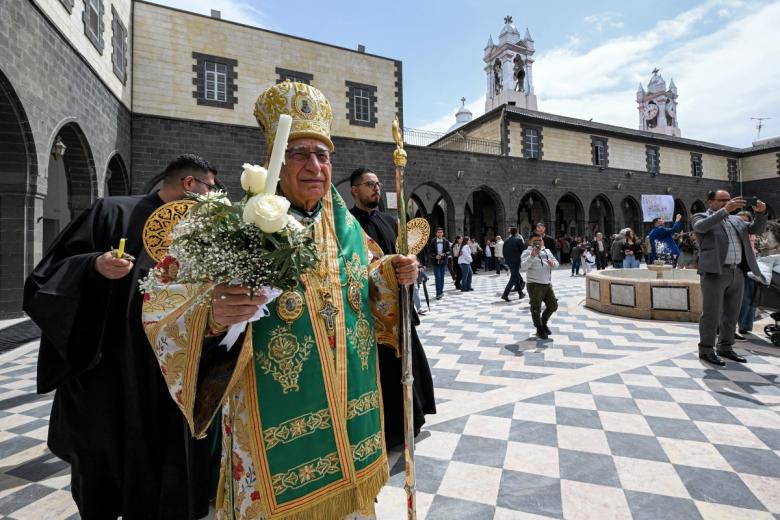
The Greek-Catholic Patriarchate of Antioch has decided to suspend public Holy Week celebrations in Damascus due to the security situation affecting the region.
According to an official statement dated March 28, 2026, and signed by Patriarch Joseph Absi, the liturgical celebrations of the Paschal Triduum will be limited exclusively to the interior of the churches.
Decision Motivated by Insecurity
The measure responds, according to the document itself, to the “current unsafe conditions” affecting the Syrian capital. In this context, ecclesiastical authorities have chosen to minimize the public exposure of the faithful during one of the most important weeks in the Christian calendar.
The Patriarchate states that the decision has been taken in coordination with the various churches present in the country, pointing to a joint response to the situation.
Celebrations Limited to the Interior of the Temples
The statement specifies that the celebrations will take place “only within the churches,” thereby eliminating any external or public manifestation of the liturgy.
This is a measure that reflects the deterioration of security conditions and directly affects the public visibility of Christian life in the region.
Between Prudence and Public Witness
Although Syria has left behind the most intense years of the armed conflict, the situation remains marked by instability, precariousness, and a lack of security guarantees in various areas of the country.
The case of Damascus contrasts with what has been experienced these days in Jerusalem, where, despite restrictions and difficulties, Christians have tried to maintain the public dimension of their faith in the holy places.
While in Syria the circumstances force celebrations to be confined to the interior of the temples, in the Holy Land many faithful continue to go out to celebrate and manifest their faith, even in a context marked by limitations and tensions.