


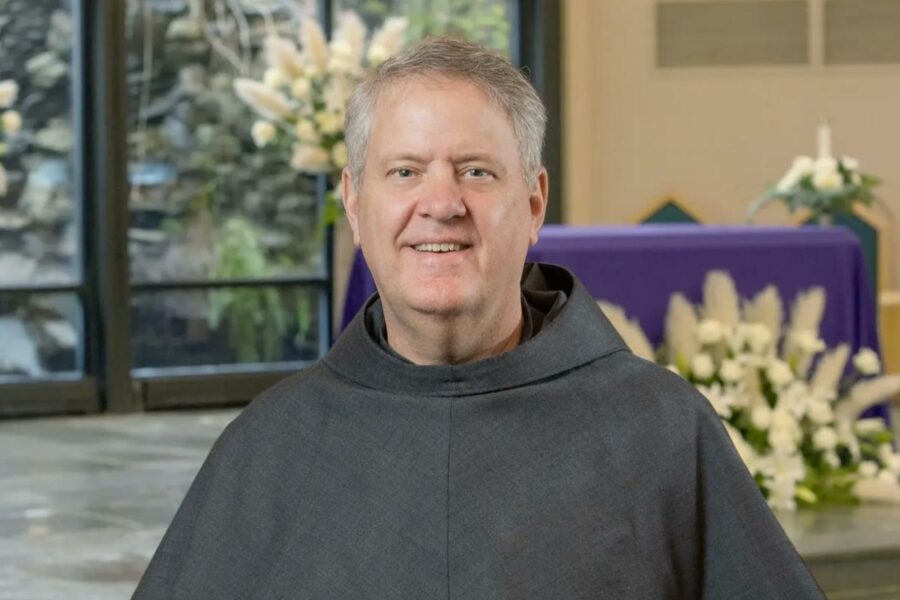
The Bishop of Charlotte, Michael Martin, has once again publicly defended the restrictions imposed on the traditional Latin Mass in his diocese and has made it clear that he does not expect a substantial shift from Rome. In statements reported by The Catholic Herald, the prelate maintained that his decisions do not stem from a personal preference, but from the direct application of Traditionis Custodes, the motu proprio promulgated by Pope Francis in 2021.
Martin rejected the idea that the faithful attached to the traditional liturgy can dictate diocesan policy. Although he acknowledged that they are not “a marginal group” and admitted that there is “goodness and holiness” among them, he insisted that attachment to the old Mass is not enough to justify its continuation without a defined transition.
Martin insists that he is only applying Rome
During his appearance on the podcast Jesuitical from America Magazine, the bishop stated that everything he has done in Charlotte has been to apply the current Vatican norms. With this, he sought to dispel the perception, widespread among many faithful, that his offensive against the traditional liturgy obeys a personal or ideological agenda.
His stance clashes, however, with the expectation of many Catholics who had hoped for a possible relaxation of the restrictions under the pontificate of Leo XIV. Martin was also blunt on this point: he assured that he saw “relatively slim” chances that the new Pope would modify what was established by Francis.
The Diocese of Charlotte, a focal point of liturgical conflict
The controversy is not new. Since his arrival in the diocese in 2024, following the resignation for health reasons of Bishop Peter Jugis, Michael Martin has been the target of strong criticism from the faithful attached to the traditional liturgy.
The most significant episode occurred in May 2025, when he reduced from four to one the authorized locations for the celebration of the traditional Latin Mass, leaving only one chapel for these celebrations. The measure was presented expressly as part of the application of Traditionis Custodes.
This was followed by leaked diocesan documents that pointed to new restrictions, including possible limits on the use of Latin in the liturgy, certain traditional vestments, and some habitual postures of the faithful at the moment of Communion.
Prohibition of kneelers and Communion rails
The tension increased even further in September 2025, when Martin prohibited the use of an altar rail in a Catholic school in Charlotte. Months later, in December, he published a pastoral letter in which he established new norms for the reception of Communion throughout the diocese.
Those provisions, in effect since January 16, 2026, completely prohibit altar rails, kneelers, and prie-dieus at the moment of receiving Communion. The bishop maintained that the norms of the episcopal conference do not contemplate those elements and that their use visibly contradicts the normative posture established for the reception of the Eucharist.
Martin also defended that Communion must be received in procession, as an expression of a pilgrim Church, and instructed priests and extraordinary ministers not to teach that other ways of receiving it are better, preferable, or more effective.
A new chapter in the offensive against liturgical tradition
The words of the Bishop of Charlotte confirm that, at least in that diocese, there is no willingness to ease the pressure on the traditional liturgy. Even more so: Martin suggests that any continuation of the old Mass would only be tolerated temporarily and on the condition that it leads to a clear pastoral change.