


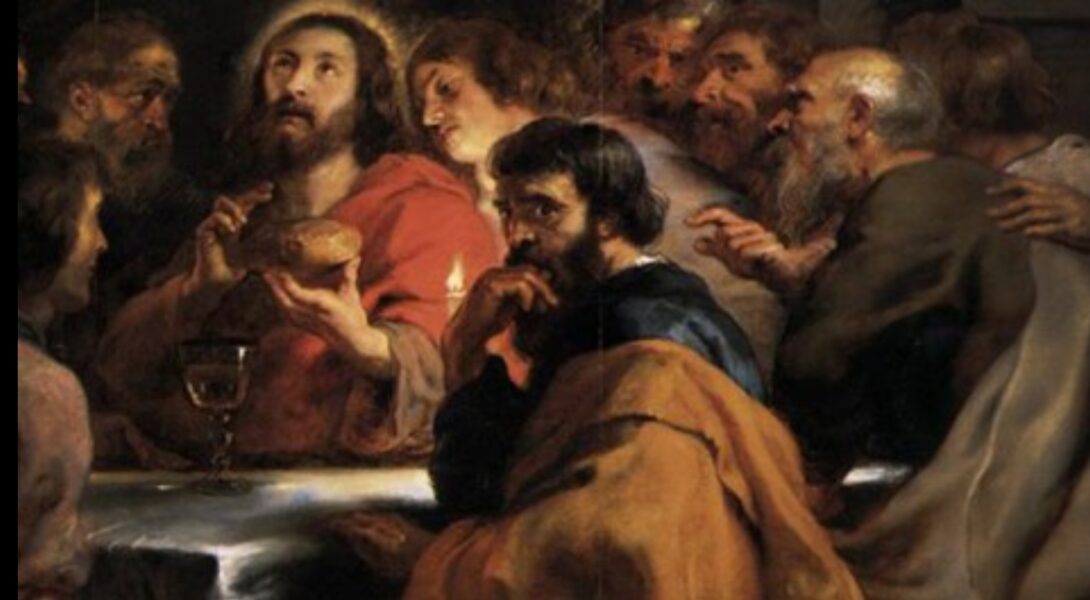
Certain phrases from Scripture, during Lent and even more so during Holy Week, repeated frequently in the traditional Divine Office, seem to take on a new, shuddering density. Like this one from the prophet Jeremiah that serves as the epistle for Holy Tuesday, before the Passion according to Saint Mark: «Mittamus lignum in panem eius»: “let us put wood in his bread.” So mysterious, that it seems permeated with a dark light that only the Cross of Christ can reveal.
Jeremiah speaks in the first person, but in him already resonates Another. He feels like «agnus mansuetus, qui portatur ad victimam», a lamb led to the sacrifice as a victim of immolation. It is innocence besieged, meekness betrayed, goodness harassed by a perverse intelligence that schemes in the shadows. And then arises that strange, almost violent expression: to introduce the wood into the bread.
What does this mean? In its immediate sense, it is the conspiracy to destroy the prophet, to embitter his life until making it impossible, to mix death into what should be food. But in the liturgy of these days, the Church, with deeply theological intuition, hears here a veiled announcement of the mystery of Christ the Redeemer.
Because, when the fullness of time arrives, the “bread” will no longer be just a metaphor for the life of the just: it will be Christ himself, «Panis vivus qui de caelo descendit». And the “wood” will no longer be a figure: it will be the real, concrete, heavy Cross, on which that Bread will be offered.
«Mittamus lignum in panem eius»: let us put the wood in his bread. It is as if, even without knowing it, the enemies of God had described in detail the manner of our redemption: the Bread pierced by the wood, the Bread crucified, the Bread given.
Here is the mystery of Holy Tuesday: the Eucharist and the Cross cannot be separated. The same one who is given to us as food is the one who is nailed to the wood. The same one who breaks the bread at the Supper is the one who will be broken in the Passion. We, so many times, would want a Christianity without a cross, bread without wood, a communion without sacrifice. But there is no bread of life without the wood of the Cross.
And there is something even more unsettling: that phrase not only describes what the enemies of Christ did; it also describes the constant temptation of the world—and, if we are honest, of our own heart—to corrupt the sacred, to introduce the wood of hardness, of rejection, of sin, into the clean bread of grace. Every sin is, in a certain way, to repeat that phrase: mittamus lignum; to put harshness where God had placed sweetness; to introduce death where He wanted to give life.
In the face of that, Jeremiah—and in him Christ—does not respond with violence, but with abandonment: «Tibi enim revelavi causam meam, Domine». “To you I have entrusted my cause, Lord.” It is the silent prayer of Jesus in these days: he does not defend himself, he delivers himself; he does not justify himself, he offers himself; he does not flee from the wood, he embraces it.
And there is the lesson for us in these holy days: to accept that our life, if it wants to be truly eucharistic, will also have its wood. There will be misunderstandings, crosses, moments when we feel like that lamb, led without understanding. But precisely there, when the wood touches our bread, is when our life begins to truly resemble that of Christ, if we do not flee from the wood, but allow God to unite it to our bread. Only thus—mysteriously—our pain will become food, our cross into redemption, and our life into oblation and victim of sweet savor, like that of blessed Christ, before the co-redemptive gaze of Mary, Pure Lamb, Mulier Eucharistica, Mater Panis vitae.