


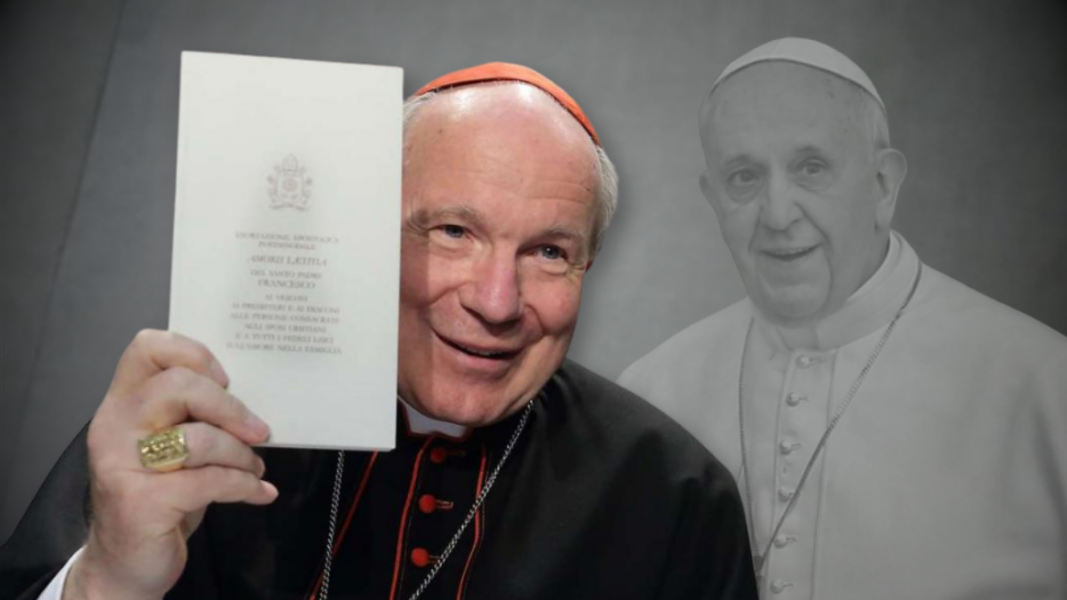
Ten years after the publication of Amoris laetitia, the Austrian cardinal, Christoph Schönborn, has once again come out in defense of Francis’s controversial document, rejecting accusations of doctrinal rupture and claiming its pastoral value.
According to Kath Press, the prelate—who presented the text in the Vatican in 2016—maintains that the document did not change the Church’s doctrine, but rather introduced a more attentive gaze to the concrete situations of families.
Schönborn Denies a Doctrinal Change
The Austrian cardinal was explicit in rejecting one of the main criticisms of the document: “We do not need a new doctrine of the Church. That one is clear and is based on the teaching of Jesus”, he affirmed.
In his view, Amoris laetitia does not relativize the teaching on marriage nor introduce an indiscriminate opening to the sacraments, but rather demands greater pastoral discernment on the part of priests.
The Controversy of Communion for the Divorced and Remarried
One of the most discussed points of the text was the possibility, in certain cases, of access to confession and communion for the divorced and remarried.
Schönborn insisted that this issue cannot be understood as a general norm nor as a break with tradition, but as a call for a deeper analysis of each situation: “It is necessary to look more attentively and discern, with true sensitivity toward each concrete case”.
The cardinal also emphasized that the document should not be read from a specific footnote, but in its entirety, avoiding reducing it to a disciplinary issue.
Continuity with St. John Paul II
In the face of those who see in Amoris laetitia a break with Familiaris consortio, Schönborn defended the continuity between both texts.
As he explained, St. John Paul II placed emphasis on the foundations—the indissolubility of marriage and its sacred character—while Francis has wanted to illuminate the real situations in which many families live.
In this sense, he affirmed that the 2016 document can serve as a key to reread the previous one from a more pastoral perspective.
An Approach Centered on the Reality of Families
Schönborn especially highlighted the passages in which Francis invites priests to focus on families living in difficult situations.
As he pointed out, the Church cannot limit itself to applying abstract criteria, but must recognize the effort of those who try to sustain family life in complex conditions.
The cardinal insisted that the document proposes a path of discernment and accompaniment, rather than a simple normative response to irregular situations.
Ten Years Later, a Debate That Continues
A decade after its publication, Amoris laetitia remains one of the most debated texts of Francis’s pontificate.
Schönborn’s words expose the position of those who see in the document a pastoral development without doctrinal rupture, although the discussion on its interpretation and application remains open in the Church.