


By Fr. Paul D. Scalia
The whole of Lent is an exercise in holy sorrow. We do not know how to weep as we should, especially for our sins. That is why we need these 40 days of penance: to train ourselves in how to be sad in the right way. We need to learn true contrition. How not to overlook the gravity of our sins, nor to catastrophize about them as if there were no Redeemer. To feel sorrow for our sins, not because they shame us («I can’t believe I did that!»), nor just out of fear of hell, but because they have wounded Him, who loves us perfectly and therefore deserves to be loved.
Blessed are those who mourn, for they shall be comforted. That is the Lenten beatitude. We want to know how to weep for our sins, the sins of others, the fallen world, and above all, for Christ Himself. We want to experience the joy of that kind of weeping that frees us from sin.
Blessed are those who mourn… Jesus exemplifies this beatitude. He is the one who wept first and perfectly. Last week we heard that He wept at Lazarus’s tomb. He did so because He had lost a friend, because sin has entered the world and, with it, death. But He also wept to give us an example of mourning.
For they shall be comforted. Jesus also shows the reward of the beatitude. By weeping at Lazarus’s tomb, He shows us how to weep. By raising Lazarus from the dead, He offers an image and a foretaste of the reward promised to all.
The Lord’s weeping for Lazarus and his resurrection prepare us for today’s account of His Passion, in which we find the perfection of His weeping and the sanctification of ours. In the Garden, Jesus announces the beginning of His Passion by saying: «My soul is sorrowful unto death». God became man, assumed our passible nature, so that He could suffer and die for our sins. It is significant that the first suffering He experiences is the sorrow of the soul. «His passion has begun from within», said John Henry Newman.
The cause of His sorrow is our sins. He is in agony, yes, because He anticipates the physical sufferings that will come. But His greatest agony is interior, in the sorrow that allows our rebellion against God to rush upon Him. It is the sorrow of the Holy One, who knew no sin but was made sin. It is a sorrow exacerbated by our lack of sorrow: by our tendency to justify, minimize, or simply deny sin.
Blessed is the one who weeps. Jesus is the Man of Sorrows. He is also blessed—happy—because He is doing the Father’s will. In fact, the reason He weeps is because He assumes the guilt and punishment for our sin in obedience to the Father. His weeping shows His unity with the Father, His participation in the Father’s plan to confront and eradicate sin.
For He shall be comforted. Jesus promises comfort to those who weep. So too, He is granted comfort even in His Passion. The high priest puts Him under oath and commands Him to say whether He is «the Messiah, the Son of God». It is the crucial question, the very thing He has come to reveal and proclaim.
Perhaps in the midst of all His pain and sorrow, Jesus experiences a slight comfort in this opportunity to solemnly affirm His identity. He confirms with joy His sonship and, therefore, also reveals the Father: «You have said so. But I tell you: from now on you will see the Son of Man seated at the right hand of the Almighty and coming on the clouds of heaven».
The whole of Lent is an exercise in holy sorrow. The sorrow we desire is beautifully summarized in the thirteenth stanza of the Stabat Mater:
Make me weep sincerely
and share your sorrow,
as long as I live, for the Lord.
Weep for Him who wept for me… Blessed are those who weep because the Blessed One has already wept. We are happy to be able to share the sorrow of Him who was sorrowful for us. We must weep for Him because His soul was sorrowful first unto death.
All the days that I may live. No, our weeping cannot always be as intense as it is during Lent. But such sorrow should be a constant in Catholic life. In fact, the more we deepen in this sorrow for sin, the more we rejoice—we are comforted—by the Lord’s forgiveness.
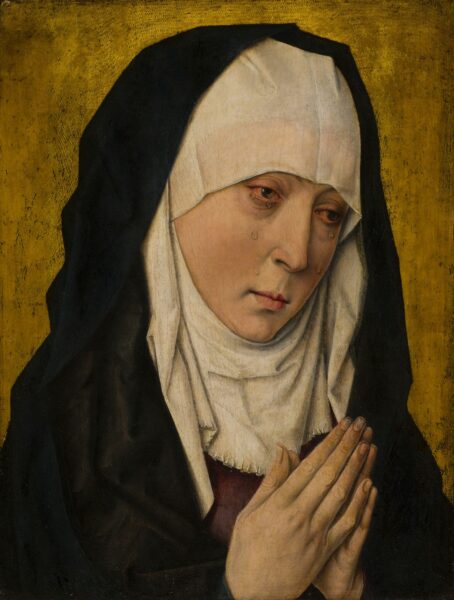
Of course, this stanza begins with a reminder that there is already someone whose sorrow has been perfected by His. It is to Mary that we sing: Make me weep sincerely. We want to be united to her in her sorrow, to learn from her how to weep for Christ’s agony, which is to weep for sin.
In the Extraordinary Form, the Friday of Passion Week (the Friday before Palm Sunday) commemorates Our Lady of Sorrows. A vestige of that Mass remains in the alternative collect for Friday in the Ordinary Form: Lord, our God, who in this time give your Church the grace to devoutly imitate the most holy Virgin Mary in the contemplation of Christ’s passion.
Such is the Church’s sentiment: that Mary’s sorrow has been perfected and that this week we must draw near to learn from her.
About the author
Fr. Paul Scalia is a priest of the Diocese of Arlington, Virginia, where he serves as Episcopal Vicar for the Clergy and Pastor of Saint James in Falls Church. He is the author of That Nothing May Be Lost: Reflections on Catholic Doctrine and Devotion and editor of Sermons in Times of Crisis: Twelve Homilies to Stir Your Soul.