


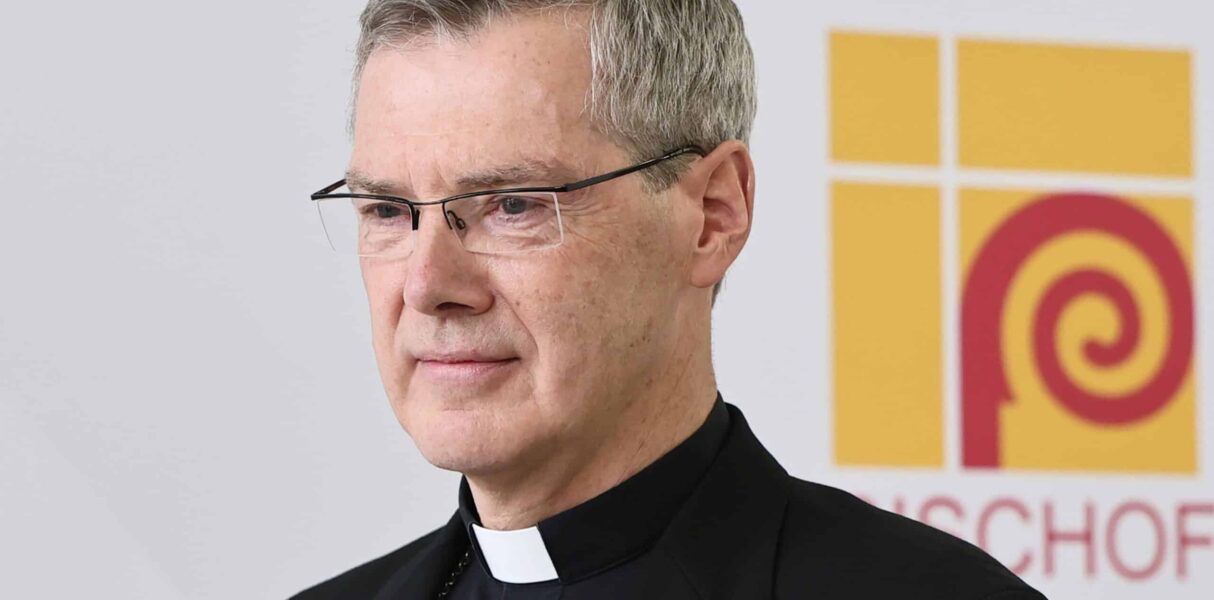
Pope Leo XIV received Mons. Heiner Wilmer, bishop of Münster and president of the German Bishops’ Conference, in audience this Monday, in a meeting that takes on special relevance given the current situation facing the Church in Germany.
The audience, included in the official agenda published by the Holy See, takes place a few days after his appointment as bishop of the diocese of Münster.
President of the German Bishops’ Conference
Wilmer, a member of the Congregation of the Sacred Hearts, succeeded Georg Bätzing as president of the German Bishops’ Conference (DBK) in February of this year, also inheriting leadership of the controversial Synodal Way.
His election has not meant a change of course, but rather continuity with the line set in recent years by the DBK and the development of the Synodal Way, of which he has been a staunch defender.
Beyond his institutional role, Wilmer has held positions that have generated debate in the ecclesial sphere.
He has shown himself favorable to reviewing issues such as priestly celibacy and introducing changes in sexual morality, aligning with the reform proposals promoted in Germany.
These positions place him as a representative figure of the sector that pushes for structural changes within the German Church.
The Synodal Conference, approved despite warnings from Rome
In the same plenary assembly in which he was elected, the German bishops approved the statutes of the future Synodal Conference, the body conceived to give structural continuity to the controversial Synodal Way.
This new body aims to establish itself as a permanent instance in which bishops and laity share deliberation and strategic guidance of the Church in Germany.
However, the approval took place in a context marked by prior warnings from the Holy See about the risks of creating structures that could affect the exercise of episcopal authority or introduce divergent dynamics in the life of the Church.
The process was also not free of internal tensions, reflecting the lack of solid consensus within the episcopate itself.
Among the most debated aspects are proposals that expand the role of the laity in ecclesial life, including their participation in functions traditionally reserved for the ordained ministry, such as preaching.
Pending the Vatican’s decision
After its approval, the statutes have been sent to Rome for formal recognition (recognitio), an indispensable requirement for their canonical validity.
The decision adopted by the Holy See will be decisive, not only for the future of the Synodal Conference, but also for the balance between national initiatives and the universal authority of the Church.
An audience at a decisive moment
In this context, the audience between Leo XIV and Wilmer takes on particular significance, occurring at a time when the new president of the German episcopate will have to interlocute directly with Rome on one of the most sensitive processes in the European Church.
The meeting is framed within the Pontiff’s ordinary audience agenda, in which ecclesial, institutional, and academic representatives also participated.