


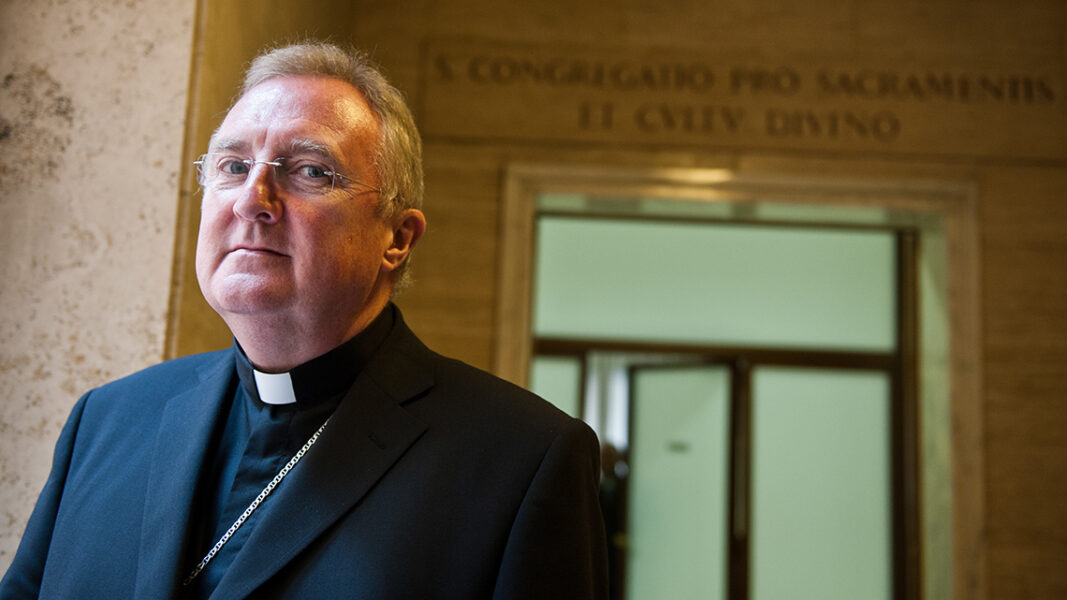
The possible departure of Cardinal Arthur Roche from the Dicastery for Divine Worship and the Discipline of the Sacraments once again places the Church’s liturgical direction at the center of the debate, and with it a vital part of its future in the coming years. The information, advanced by British journalist Damian Thompson, points—citing Vatican sources—to an imminent transfer of Roche to the position of patron of the Sovereign Order of Malta. Without official confirmation, the move is already being interpreted as a possible reconfiguration of one of the Curia’s most sensitive dicasteries.
The Profile of Roche: Executor of a Line
Roche has not been a transitional prefect. Since his appointment in 2021, after having been secretary of the same dicastery, he became the main executor of the liturgical policy promoted from Rome in recent years. His management has been marked by a strict, even expansive, application of the guidelines emanating from the motu proprio Traditionis Custodes.
In practice, his role has been less that of a proactive theologian and more that of a disciplinary guarantor. Various public interventions and official responses from the dicastery under his direction consolidated a restrictive interpretation of the use of the traditional rite, limiting margins that in previous stages had remained open. This made him a highly controversial figure, especially in ecclesial sectors that had found in traditional liturgy a space for doctrinal and pastoral stability.
Traditionis Custodes: An Open Wound
The axis of his prefecture has undoubtedly been the implementation of Traditionis Custodes. The document represented a break with the previous framework established by Summorum Pontificum, reversing the logic of coexistence between liturgical forms and returning effective control to the bishops under Roman supervision.
The criticism has not focused solely on the normative content, but on its application. Under Roche, the dicastery adopted criteria that, in practice, significantly reduced the public presence of the traditional rite, imposing restrictive authorizations, geographical limitations, and additional controls. For many, this was not a simple regulation, but a strategy of progressive attrition.
The result has been persistent tension in multiple dioceses, with a growing perception that the liturgical issue has ceased to be a pastoral sphere to become a terrain of disciplinary control. That wound, far from closing, has become institutionalized.
The Sovereign Order of Malta as a Retirement: Precedents
The possible transfer of Roche to the position of patron of the Sovereign Order of Malta fits into a pattern already known within curial dynamics. The Sovereign Order of Malta has served on various occasions as a destination for cardinals who, for various reasons, left the core of Roman power without an explicit break.
The most evident case is that of Cardinal Raymond Leo Burke, who was appointed patron after having held positions of greater weight in the Curia. Although Burke’s context was different—marked by more visible doctrinal tensions—the institutional scheme is comparable: a transfer to an honorable position, with formal relevance, but away from the center of decision-making.
In this sense, the move now attributed to Roche can be interpreted as an orderly exit, without explicit disauthorization, but with clear effects on the internal redistribution of power.
What is at Stake: The Next Prefect
Beyond the personal replacement, the decisive issue is who will occupy the Dicastery for Divine Worship. The profile of the new prefect will determine whether the line marked in recent years is consolidated or whether a correction is introduced.
The real margin for change will not depend solely on the appointment, but on whether the application of Traditionis Custodes is reviewed—explicitly or implicitly. Without that element, any replacement could be reduced to a stylistic adjustment without substantive consequences.
For now, the information remains without official confirmation. But the mere fact that it has emerged with some credibility puts the focus on this Dicastery where the future of the Church and the first major decision of the pontificate of Leo XIV can be decided.