


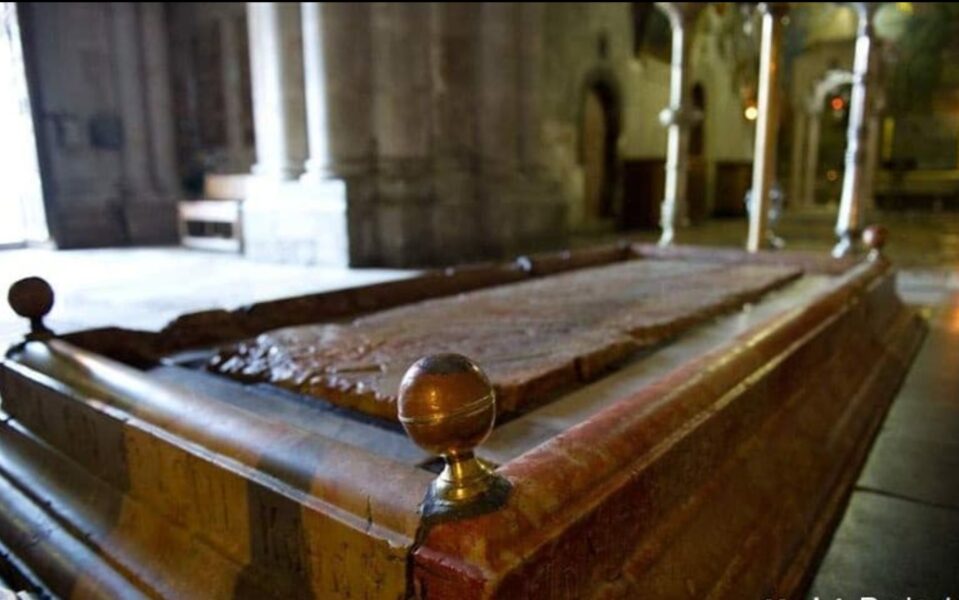
The decision by Israeli authorities to prevent Cardinal Pierbattista Pizzaballa from accessing the Holy Sepulchre this morning on Palm Sunday has triggered a high-level political reaction that has already escalated to the formal diplomatic arena, with Italy at the forefront.
The Italian Foreign Minister, Antonio Tajani, has summoned the Israeli ambassador in Rome following the incident, a gesture that in diplomatic terms amounts to an official protest. From the Italian Government, the decision has been described as “unacceptable,” while Prime Minister Giorgia Meloni has stated that preventing the celebration of Mass at the Holy Sepulchre constitutes “an offense to the faithful” and “a violation of the principle of religious freedom.”
In France, President Emmanuel Macron has followed the same line, denouncing a “multiplication of violations of the status quo in Jerusalem” and emphasizing that “the free exercise of worship must be guaranteed for all religions.” His explicit support for the Latin Patriarch confirms that the episode has been perceived as more than a one-off incident.
From Spain, President Pedro Sánchez has joined the fray. “Israel has prevented Catholics from celebrating Palm Sunday in Jerusalem without any explanation, without reasons or motives,” he stated, describing what happened as “an unjustified attack on religious freedom.”
Criticisms have also come from the United States, unusual given their origin. The ambassador to Israel, Mike Huckabee, has acknowledged that the decision is “difficult to understand or justify” and has described it as an unfortunate overreach, that is, an unjustified overreach. He also highlighted a key fact: the ecclesiastical delegation consisted of only four people, well below the limits set by the Israeli authorities themselves.
In the Italian political sphere, Deputy Prime Minister Matteo Salvini described the episode as “unacceptable and offensive,” aligning with the official position of the Executive. In France, leader Jean-Luc Mélenchon directly accused Benjamin Netanyahu of “persecuting Eastern Christians,” in one of the harshest formulations recorded so far.
From the Israeli side, Prime Minister Benjamin Netanyahu has denied any hostile intent, assuring that the decision was solely due to “security reasons” and that there was “no malicious intent.” However, Israel’s own President, Isaac Herzog, was forced to intervene later, conveying to the cardinal his “deep regret” for what happened.
The set of reactions reveals a qualitative leap. It is not just political criticisms, but a crisis that has activated formal diplomatic mechanisms, with explicit accusations of violation of freedom of worship and breaking the historical balance in the Holy Places. Italy’s summoning of the ambassador marks, in that sense, a turning point that is hard to ignore.