


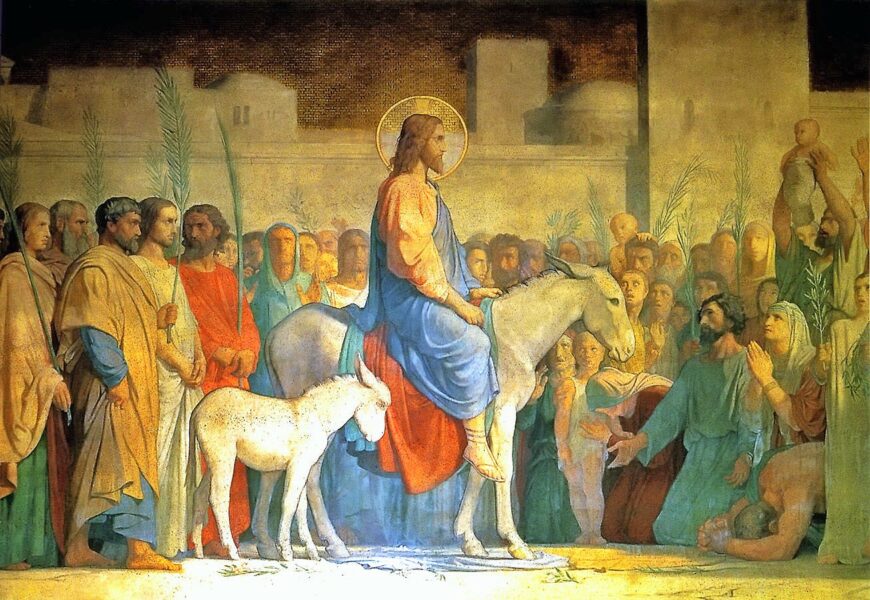
Jerusalem is in motion. There is expectation. The crowd gathers, spreads cloaks, waves branches, cheers. Everything seems to announce the arrival of a king. But he is not a king like the others.
There are no war horses or imperial banners. There are no soldiers or display of force. Just a man entering mounted on a colt, amid cheers that will soon fade.
Saint John Baptist de La Salle contemplates this scene in his meditations. Christ does come to reign, but not as the world understands power. His kingdom, he reminds us, “is not of this world,” and it is not imposed from outside, but “is within us.”
A reign that begins within
That day, many acclaimed Christ without truly understanding what kind of king he was. They expected a visible liberation, a political restoration, an immediate change in the external order.
But Christ to take possession of the human heart.
It is easy to receive Christ on the surface—in words, in gestures, in celebrations—but much more demanding to let him govern one’s own life.
Saint John Baptist de La Salle expresses it clearly: “For Jesus Christ to reign in your souls, it is necessary to give him in tribute your actions, which must all be consecrated to him, putting nothing in them but what is pleasing to him, and having no other aim, in doing them, than to fulfill his holy will, which must guide them all, so that there is nothing human in them.”
A battle that is not seen
But this reign is not established without the cross; there is no peace without battle.
The battlefield is not outside. It is within. There where disordered passions arise, where the ego claims its place, where sin leaves its mark.
La Salle does not soften this reality. He warns that it is necessary “to combat… the enemies of your salvation,” starting with what dwells in one’s own interior. It is not a symbolic struggle, but a real one: a break with sin and with everything that prevents Christ from reigning.
There is in this an uncomfortable truth for modern man: freedom does not consist in doing what one wants, but in freeing oneself from what prevents one from living in the truth. The saintly priest says that “it is necessary for him to overcome it, and for you to overcome it with him, with his help, everything that can hinder it, such as your passions and your bad inclinations; and that you destroy in yourselves the man of sin, who previously reigned in you, to free yourselves from the shameful slavery to which sin had reduced you.”
When Christ takes the central place
The Christian is called to stop living for himself. It is not a pious metaphor, but a concrete reality. La Salle explains that, “by letting him reign over all your interior movements, so absolutely on his part, and so dependently on yours,” one can say, with Saint Paul, words that do so much good to meditate on this day: “it is no longer you who live, but Christ who lives in you.”
This does not annul man. It elevates him. Because, when Christ occupies the center, everything finds its order: decisions become clear, priorities are purified, life acquires unity, man is ordered to God.
But that step is not taken without abandonment. One must cede control. One must trust.
An invisible army
Christ does not enter alone. Where he reigns, he raises a new order. Not made of visible structures, but of virtues.
Saint John Baptist de La Salle speaks of a true spiritual combat, in which the soul arms itself with truth, justice, faith, and hope. They are, in his words, the weapons with which one conquers and establishes the peace of Christ in the heart.
Today little is said about these things. Quick solutions, superficial changes, empty speeches—though they sound good—are preferred. But without virtue, Christ’s reign in the heart is not possible. Thus the saintly priest concludes his meditation on Palm Sunday: “it is necessary that he can raise an army, composed of the virtues with which you must adorn your soul, that allow him to be the total master of your heart.”
The moment to decide
Palm Sunday is not just the remembrance of a triumphal entry. It is a scene that repeats itself. Christ continues to enter, not into Jerusalem, but into the life of every man. And he does so in the same way: without imposing himself, without forcing, waiting to be received.
Is he allowed?
Because among those who acclaimed him that day, many ended up turning their backs on him a few days later. And that possibility remains open today.