


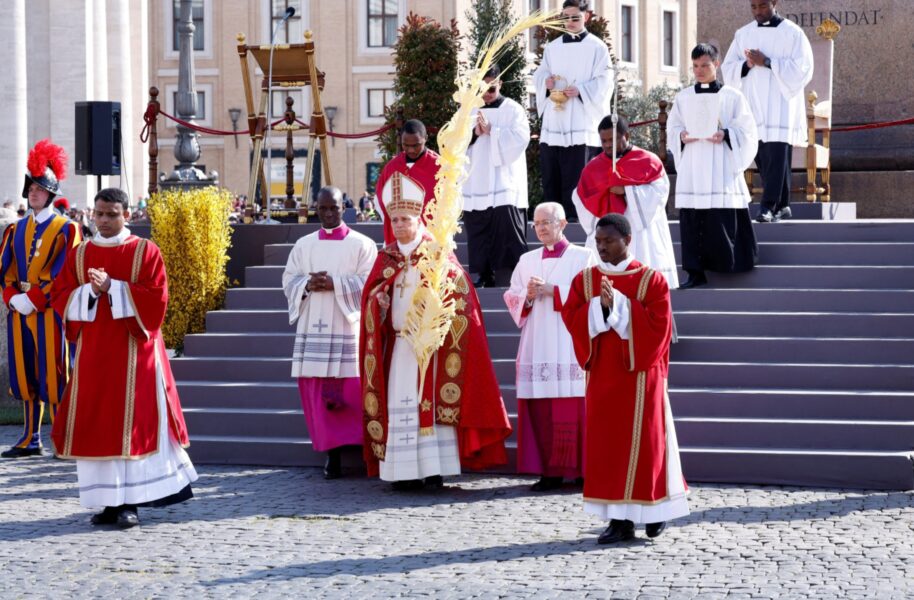
Pope Leo XIV presided over this Palm Sunday the Mass of the Lord’s Passion in St. Peter’s Square, centering his homily on the figure of Christ as King of Peace, in contrast to the violence that surrounded him in the moments prior to his death.
During the celebration, the Pontiff recalled that, by walking the Way of the Cross, the faithful accompany Christ contemplating a passion assumed as a gift out of love for humanity. He emphasized that Jesus remains firm in meekness while others resort to violence, and that he offers himself to embrace man even when swords and clubs are raised around him.
The Pope insisted that Christ came to bring life and light to the world, precisely when darkness and death seemed to impose themselves. His mission, he explained, was to lead humanity to the Father and tear down every barrier that separates men from God and from one another.
Throughout the homily, he repeated the expression “King of Peace” to describe Jesus, highlighting concrete gestures of the Passion. He recalled, for example, how the Lord orders one of his disciples to put away the sword after wounding the high priest’s servant, warning that those who live by the sword die by the sword. Similarly, he pointed out that, at the moment of the crucifixion, Christ did not defend himself, but allowed himself to be led like a lamb to the slaughter.
In that attitude, he affirmed, the meek face of God is revealed, who always rejects violence. Christ does not save himself, but accepts the cross, embracing in it all human suffering of all times.
The Pontiff also evoked the words of the prophet Isaiah —“even though you multiply the prayers, I will not listen: your hands are full of blood”— to warn that Christ, King of Peace, cannot be instrumentalized to justify war. In that line, he clearly affirmed that he does not listen to the prayers of those who make war, but rejects them.
The Pope lamented the wounds that today afflict humanity, marked by conflicts and violence, and pointed out that many raise their cry to God from the suffering of oppression and war. In the face of this, he affirmed that Christ continues to cry out from the cross: “God is love. Have mercy. Lay down your arms. Remember that you are brothers”.
In the conclusion, he quoted the Servant of God Tonino Bello while evoking the Virgin Mary at the foot of the cross. He asked, in that context, for the certainty that death will not have the last word, that injustices are numbered and that violence will be extinguished. And he finally prayed that the tears of all the victims of pain and war be soon wiped away.