


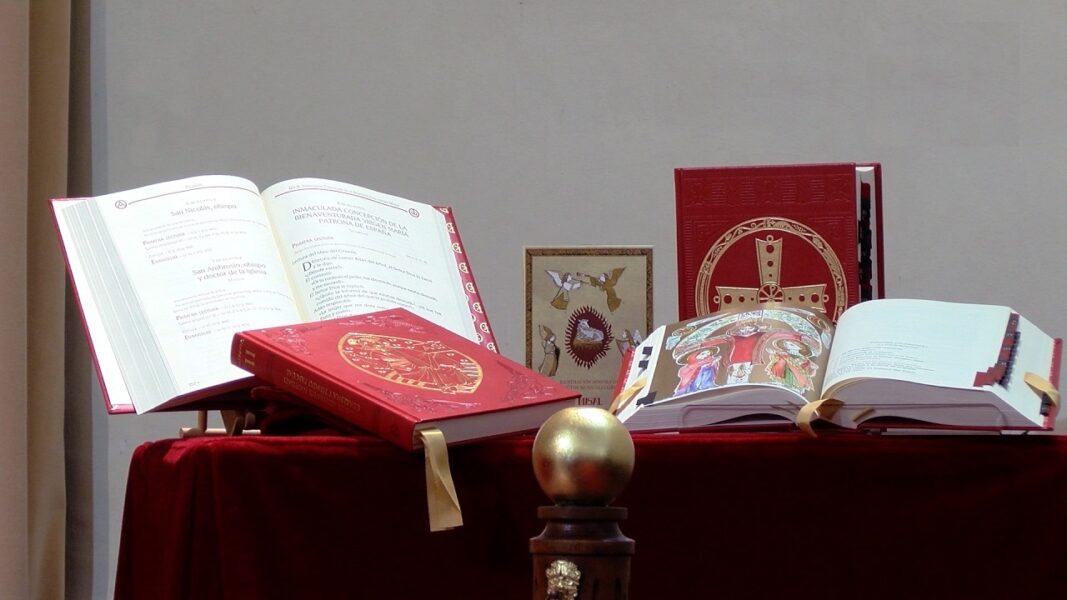
The liturgy of the Church is not a set of circumstantial texts that can be adapted without consequences. It is the public expression of the Church’s faith and, as such, every word that composes it has been carefully transmitted for centuries. When the Latin of the liturgical texts is examined carefully and compared with some modern translations, a reality emerges that many faithful perceive with increasing clarity: at certain points, the translation does not accurately reflect the original content.
In recent weeks, we have examined two concrete examples. The first appeared in the Nicene-Constantinopolitan Creed, where certain Spanish translations have tended to weaken the precision of theological expressions that the councils defined with extreme care. The second example was found in the Roman Canon, the current Eucharistic Prayer I, where the Latin structure precisely delineates ecclesial communion around the Pope, the local bishop, and those who profess the Catholic and apostolic faith, while the Spanish translation introduces an explanatory construction that dilutes that nuance.
These cases do not constitute an accusation or suspicion about the intention of those who made the translations. Post-Vatican II liturgical translations were carried out in a complex pastoral context, with the desire to facilitate the understanding of the texts and make them accessible to the faithful in their vernacular languages. However, the experience of the last decades has shown that this pastoral intention can come into tension with another equally important principle: literal fidelity to the liturgical text that the Church has received and transmitted.
Precisely for that reason, the Holy See promulgated in 2001 the instruction Liturgiam authenticam, which insisted on the need for liturgical translations to reproduce the doctrinal content of the liturgical Latin with the greatest possible fidelity. The document reminded that the texts of the Roman liturgy are not mere literary compositions, but expressions of the faith of the universal Church that must preserve their integrity in any language.
In light of that principle, the examples mentioned invite serene reflection. This is not about academic polemics or philological disputes. It is about ensuring that what the Church prays in each language corresponds exactly to what the Church believes.
The history of the liturgy demonstrates that this type of revision is not something extraordinary. Over the centuries, the Church has corrected or perfected liturgical translations when it was noted that they could generate ambiguity or loss of precision. In recent times, for example, several episcopal conferences revised the translation of the Creed to recover the term “consubstantial,” precisely because it better reflected the conciliar original.
In this context, many faithful—priests, theologians, and laity attentive to the liturgy—naturally look toward Rome. The unity of the Latin Church in the celebration of the liturgy has always been linked to the authority of the Apostolic See, which safeguards the liturgical heritage received from tradition.
That is why it is legitimate to raise a filial supplication to the Holy Father. Not a request born of controversy or criticism, but of the sincere desire that liturgical translations reflect the content of the original texts with the utmost possible fidelity.
The Pope, as successor of Peter and visible principle of unity in the Church, also has the mission to safeguard the integrity of the lex orandi, the law of prayer that expresses the faith of the Church. When the liturgy speaks clearly, the faith of the faithful is strengthened. When formulations become ambiguous or less precise, that clarity can weaken.
The request that many believers make is simple: that liturgical translations be reviewed where fidelity to the original text advises it. Not to introduce novelties, but precisely to recover the theological precision that the Latin texts have preserved for centuries.
The Church has always understood that the lex orandi and the lex credendi are deeply united. What the Church prays forms the faith of the faithful. For that very reason, caring for the accuracy of the words of the liturgy is not an erudite exercise reserved for specialists, but a pastoral task of first importance.
If the Creed was born in the councils to protect the faith against error, and if the Roman Canon has transmitted for more than fifteen hundred years the same sacrificial prayer of the Latin Church, then the most reasonable thing is that its words continue to resound in each language with the same clarity with which they were formulated.
It is not an ideological claim or liturgical nostalgia. It is simply a filial request: that the Church pray in all its languages with the same precision with which the Church has always believed and prayed. Because in the liturgy, sometimes a single word is enough to preserve intact an entire truth of faith.