


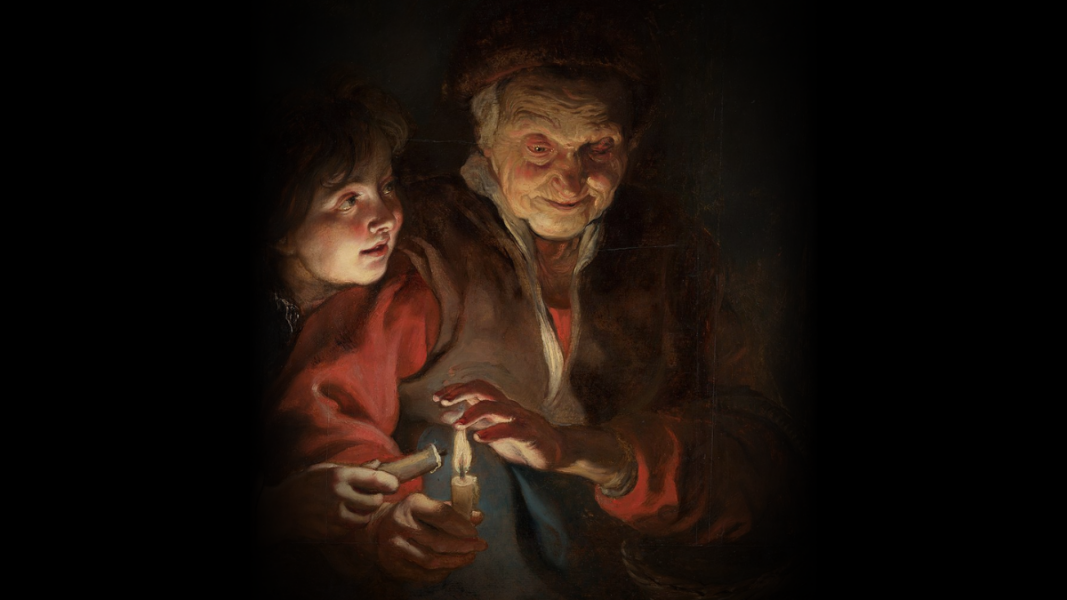
There comes a moment in life when time, without warning, changes direction. One day you discover that those who taught you to tie your shoes now ask you twice where they left them and that those who decided for you now await your assent. The firmness of yesteryear has become fragility, and security… questions. At first, it is lived as a small tragedy, although in reality it is a silent law of the human condition. Life, which in childhood flows from top to bottom—from adult to child—begins slowly to reverse its course, and the disconcerting thing happens: parents start to need to be cared for like children. The added problem is the contemporary misunderstanding: our culture has serious difficulties in understanding this role reversal. By absolutizing autonomy, efficiency, productivity as synonyms of dignity, when those categories weaken, we believe that something essential has been lost. And that’s why the repetitions, simple questions, slowness, dependence bother us. We interpret them as a system failure, when in reality they are the revelation of what the human being truly is when they can no longer hide behind competence.
From a psychological point of view, that return to the elemental is not a degradation, but a functional regression that seeks security, bond, and confirmation. Anthropologically speaking, it is the final stripping away of social masks. At a philosophical level, it is proof that a person’s value is not measured by what they produce, but by what they are. And from a sociological point of view, it is an uncomfortable mirror that unmasks the affective poverty of a society that does not know how to care for the weak.
What we call “senility” is nothing other than time returning, turning back on itself, undressing: it is the human being reduced to the essential, as at the beginning. That’s why the elderly—and especially ailing parents—do not need corrections or advice, nor haste, nor improper demands for their life stage. They need, and silently scream for with their faded gaze, something much more difficult: loving patience, the same that they had with us for so many years.
Here something decisive for a person’s moral maturity is at stake. Caring for parents when they can no longer sustain themselves alone is not a biographical accident, nor a logistical misfortune, nor a burden that “has fallen”; it is a superior form of affective justice: not contractual, but existential. Feeling that caring for parents is a burden reveals more about the one who feels it than about reality, because no one who has truly loved can call the return of received love a weight. It’s not about settling a debt—love doesn’t work that way—but about entering a deeper logic: that of the continuity of the bond. In psychological terms, those who accompany this process with tenderness usually experience, along with fatigue, a strange form of fullness: that of doing what is right. In human terms, it is a reward that is not displayed, that is not applauded or socially valued, but that leaves an inner mark difficult to describe: it is a reward discreetly wrapped in love.
Perhaps the last great lesson of life is not accepting death, but one’s own dependence, but before that, others’: learning to care without infantilizing, to accompany without humiliating, to protect without dominating; learning not to hurry the other’s step when they can no longer walk at our pace.
Because in the end, when all has been said, the only truly human thing that remains is this: someone who cares and loves (and is strangely, but endearingly loved), and someone who is cared for and loved (and loves more than ever loved, perhaps without knowing they are loving). Everything else is accessory. And in that silent exchange, for once time steals nothing: it returns everything.