


The entire Church is praying intensely these days for a solution that does not imply a break after the Priestly Fraternity of St. Pius X announced its willingness to consecrate bishops on July 1. After a frustrated meeting with Tucho Fernández, Prefect of the Congregation for the Doctrine of the Faith, they have declared that they will do it because, since the supreme law of the Church is the salvation of souls, there is a state of necessity, as most parishes do not offer the necessary tools for the salvation of souls.
Is that true? Personally, I believe it is. And I would like to comment on this extremely serious issue based on a specific case, but not unique.
I had spoken in these texts on a couple of previous occasions about my friend Laura, who lives in a small village in rural Catalonia, in the province and diocese of Lleida. After my first visits to that village years ago, I had considered buying a little house there to move, since the price, compared to Barcelona and its surroundings, is ridiculous, and I no longer wanted to keep living in rentals. Additionally, traveling frequently for work reasons, I wanted to have a base in a quiet, small, rural place. Laura’s village is very well connected to the A2 highway, the AP2 motorway, and the city of Lleida, with an AVE station, which facilitated both train trips to other mainland cities and travel to Barcelona’s airport.
Everything indicated that it was the ideal place to move to live. However, there were two particularly negative important factors: the situation of Renfe and, above all, of the Church. Lately, the trains have started functioning so poorly that they represent a serious problem for my demanding work. But what raises the greatest doubt for me is the moribund situation of the Church in these parts: few (and bad) priests, worse bishops, scant faithful, numerous Muslims, and a native population mostly apostate that hates the remnants that still survive in the Church.
Sociologically, we understand that the reality is very different from that of the city; these villages are part of the so-called Empty Spain: few people and mostly elderly. Much presence of immigration from North and West Africa. And this demographic composition, needless to say, translates in the Church to temples closed all day, open only at the time of Mass (in those where there is daily Mass, which are the minority) and attendance reduced to its minimum expression. In my friend Laura’s village, for example, Mass is not celebrated every day. Not even every Sunday. To attend Mass daily, it is necessary to travel by private vehicle (impossible to rely on public transport in this area) to the city of Lleida. There is no resident priest in this village. The parish priest has several other villages and parishes under his care, and he celebrates Mass in this village one Sunday a month. There is no parish office hours or confessions. Most Sundays, a Liturgy of the Word is celebrated, led by a permanent deacon or some retired nuns. It is not something extraordinary. It has been functioning this way permanently for years.
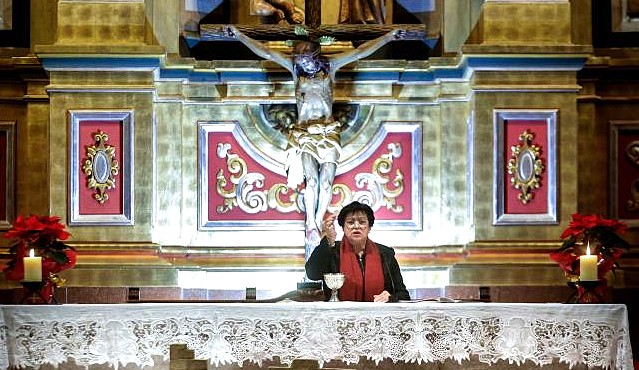
My experience of visits to this place for more than ten years allows me to confirm that the situation only worsens: there is no replacement for priests or for the faithful. When a priest dies, the only alternative for worship in the parishes he was in charge of are permanent deacons, nuns, and laity, solemnly instituted as acolytes and lectors or pastoral agents. And a very serious issue arises in this: on the one hand, many faithful do not see the difference and speak of “the nuns’ Mass”. On the other, from the diocese, the only concern seems to be maintaining the fiction of Sunday worship; not with a Mass, but with a Liturgy of the Word. Then, the faithful do not fulfill the precept of hearing Mass, but they do receive Communion. But the precept is not to receive Communion, but to hear Mass, even without receiving Communion, if one is not in a state of grace! And how can one be if there are no confessions in the parish?
How much time does this rural Church have left? One or two generations, unless the Lord works a miracle. For now, and to maintain appearances, what seems to be the hierarchy’s bet is to prepare a Church without priests, with many more Liturgies of the Word than Masses.
That seems to be the bet, and not only in Catalonia, but in all the rural dioceses of Spain, as if it were a directive from the Episcopal Conference. In the ten dioceses in Catalonia, we find that at least half – Lleida, Solsona, Urgell, Tarragona, and Tortosa – are training laity to celebrate Liturgies of the Word “in waiting” for a priest. In Tarragona, they promoted with fanfare their team of “ladies who bring the Word where priests do not reach”. In Urgell, a team of 13 or 14 acolytes and lectors was appointed a couple of years ago to perform Liturgies of the Word. In Tortosa, they learn from the bishop of Barbastro and his team to do the same. It may be a strategy to collect from the CEE for keeping worship centers open, even if Mass is not said in them, not even on Sundays. In this sense, the case of Solsona seems particularly interesting. Let us remember that Bishop Novell – yes, the one who married an erotic novel writer – had bet on unifying communities and closing temples. Well, judging by the news published by the same diocese, his successor, Bishop Conesa, seems to have opted for the opposite strategy, as this past Thursday, March 19, a group of 50 extraordinary ministers of Communion, men and women was solemnly instituted in the cathedral. Fifty extraordinary ministers of Communion in a diocese that in 2025 had 69 priests. It doesn’t take a genius to see that soon there will be more lay ministers than priests in this diocese. And very few Masses, consequently.
There are priests and bishops who shield themselves behind the functioning of ad gentes missions, with the existence of catechists, to justify this situation, and try to convince us that Empty Spain is now mission territory. In the Catalan case, however, it is very easy to disagree with this excuse that surely not even the bishops believe. Mission territories are those where the Gospel is unknown and is preached for the first time. That is not the Spanish case, evidently. What this situation most resembles, as chilling as it sounds, is that of generalized apostasy. According to the RAE, “apostasy” is “abjuration, retraction, renunciation, abandonment, desertion, repudiation”. Renunciation, abandonment, and desertion, without a doubt. Juan Manuel de Prada stated years ago with much common sense that it is infinitely more complicated to announce the Gospel to people who not only do not know it, but know it and have discarded it as something useless, dispensable, and that should disappear, as outdated.
We can exemplify it again by referring to my friend Laura’s village. A rural place, from deep Catalonia, surrounded by pig farms. At the same time, it is common to see sixty-something ladies with their leggings and yoga mats on the street heading to the gym. Theatrical and musical shows in the people’s athenaeum funded by the town hall with explicit homosexual, transsexual, and far-left content. Laura told me that they are even considering changing the children’s school. The only school up to second year of high school in her village is the public one, and she says she notices a lot of changes in recent years toward very intense woke indoctrination. She and the father of her children, with whom she lives without being married, are not practicing Catholics, obviously, but they are willing to make an effort to take the children to a Catholic concerted school. Something that, said like that, is also no guarantee of anything. Schools like the Vedruna nuns and similar are the same as the public school, and Opus Dei schools are very expensive.
In that village, there are ground-floor premises in an apartment building that house the venue of an evangelical sect attended, it seems, exclusively by the Brazilian community. But it is full of people of both sexes and all ages, while standing at the door of the parish on Sundays at 12:35 p.m., when there is Mass, is enough to make one cry.
We know on the other hand that our obligation is not only to attend Mass on precept days, but to attend the Mass that most worthily gives glory to God. But it is very difficult to find something that fits this definition within many kilometers in these parts. I decided years ago not to attend Mass in that village. I tried it at the beginning during visits to Laura. But abuses are committed, preaching about welcoming immigrants and the like. During the years I have gone to visit her, I have driven kilometers and kilometers looking for the most worthy Mass to attend and I have seen the most aberrant horrors of the (bad) spirit of the Council that one can imagine.
The Traditional Mass is non-existent in all these rural dioceses. To attend the vetus Mass, it is necessary to travel to Barcelona. And we are talking about more than 150 km.
For all these reasons, I have concluded that it is not worth being able to buy a property when what is sacrificed is the possibility of daily Mass and a worthy Sunday Mass, and above all, the Traditional Mass (I haven’t attended the Novus Ordo for a long time). And I am not only talking about my case, but about the possibility, because housing is affordable and there are many aids for young entrepreneurs, that young families with children settle in these villages and not only halt depopulation and gain in quality of life, but could form small Catholic communities in the style of St. Irenaeus of Lyons (The Awakening of Miss Prim) and the Benedict Option. But if there are no good priests and there is no possibility of living the faith in a firm way because the Church is in ruins, it is of no use that housing is at a very low price.
A couple of years ago, I met a priest from the wonderful Institute of the Good Shepherd, founded in 2006 under the pontificate and with the support of Pope Benedict XVI, and which has the specific mission of spreading the liturgical and doctrinal treasures of Catholic Tradition within the Church. For this purpose, the priests of the Institute are at the service of all dioceses in their traditional apostolate. The mission of the Institute is characterized, first of all, by the exclusive use, in all its liturgical acts, of the traditional Roman liturgical books of 1962.
One of the pillars of the charism of this institute is the new evangelization of the rural world through the traditional liturgy. However, this priest told me, the experience of the institute is that many, the majority, are the bishops who prefer that Liturgies of the Word be celebrated in their temples rather than allowing a Traditional Mass to be celebrated.
Thus, what real possibilities exist for a “missionary Church”, which the bishops fill their mouths with, while their forces are four heroic elderly women and a few – not much younger – laity eager to be actively clericalized? Do they really intend to convince us that some ladies with an alb and a wooden cross hanging from their necks represent some kind of vitality in the Church when we witness an ever faster Protestantization of the Church? One thing is to make a virtue of necessity and another very different is to take the faithful for fools.
¿Are we not perhaps faced with a clearest and most generalized STATE OF NECESSITY, as the superior of the FSSPX affirmed, in which many parishes do not offer the necessary means for the salvation of souls?