


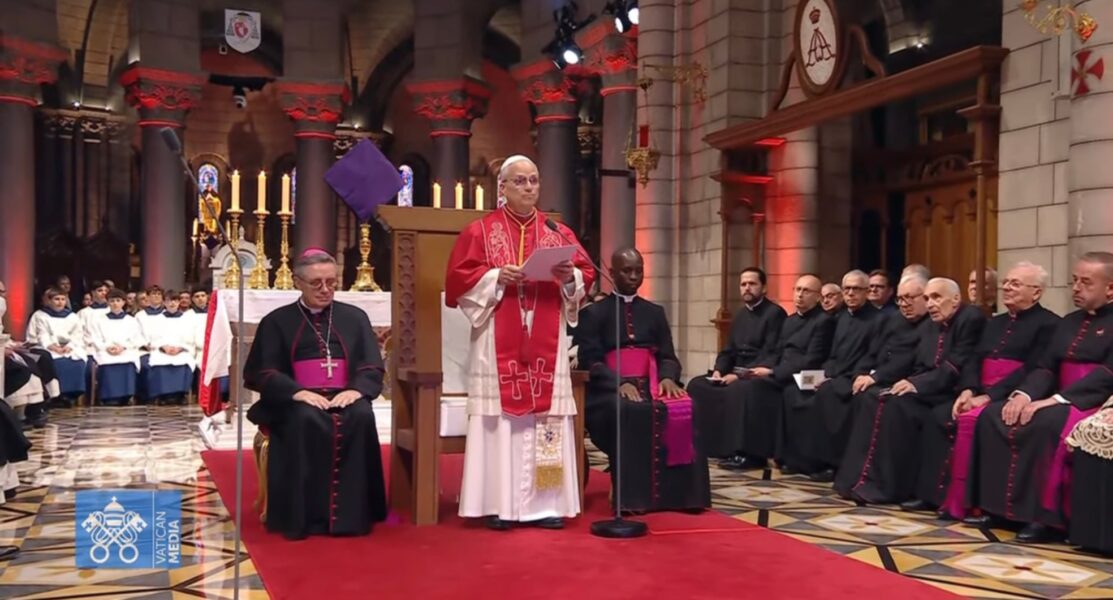
Pope Leo XIV has centered his intervention in Monaco on a concrete idea: the Church must act as an “advocate” for the human being, with an explicit defense of life from conception to its natural end, against a social model that tends to reduce man to individualism and economic logic.
During the celebration in the Cathedral of the Immaculate Conception, the Pontiff developed a clear line: Christ not only redeems, but restores man to his dignity, and that logic must be transferred to the action of the Church. In that framework, he insisted that the proclamation of the Gospel necessarily implies the active defense of human life, “from its conception to its natural end,” placing the pro-life axis at the center of the discourse.
The Pope warned against secularism that reduces man to an isolated individual and against a social model based on the production of wealth as the ultimate criterion. Echoing Benedict XVI, he questioned the logic of profit as an end in itself and urged the recovery of an ethics of responsibility oriented toward the common good.
At the same time, he called for a living faith, not reduced to custom, capable of questioning social structures and proclaiming the Gospel also with new languages, including digital ones, with special attention to those who approach or return to the faith.
—
FULL TEXT (translation to English)
Dear brothers and sisters:
Before God and in the presence of God we have an advocate: Jesus Christ, the righteous one (cf. 1 Jn 2:1-2). With these words, the apostle John helps us understand the mystery of salvation. In our fragility, burdened with the weight of sin that marks our humanity, unable to achieve by our own strength the fullness of life and happiness, we have been reached by God himself through his Son Jesus Christ. He —affirms the Apostle— as a victim of expiation, has taken upon himself the evil of man and of the world, has carried it with us and for us, has pierced through it transforming it and has freed us forever.
Christ is the dynamic center, the heart of our faith, and from this centrality I wish to address you, while I cordially greet His Highness Prince Albert, His Excellency Mons. Dominique-Marie David, the priests, religious and religious sisters present, expressing to all the joy of being here and sharing your ecclesial journey.
Looking at Christ as “advocate,” in reference to the reading we have heard, I wish to offer you some reflections.
The first refers to the gift of communion. Jesus Christ, the righteous one, interceding for humanity before the Father, reconciles us with Him and among ourselves. He does not come to carry out a judgment that condemns, but to offer everyone his mercy that purifies, heals, transforms and makes us participants in the one family of God. His compassionate and merciful attitude makes him an “advocate” in defense of the poor and sinners, not to justify evil, but to free them from oppression and slavery and make them children of God and brothers to one another. It is no coincidence that the gestures performed by Jesus are not limited to the physical or spiritual healing of the person, but also include an important social and political dimension: the healed person is reintegrated, in all his dignity, into the human and religious community from which, often precisely because of his condition of illness or sin, he had been excluded.
This communion is the preeminent sign of the Church, called to be in the world a reflection of God’s love that shows no partiality (cf. Acts 10:34). In this sense, I wish to say that your Church here in the Principality of Monaco possesses a great wealth: being a place, a reality in which everyone finds welcome and hospitality, in that social and cultural mix that is a typical feature of yours. The Principality of Monaco is indeed a small State inhabited in a varied way by Monegasques, French, Italians and people from many other nationalities. A small cosmopolitan State, in which the variety of origins is also added to other socioeconomic differences. In the Church, such differences never become an occasion for division into social classes, but on the contrary, all are welcomed as persons and children of God, and all are recipients of a gift of grace that impels communion, fraternity and mutual love. This is the gift that comes from Christ, our advocate before the Father. In fact, we have all been baptized in Him and, therefore, Saint Paul affirms: “There is neither Jew nor Greek; there is neither slave nor free; there is neither male nor female; for you are all one in Christ Jesus” (Gal 3:28).
A second aspect, however, seems necessary to emphasize: the proclamation of the Gospel in defense of man. Desiring that all welcome the good news of the Father’s love, Jesus positions himself as “advocate” especially in defense of those who were considered abandoned by God and who are judged as forgotten and marginalized, becoming the voice and face of the merciful God who “defends the rights of all the oppressed” (Ps 103:6).
I then think of a Church called to become an “advocate,” that is, to defend man: the whole man and all human beings. It is a path of critical and prophetic discernment oriented toward promoting “an integral development of humanity, which respects its dignity and its authentic identity, as well as its ultimate end, which refers to a mystery of full communion with the Trinitarian God and among us” (International Theological Commission, Quo vadis, humanitas?, 22).
This is the first service that the proclamation of the Gospel must provide: to illuminate the human person and society so that, in the light of Christ and his Word, they discover their own identity, the meaning of human life, the value of relationships and social solidarity, the ultimate end of existence and the destiny of history.
In this regard, I wish to encourage you to provide a passionate and generous service in evangelization. Proclaim the Gospel of life, hope and love; bring to all the light of the Gospel so that the life of every man and every woman may be defended and promoted from conception to natural end; offer new keys of orientation capable of curbing the tendencies of secularism that risk reducing man to individualism and founding social life on the production of wealth.
It is important that the proclamation of the Gospel and the forms of faith, so rooted in your identity and society, guard against the risk of being reduced to a custom, even if it is a good one. A living faith is always prophetic, capable of raising questions and offering provocations: Are we really defending the human being? Are we protecting the dignity of the person in the care of life in all its phases? Is the current economic and social model truly just and supportive? Is it imbued with an ethics of responsibility that helps us go beyond the “logic of exchange of equivalents and profit as an end in itself” (Benedict XVI, Enc. Caritas in veritate, 38), to build a more just society?
Dear brothers, keeping our gaze fixed on Jesus Christ, our advocate before the Father, generates a faith rooted in the personal relationship with Him, a faith that becomes witness, capable of transforming life and renewing society. This faith needs to be proclaimed with new instruments and languages, also digital ones, and all must be introduced and formed in it with continuity and creativity. This holds true in particular for those who are opening up to the encounter with God, the catechumens and those who are restarting, toward whom I recommend special attention.
May your Holy Patroness, the virgin and martyr Devota, inspire you with her example, and may the Most Holy Mary, Immaculate Virgin, intercede for you and always guide you on your path.