


The Pablo VI Foundation has published a text that, under the guise of bioethical reflection, ends up deriving into a positioning that is difficult to sustain both intellectually and morally. The article, signed by José Ramón Amor Pan, addresses the case of Noelia Castillo—the 25-year-old woman euthanized in a hospital owned by the Order of the Camillians—and presents it as a “collective failure”. However, when descending from the theoretical plane to the concrete, it introduces statements that alter the axis of the analysis and shift the responsibility toward parents who are still mourning the body of their euthanized daughter.
The author states literally:
A penultimate reflection has to do with what Santiago Abascal (president of Vox) wrote on his social networks: “I am very affected by this news. The State takes a daughter away from her parents. The Menas rape her. And the solution the State gives her is to suicide her. Sánchez’s Spain is a horror movie.” Except for the first statement, the rest is unacceptable and does not constitute ethically acceptable language. Much less the second of the phrases, “The State takes a daughter away from her parents,” because we are, on the one hand, faced with an autonomous decision by Noelia and, on the other hand, as is public and notorious, we are faced with parents who have not known or been able to build a good relationship with their daughter. Politicians would do well not to tension what is already a super complex and tragic reality in itself.
The text states that the parents “have not known or been able to build a good relationship with their daughter”. In a context marked by severe depression, institutionalization, suicide attempt, sexual assault, and a final euthanasia decision, placing the immediate family as the explanatory element is equivalent to loading them with an implicit responsibility. It is a form of blaming that, moreover, is formulated when the daughter has died and the parents are left publicly exposed without the possibility of reply. That statement, presented as something “public and notorious”, operates as an imposed conclusion, reckless, lacking in prudence and charity but above all unfocused on the true culprits.
The objective of the article is to shift the focus from institutional responsibility to the guilt of the family environment. The case contains a chain of perfectly identifiable public decisions: guardianship by the administration where she was raped, deficient passage through the care system, negligent medical evaluation, authorization by regional commissions, and judicial validation in several instances. That journey defines the real framework of the case. Introducing the parents as the central piece of the problem alters the reading of the facts and reduces the demand on the system’s functioning.
If that were not enough, in that same text, a valuation is introduced about the statements of Santiago Abascal, whose criticism of the State’s role is qualified as unacceptable. The objective sequence of the case includes state intervention from minority age, inability to prevent situations of extreme vulnerability, and a final resolution through euthanasia. Pointing out that sequence is not an exaggeration; it is a reading of the facts. The article chooses to discredit that reading while maintaining an unproven accusation against the immediate family. The result is an inversion of the plane of demand: institutional responsibility is softened, and a reckless imputation that is very uncharitable to the family is intensified. Is this the way of thinking of the ecclesiastical hierarchy, of the president of the ACdP, and of the members of such a significant ecclesial foundation?
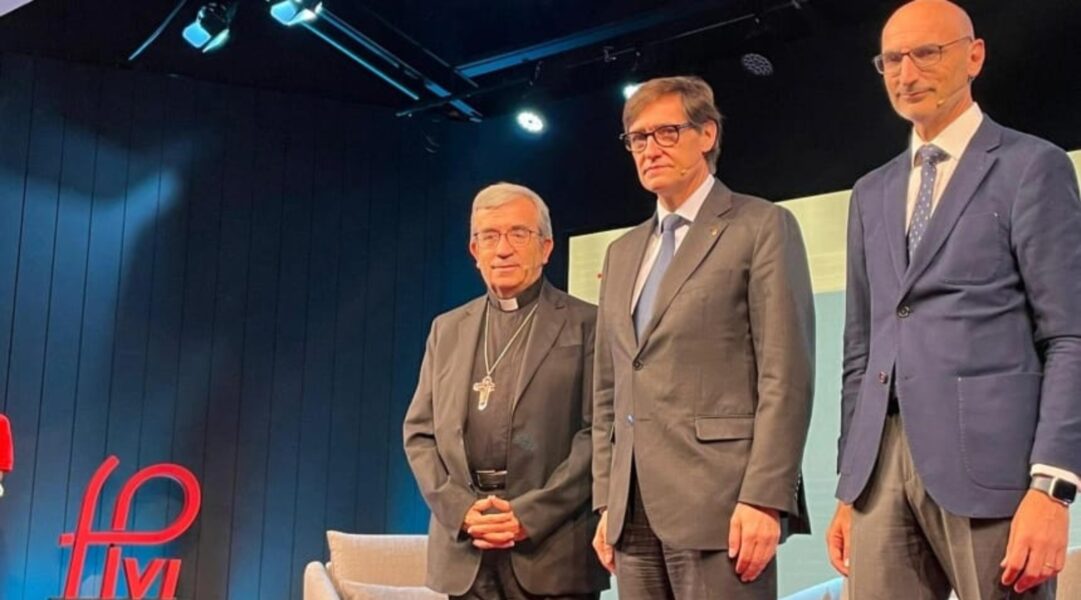
The positioning acquires greater scope by being situated within the Pablo VI Foundation, an entity whose board of trustees concentrates a significant part of Spanish ecclesial leadership. It is chaired by Ginés Ramón García Beltrán and includes top-level figures such as Luis Argüello García, president of the Spanish Episcopal Conference, José Cobo Cano, José Luis Retana Gozalo, Juan Antonio Martínez Camino, Jesús Fernández González, Joseba Segura Etxezarraga, and José María Gil Tamayo. Along with them, Alfonso Bullón de Mendoza, Jesús Avezuela Cárcel, Fernando Fuentes Alcántara, and Alfonso Carcasona García participate.
This board of trustees is not a symbolic instance. It defines the orientation of the institution and backs the framework in which its contents are published. When from an environment of this nature a text is disseminated that introduces unfounded judgments about a family in mourning and, at the same time, corrects those who direct their criticism toward the true culprit, the issue ceases to be anecdotal. It reflects a criterion of approach. Noelia’s case demands precision in the attribution of responsibilities and prudence in the treatment of the people involved. The text opts for a different line: it fixes the focus on the parents without proof and downplays institutional criticism through the disqualification of the political discourse that formulates it and, in passing, attempts to criticize Santiago Abascal, which seems somewhat fashionable in the clericalist environment. A worrying delusion.