


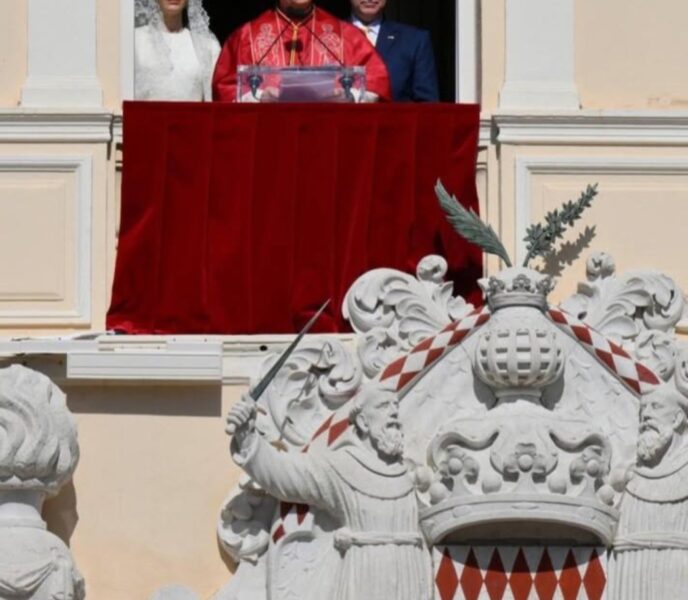
What has been seen in Monaco is not diplomatic prudence. It is deliberate opacity.
A country that, in its own legal system, recognizes the Catholic faith as the state religion. A perfect scenario to clearly affirm whether that is legitimate, whether it is desirable, or whether it is an uncomfortable remnant that should be overcome. And yet, neither one nor the other. Neither affirmation nor correction. Only circumlocution.
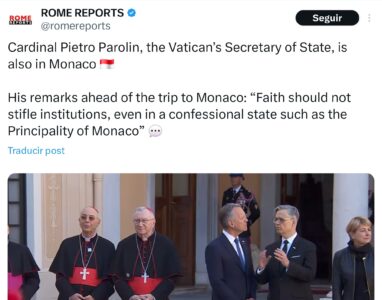
The Secretary of State speaks of the faith not «suffocating the institutions.» What does that mean in concrete terms? That civil law should not be inspired by the truth proclaimed by the Church? That confessionality is decorative? He doesn’t say it. He suggests it, he insinuates it, but he doesn’t formulate it.
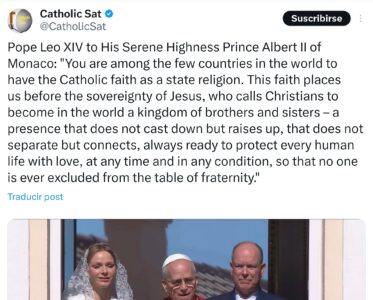
The Pope, for his part, describes faith as a presence that «does not impose itself,» that «connects,» that «elevates.» Pastoral language, abstract, unassailable. But completely useless for responding to the real question: should a State publicly recognize the truth of the faith or not?
Here is the problem. It is not that there is a difficult doctrine. It is that it is avoided to express it. It is replaced by a soft semantic field where everything fits and nothing obliges. Thus, each listener can project what they want: the traditionalist sees an implicit defense; the liberal, an elegant deactivation.
That is not an accident. It is the method.
Ambiguity allows maintaining simultaneously incompatible positions without assuming the cost of choosing. It allows being in Monaco without bothering Monaco, and at the same time not committing to the very idea of confessionality. It allows speaking without saying.
The result is that an informed Catholic does not know what to hold on to. He does not know if a political model is being legitimized or if it is being tolerated as a relic. He does not know if faith should have legal consequences or if it should remain confined to the symbolic.
And that erodes something basic: the intelligibility of ecclesial discourse. If language ceases to be an instrument of transmission of truth and becomes a tool for managing balances, it ceases to serve for teaching.
There is no lack of information. There is a lack of decision to say something with verifiable content.
The consequence is simple: where there should be doctrine, there is fog.