


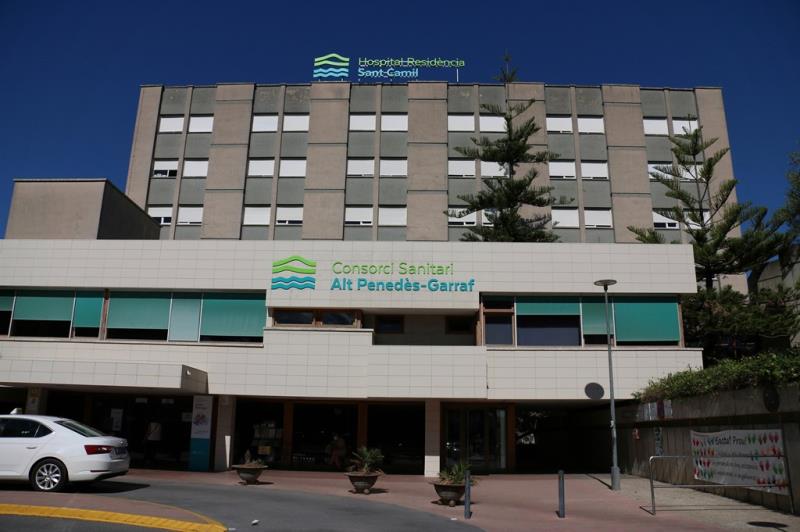
The Hospital Residència Sant Camil, in Sant Pere de Ribes, is a work of religious ownership linked to the Order of the Ministers of the Sick, the well-known Camilian religious order. Sant Camil was born as a healthcare infrastructure promoted by this Catholic order on land donated precisely for an assistance work.
The history of the center begins with the donation of land linked to Amanda Sagristà Colomé, widow of Josep Marcer Carbonell, with the purpose of building a residence for the care of needy people. On that basis, the Camilians first developed a residence and then a hospital, configuring a healthcare complex that has been united from its origin to the spirituality and assistance mission of the order. It was not simply a matter of managing beds or medical services, but of embodying in the healthcare field the charism proper to San Camilo de Lelis: caring for the sick with love, tenderness, and reverence for human life.
Religious ownership and public management
Over time, that reality was legally reorganized. In 2002, the Fundación Hospital Residencia Sant Camil was established, created by the Spanish province of the Camilian Religious to manage the complex. And in 2009, that foundation agreed to transfer the assistance management to the Consorci Sanitari de l’Alt Penedès i Garraf, integrating the hospital into the Catalan public healthcare network. That is the scheme that remains in force: Camilian religious ownership and public management by agreement with Catalan healthcare.
We are not dealing with a purely public hospital in which the Church has an accessory pastoral presence. Nor with a center that was once religious and completely ceased to be so. What exists is a hospital of religious ownership, articulated through the foundation linked to the Camilians, whose ordinary management was transferred to a public entity. The management is public; the work, its root, and its identity remain Camilian.
Camilian continuity: the 50th anniversary
The order itself expressly claims this continuity. On October 18, 2025, on the occasion of the hospital’s 50th anniversary, the Camilian Religious organized, together with the center itself, a celebration with a strong institutional and religious charge. The main event was an Eucharist presided over by Mons. Xabier Gómez, bishop of Sant Feliu, in which the Dra. Olga Farré, manager of the hospital; the P. John Le Van, local superior of the Camilian community; and the H. José Carlos Bermejo, provincial superior of the Camilians in Spain and Argentina, participated.
The full chronicle of the event can be read on the order’s own website:
The Sant Camil Hospital celebrates 50 years of service with “heart in the hands”.
What was said there is impossible to ignore today. José Carlos Bermejo stated that those present were “heirs of the good that others have done,” “of so many hands and hearts that have built this place as a true temple of care.” He also remembered the religious who had passed through the Sant Camil community and evoked Amanda Sacristán as donor and promoter of its construction, as well as P. Canet as the first promoter of the project.
Even more significant was the language used to define the nature of the hospital. Bermejo argued that in Sant Camil “every act of care is a liturgy of service, an expression of the Kingdom of God,” and added that the hospital is “a sacred place where life, relief, and tenderness are celebrated every day.” He concluded his intervention with the phrase that he identified as the emblem of the place: “more heart in the hands, the wisdom of the heart that sees, discerns, and acts with compassion.”
Bishop Xabier Gómez, for his part, thanked the trajectory of the religious and collaborators of the hospital and encouraged the Camilians to keep their presence alive in Sant Pere de Ribes, “contributing the richness of the charism of tenderness and collaborating in the pastoral care of health and the humanization of care.”
The Noelia case: the rupture
That context makes the contradiction that has become visible today even more serious. Because in that same hospital, presented by its own religious leaders as a “temple of care,” “sacred place,” and space where “life is celebrated every day,” the life of a 25-year-old young woman with post-traumatic depression problems after having suffered multiple rape, Noelia, was taken away.
Noelia was a young woman with a serious psychiatric condition. Her situation demanded precisely the opposite of what finally happened: accompaniment, treatment, containment, and hope. However, it was in Sant Camil, a hospital of Catholic religious ownership, where euthanasia was applied to her. She was killed in a center that the Camilians themselves continue to claim as their own work and as an expression of their mission.
A structural incoherence
It is not enough to say that the management is public. That argument may delimit administrative responsibilities, but it does not eliminate the underlying contradiction. Because here we are not talking about an order that provides spiritual assistance in a foreign hospital, but about an institution that retains the historical and foundational ownership of the center, that maintains its identity narrative, and that continues to participate in its institutional life.
The question is direct: if Sant Camil is, as the Camilians say, a “sacred place where life is celebrated,” how can it be accepted that euthanasia is practiced in that same place? If they remain present, if they celebrate, if they claim the work as their own, can they wash their hands of what happens inside by claiming that the management is public?
The case forces a review of the model. For years, a comfortable separation between religious ownership and public management has been sustained. But when that separation results in patients being killed within a Catholic hospital work, it ceases to be a technical issue to become an unsustainable moral contradiction.
The need to rethink the model
If a hospital is of Catholic ownership, it cannot become a place where euthanasia is practiced without a serious breach of coherence occurring. And if the agreements signed with the State allow that outcome, those agreements must be reviewed. Not to enter into nominalist debates, but to recover a minimum coherence between what an institution says it is and what it allows to happen in its own house.