


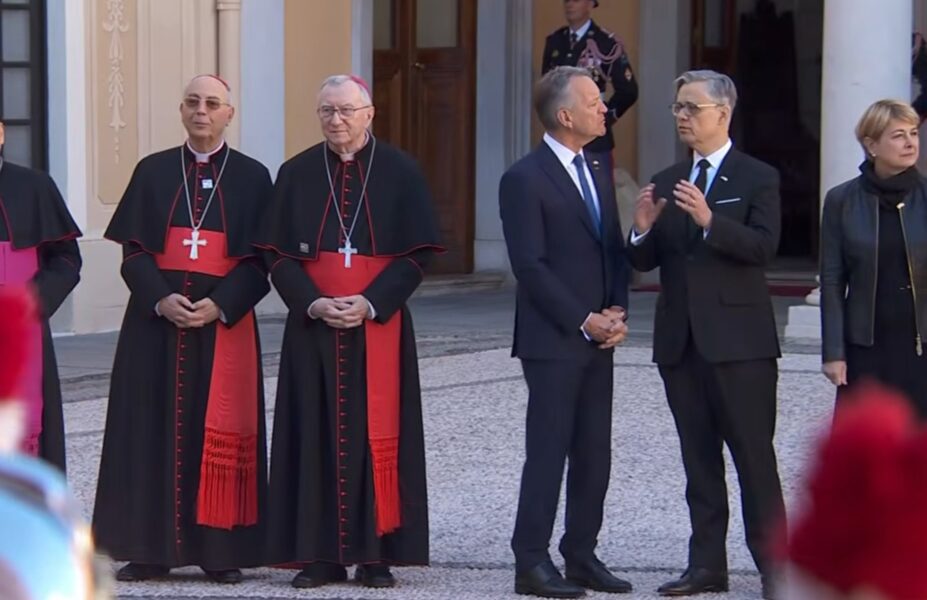
Cardinal Pietro Parolin has introduced a confusing approach to the debate on the relationship between faith and institutions in states with a Catholic tradition. In statements prior to his trip to the Principality of Monaco alongside the Pope, the Vatican Secretary of State stated, according to Rome Reports: “Faith should not stifle institutions, even in a confessional state like the Principality of Monaco”.
The statement comes in the context of the official trip in which he accompanies Pope Leo XIV, whose public intervention has followed a different line regarding the role of state confessionality. During his meeting with Sovereign Prince Albert II of Monaco, the Pontiff emphasized the unique value of those countries that maintain the Catholic faith as the official religion, highlighting that this condition implies a specific responsibility in promoting a society inspired by Christian principles.
According to the Pope’s words, faith, in that context, acts as an element that articulates coexistence, oriented towards the protection of human dignity and social inclusion, avoiding dynamics of exclusion and strengthening community bonds. In contrast to this perspective, Parolin’s declaration introduces a different emphasis by warning about the risk that the religious dimension may interfere with the autonomous functioning of institutional structures, even in states where confessionality is formally recognized.
Both positions occur within the same diplomatic and geographical framework, but reflect different emphases in the interpretation of the public role of religion. While the Pontiff insists on the integrative potential of faith as an element that shapes the social order, the Secretary of State points to the need to preserve a balance that avoids the subordination of institutions to a strictly confessional logic.