


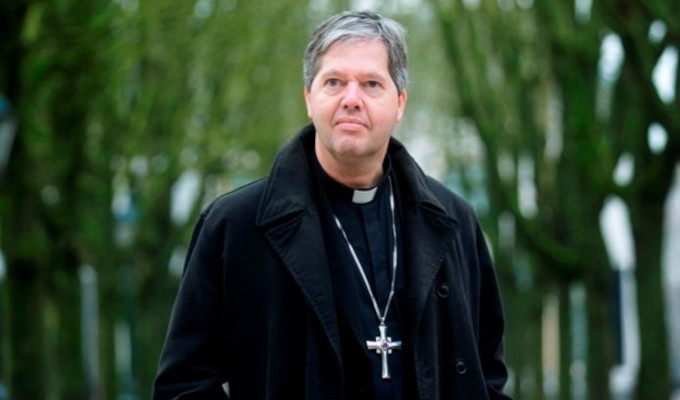
The auxiliary bishop of ‘s-Hertogenbosch, Robert Mutsaerts, has straightforwardly acknowledged the collapse of the Catholic Church in the Netherlands following the reforms promoted in the decades after the Second Vatican Council. His diagnosis is clear: the attempt to adapt the faith to cultural currents ended up emptying religious practice and diluting Catholic identity.
In an interview granted to LifeSiteNews, the prelate describes a profound transformation in just a few years. Where attendance at Mass was once practically universal, today barely 2% of Catholics attend on Sundays. In some areas, before the council, that figure reached 96%.
From a Solid Church to an Accelerated Collapse
Mutsaerts recalls that the Dutch Church started from an exceptionally strong position. In his youth, in dioceses like that of ‘s-Hertogenbosch, almost the entire population identified as Catholic and religious practice was part of everyday life.
However, after the Second Vatican Council, the country took a radical turn. In the bishop’s own words, it went from being “the most obedient student” to becoming one of the most rebellious, determined to reform the Church in depth. The result was not renewal, but a rapid collapse: sacramental practice plummeted in a matter of a few years.
Reforms, Rupture, and Loss of References
According to Mutsaerts, the problem was not only pastoral but also cultural. Many within the Church adopted the “ideals of the sixties,” with a strong charge of rejection of authority and norms, attempting to adapt the Christian message to the climate of the time.
In that context, initiatives like the “Dutch Catechism” emerged, with ambiguous formulations on key issues, and the influence of progressive theologians was consolidated. At the same time, the liturgy was subject to continuous changes that the bishop himself describes as “disastrous,” due to their impact on the perception of the sacred.
“When Truth is Relativized, Everything Crumbles”
For Mutsaerts, the turning point was doctrinal. “They began to relativize objective truth, and that was the main problem,” he explains. From there, the crisis became inevitable.
The attempt to make the Church more acceptable to society ended up producing the opposite effect. “We wanted to please society and lost our identity,” he states. As the difference between Catholic faith and the dominant mentality disappeared, the Church stopped offering something unique and lost its ability to sustain the faithful.
Germany is Warned
The Dutch bishop draws a direct parallel with the current situation in Germany. In his view, the so-called “synodal way” reproduces “the same themes and the same ideas” that were already tested in his country decades ago.
For that reason, he warns that insisting on that path will lead to “disastrous” results. The Dutch experience, he maintains, is not a hypothesis but a concrete precedent of what happens when doctrine is diluted in the name of adaptation.
After the Collapse, a Timid Beginning
Despite everything, Mutsaerts does not completely rule out a recovery. He points out that, after decades of crisis, a certain change of course has occurred, in part thanks to the Vatican’s intervention in the appointment of more doctrinally firm bishops.
The starting point remains very low, but some new signs are beginning to be perceived. “The numbers are small, but they are there,” he states, referring to the interest of young people who are starting to approach the faith again. For the bishop, after hitting rock bottom, a new stage could slowly open up.