


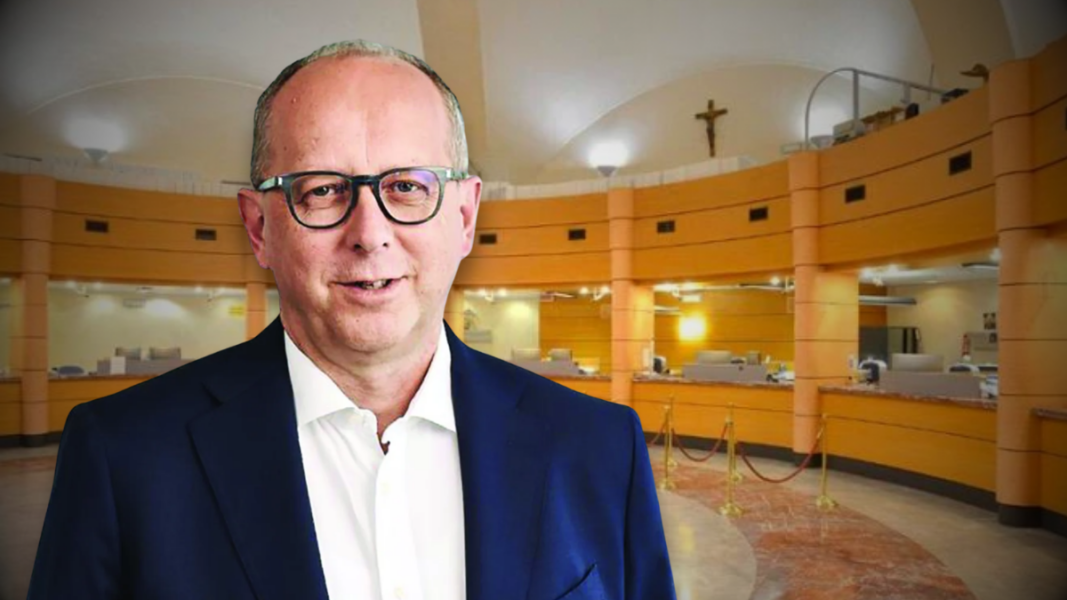
The Institute for the Works of Religion (IOR), known as the “Vatican bank”, has announced the appointment of Luxembourgish financier François Pauly as the new president of its Supervisory Board, replacing Jean-Baptiste Douville de Franssu, in a handover that will take effect at the end of April.
A scheduled handover after a year of preparation
According to an official statement from the IOR itself, Pauly will assume the position after the Board meeting scheduled for April 28, 2026, in which the accounts for the 2025 fiscal year will be approved. Until then, Douville de Franssu will remain in office.
The succession process, carried out over the last twelve months, has been coordinated between the Supervisory Board and the Cardinals’ Commission, with the aim of ensuring continuity in the Institute’s governance.
Pauly’s appointment was approved by said Commission on January 28, 2026, following the formal proposal submitted by the Board on December 12, 2025, in accordance with the IOR’s statutes.
Presence in financial and corporate networks
François Pauly has more than three decades of experience in the European financial sector, with a career linked to institutional banking, public financing, and the management of large banking structures.
He began his career in the 1980s and soon specialized in infrastructure financing and relations with public entities, a key area in the European financial architecture. His time at Dexia Crediop, where he was deputy general manager between 2002 and 2003, placed him at the center of structured financing in Italy.
His consolidation came at the helm of Banque Internationale à Luxembourg (BIL), one of the main entities in the Grand Duchy. Between 2011 and 2016, he served as CEO and president, leading the bank’s restructuring process after the financial crisis and its exit from the Dexia group.
Subsequently, he has held multiple positions on boards of directors in the insurance, private banking, and asset management sectors in Luxembourg, Switzerland, and Belgium. He currently chairs the insurance group La Luxembourgeoise, which strengthens his profile as a manager of assets and complex financial structures within the circuits of high European finance.
A banker from the Rothschild orbit
François Pauly’s international projection was consolidated in the Edmond de Rothschild group, one of the family’s branches focused on private banking and the management of large assets —distinct from Rothschild & Co and with a more discreet and reserved profile—.
Since June 2021, he served as CEO of the Swiss perimeter and president of the executive committee of Edmond de Rothschild (Suisse), positioning himself at the core of the group’s operational management. His responsibility extended to a network of subsidiaries in Europe and other markets —including Monaco, Israel, the United Kingdom, and France—, with participation in key boards and committees, especially in control and risk areas.
His tenure coincided with a particularly delicate moment for the group following the death of Benjamin de Rothschild. In that context, he participated in the management of the transition and in strategic operations, during a period in which the entity highlighted growth in assets and activity.
His departure was formalized in March 2023. The official version frames it as a natural evolution toward roles as an independent advisor, maintaining a partial link with the group. However, economic press reports pointed to possible internal strategic divergences, a hypothesis not publicly confirmed by the entity.
Previous ties to the Vatican
This is not a newcomer to the Vatican environment. Pauly was a member of the Vatican Pension Fund’s board between 2017 and 2021, which allowed him to integrate into the Holy See’s economic structure before his current appointment.
In addition, he maintains relations with the Church in his country of origin, as part of the Economic Affairs Commission of the Archdiocese of Luxembourg, a key body in ecclesiastical asset management.
Balance of a decade of reforms
The outgoing president, Jean-Baptiste Douville de Franssu, has emphasized in the statement that, since 2014, the IOR has undergone a “profound structural transformation” after years marked by management difficulties.
According to the Institute itself, this process has allowed for the establishment of a more solid governance framework, the strengthening of control mechanisms, and the achievement of international standards in the fight against money laundering and terrorist financing, recognized by Moneyval.
The IOR currently maintains relations with more than 35 correspondent banks and serves more than 12,000 clients worldwide, including Holy See institutions and entities linked to the Church.
Continuity, control, and financial power
Cardinal Petrocchi, president of the IOR’s Cardinals’ Commission, has thanked Douville de Franssu for his work and highlighted Pauly’s experience as a guarantee of continuity in this new stage.
The handover occurs at a time when the Vatican seeks to maintain the international credibility of its financial system, relying on technical profiles from major European banking.
However, the choice of an executive closely linked to the circles of high private banking —and particularly to the Rothschild environment— highlights the growing weight of technocratic profiles in the economic management of the Holy See.
In a field where decisions are made in small and highly specialized circles, it is worth asking to what extent these appointments truly respond to criteria of openness or participation. At least in the governance of the Vatican bank, the much-invoked “synodality” seems not to have found its space yet. When power, money, and international reputation are at stake, the classic governance criteria —hierarchical, selective, and technocratic— continue to prevail, far removed from synodal rhetoric.