


By Fr. «Amare Nesciri»
Note: Normally, we do not publish columns under pseudonyms. It is a good rule, both moral and editorial, that people publicly defend their ideas. But this column is so useful regarding the «liturgical wars» that we have decided to suspend the rule this time. The author, we assure you, is a priest we have known for decades as an upright citizen, but who, for various reasons, wishes to remain anonymous. He is an American priest who teaches in a seminary, does parish work, and celebrates both forms of the Roman rite. – Robert Royal
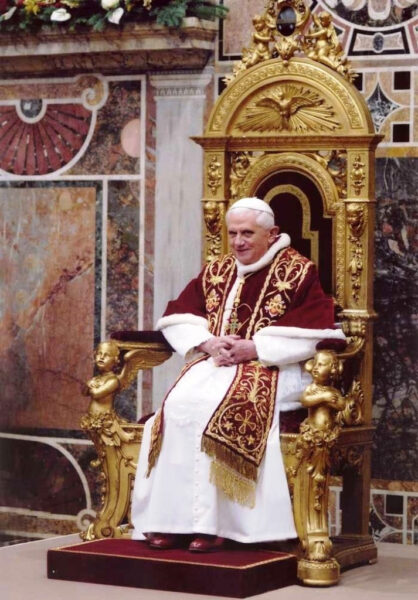
The motu proprio Summorum Pontificum (2007) of Pope Benedict XVI introduced into contemporary ecclesial vocabulary a distinction that has since become as fruitful as it is contentious: the «Ordinary Form» and the «Extraordinary Form» of the single Roman Rite. Benedict took pains to insist that these are not two rites, but two uses of the same lex orandi. The Missal promulgated by Pope Paul VI after the Second Vatican Council constitutes the Ordinary Form; the Missal of Pope John XXIII (1962), which remains in organic continuity with the Tridentine codification of Pope Pius V, may be celebrated as the Extraordinary Form.
Benedict’s assertion was juridical and pastoral, but its deeper importance is theological. The coexistence of the two forms within a single rite can be understood as a «polar unity» in the sense articulated by Hans Urs von Balthasar: a living tension of complementary principles whose unity is not the flattening of difference, but its orchestration.
Benedict himself rejected the hermeneutic of rupture that would pit the pre-conciliar liturgy against the post-conciliar one. In his famous 2005 address to the Roman Curia, he contrasted a «hermeneutic of discontinuity and rupture» with a «hermeneutic of reform in continuity».
The liturgy, precisely because it is the Church’s most public act of faith, must embody this continuity in a way that is not merely conceptual, but sacramental. The two forms of the Roman Rite thus stand as a visible sign that tradition is not a museum piece or a revolutionary program, but a living stream whose depth and breadth can only be perceived by holding its historical strata together.
To interpret this polarity in a richer theological key, it is helpful to turn to Balthasar’s explanation of the Marian and Petrine dimensions of the Church. For Balthasar, the Church is first Marian before being Petrine. Mary, in her fiat and her immaculate receptivity, embodies the contemplative, spousal, and receptive essence of the Church. Peter, in his confession and his charge, embodies the Church’s apostolic, juridical, and governing mission.
These two dimensions are inseparable; however, they are not identical. The Marian dimension grounds the Petrine; the Petrine serves the Marian. The Church is not an institution that happens to have a mystical interior; it is a mystery that necessarily assumes an institutional form.
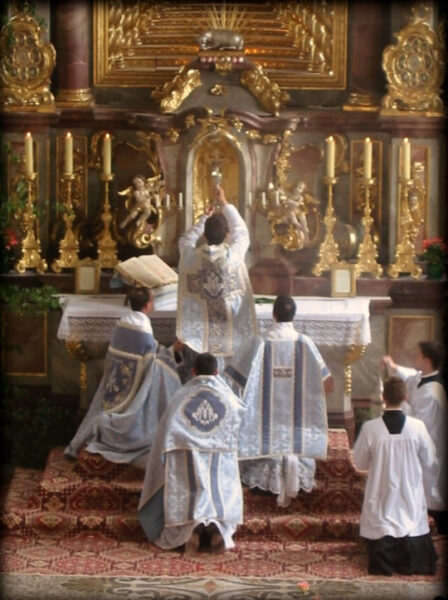
If this polarity is applied to the liturgy, the Extraordinary and Ordinary Forms can be seen as sacramental embodiments of the Marian and Petrine accents within the single Roman Rite. The Extraordinary Form, with its hieratic language, ritual density, and pronounced orientation toward transcendence, gives privileged expression to the Marian dimension: receptivity, silence, adoration, and the primacy of divine action. The Ordinary Form, especially as conceived by the Council’s Constitution Sacrosanctum Concilium, gives greater visibility to the Petrine dimension: proclamation, pastoral intelligibility, missionary outreach, and the audible participation of the assembled community in apostolic faith.
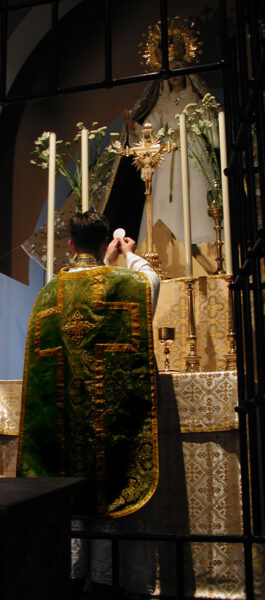
This does not intend to reduce either form to a caricature. Both forms are Marian and Petrine; both are contemplative and apostolic. Nevertheless, each manifests a particular accent. In the Extraordinary Form, the priest’s ad orientem orientation, his subdued voice in the Canon, and the stability of the ritual gestures unequivocally emphasize divine initiative. The faithful are drawn into a mystery that precedes and exceeds them. The silence of the Canon, in particular, is not an absence but a fullness: a sign that the Church receives from Christ what it cannot generate.
Here the Marian fiat resounds: «Let it be done to me according to your word». The liturgy unfolds as something given, to which the Church consents.
In the Ordinary Form, by contrast, the expanded lectionary, proclamation in the vernacular, and audible Eucharistic Prayer make explicit the apostolic dimension of the Church’s life. The Word is proclaimed abundantly; the homily interprets it for the present; the intercessions articulate the world’s needs. The gathered community responds with acclamations that punctuate the Eucharistic Prayer. This visibility and audibility correspond to the Petrine office: to confirm the brethren, to speak the faith in history, to shepherd a concrete people in a concrete time. The liturgy becomes manifestly missionary, oriented not only toward the heavenly Jerusalem, but toward the evangelization of cultures.
Balthasar insisted that the Marian dimension is ontologically prior: without the receptive fiat, there is no Incarnation; without contemplation, there is no mission. Applied liturgically, this suggests that the dimension of depth signified by the Extraordinary Form must not be lost, even when the Church emphasizes pastoral outreach.
Benedict’s concern, evident in his liturgical writings, was that a purely functional or horizontal understanding of the liturgy would obscure its nature as sacrifice and gift. By allowing the continuous celebration of the ancient form, he sought to ensure that the Roman Rite would not forget its Marian depth: its kneeling before the mystery, its sense of the sacred as something objective and given.
However, the Petrine dimension cannot be suppressed. The Church is sent into the world; it must speak intelligibly; it must gather diverse peoples into one Body. The post-Vatican II reforms were animated precisely by this apostolic concern. The Ordinary Form, when celebrated according to the Church’s mind, manifests the catholicity and missionary dynamism of the People of God. The vernacular language is not a capitulation to modernity, but an enactment of Pentecost: the one Gospel proclaimed in many tongues. The expanded participation of the faithful is not a democratization of worship, but an expression of baptismal dignity within the hierarchical order.
Here, Valentin Tomberg’s perception is suggestive. In his meditations on the Church, Tomberg speaks of polarities that must be held in creative tension: exoteric and esoteric, institution and mystery, law and grace. He saw the Catholic Church as the only one capable of sustaining such polarities without collapsing, because it lives from a sacramental center.
The liturgy, as the sacrament of sacraments, becomes the privileged stage on which these polarities are enacted. The coexistence of the two forms of the Roman Rite can thus be interpreted as a symbolic dramatization of the Church’s refusal to resolve the tension through elimination. Instead of choosing between a contemplative and hieratic liturgy and a pastoral and accessible one, Benedict allowed both to subsist within the same juridical framework, as if to say: the life of the Church cannot be reduced to a single mode.
The notions of «extraordinary» and «ordinary» invite theological reflection in themselves. The extraordinary is not abnormal; it is an intensified manifestation of what is always true. In Marian terms, it is the luminous clarity of the fiat, the transparent purity of the Bride. The ordinary, conversely, is not banal; it is the habitual and daily expression of the Church’s life. In Petrine terms, it is the constant governance and proclamation that sustain the faithful in history. The polarity is therefore not between the sacred and the profane, but between the archetype and the mission, between depth and extension.
Someone might object that this theological reading risks idealizing what has often been experienced as division. The history of the liturgical reform in the 20th and 21st centuries has been marked by controversies, misunderstandings, and even mutual suspicions. Nevertheless, a polar unity does not deny conflict; it seeks to transfigure it.
Balthasar’s theology of polarity is not an easy harmonization, but a Christological pattern: in Christ, the divine and the human, glory and humiliation, obedience and authority are united without confusion. The Church, as the Body of Christ, must learn to inhabit similar tensions.
Benedict’s vision implied that the two forms could «enrich each other». The Ordinary Form could learn from the Extraordinary a deeper sense of sacrality, silence, and ritual continuity. The Extraordinary Form could learn from the Ordinary a renewed attention to the riches of Scripture and the pastoral needs of contemporary communities. This mutual enrichment corresponds precisely to the interaction of the Marian and Petrine dimensions. The Marian guards the depth; the Petrine ensures the extension.
When either is isolated, pathology ensues: a purely Marian Church risks quietism or aestheticism; a purely Petrine Church risks bureaucratization or activism.
Inevitably, the question of authority arises. The regulation of the liturgy belongs to the Petrine office. Benedict’s motu proprio was an exercise of that authority, not a decentralization of it. However, the content of his decision pointed beyond mere juridicism. By recognizing the continuing legitimacy of the ancient Missal, he implicitly affirmed that the Church’s liturgical memory cannot be erased by decree. The Petrine serves the Marian; authority safeguards the mystery rather than replacing it. In this sense, the very act of legislating for two forms becomes a sign of the Church’s inner breadth.
Moreover, the coexistence of the two forms can be seen as an icon of eschatological tension. The Church lives between the «already» and the «not yet». The Extraordinary Form, with its marked orientation and sacrificial symbolism, may evoke the transcendence of the heavenly liturgy described in the Apocalypse. The Ordinary Form, with its dialogical structure and breadth of Scriptures, may evoke the pilgrim Church walking through history. Both are true; neither exhausts the mystery. Together they form a diptych: contemplation and mission, adoration and proclamation.
It is important, however, not to assimilate liturgical form too rigidly to theological principle. The Marian and Petrine dimensions are not monopolized by particular rubrics or languages. An Ordinary Form celebrated with reverence can radiate Marian depth; an Extraordinary Form celebration that is hurried or ideologically driven can betray it. The polarity concerns underlying ecclesial attitudes: receptivity and mission, silence and word, gift and governance. The two forms of the Roman Rite provide historically concrete matrices in which these attitudes are accentuated, but the ultimate criterion remains holiness.
In the end, Benedict’s project can be understood as an attempt to heal memory. The 20th century witnessed both liturgical ossification and liturgical experimentation. By recognizing the legitimacy of both forms, he sought to draw the Church toward a more spacious self-understanding. The Roman Rite, like the Church itself, is not a monolith but a communion. Its unity does not depend on uniformity, but on a shared sacramental center: Christ’s Eucharistic sacrifice.
Such a vision demands spiritual maturity. Polar unity is fragile; it can easily degenerate into factionalism. But the alternative—imposed homogeneity or forced amnesia—would impoverish the Church’s catholicity. Benedict’s liturgical theology invites the faithful to perceive diversity as depth and not as threat.
In this light, the Marian and Petrine dimensions are not abstract categories, but living principles embodied in prayer. The Church kneels with Mary at the foot of the Cross; it stands with Peter to preach the Resurrection. In the Extraordinary Form, one can glimpse the Bride on her knees more clearly; in the Ordinary Form, the Apostle preaching. But it is one Church, one sacrifice, one Lord. The polar unity of the two forms thus reflects, however imperfectly, the deeper unity of love and authority, of gift and office, that constitutes the mystery of the Church itself.