


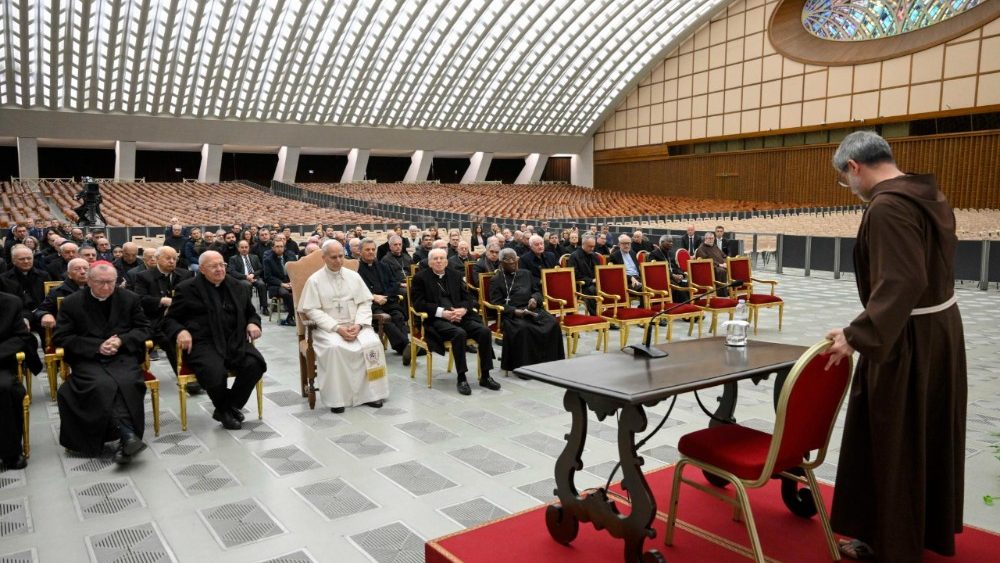
The preacher of the Pontifical Household, Capuchin Roberto Pasolini, has centered his latest Lenten meditation on the figure of Saint Francis of Assisi to explain what the “freedom of the children of God” means, a freedom that does not consist in avoiding pain, but in living it without being trapped by it.
In the reflection, disseminated by Vatican News following the preaching before Pope Leo XIV and the Roman Curia, Pasolini posits that true Christian freedom is not that of one who protects himself from suffering, but that of one who discovers that nothing—“not even illness or death”—can separate him from God’s love.
The joy that does not depend on everything going well
One of the central axes of the meditation is Saint Francis’s teaching on “perfect joy.” Against a superficial view, Pasolini recalls that true joy is not in success, recognition, or visible fruits, but in the ability to remain at peace even when rejection or humiliation arrives.
In this sense, the preacher insists that Christian happiness does not consist in protecting oneself from reality, but in learning to welcome it even when it hurts. It is not about denying pain, but about not letting it have the last word.
A freedom that is born in the midst of trial
The meditation places this experience at the heart of the Gospel, especially in the Beatitudes, where Christ declares blessed precisely the poor, those who mourn, or those who are persecuted. Far from promising a life without difficulties, the Christian message affirms that fullness can occur even in the midst of them.
In that line, Pasolini emphasizes that life should not be idealized or postponed, but welcomed in its “concrete fragility,” because it is precisely there that a new freedom can open up, not dependent on external circumstances.
Suffering is not added by God
The preacher also warns against a mistaken interpretation of Christian spirituality: the idea that God “needs” human suffering or imposes it as a requirement.
On the contrary, he holds that God does not add pain, but transforms the one that is already present in human life. Wounds—personal, physical, or spiritual—can become a place of encounter with Christ and reconciliation with one’s own history.
Death ceases to be an enemy
In the last part of his reflection, Pasolini addresses the way in which Saint Francis lived the end of his life. Far from rejecting death, he came to call it “sister,” in an expression that summarizes a long process of interior reconciliation.
As the preacher explains, the fear of death keeps man in a form of slavery, but that fear can be transformed when it is discovered that life is a gift. At that moment, death ceases to be merely a rupture and becomes a final act of trusting surrender.
A warning to pastors
The meditation concludes with a warning directed at the Church itself: the risk of watering down the Gospel to make it more acceptable.
Pasolini points out that offering a “easier but less demanding” Christianity ends up depriving the faithful of a true path of spiritual maturation. Against this, he insists on the need to safeguard the radicality of the evangelical message, which does not eliminate the harshness of life, but does allow it to be traversed with authentic freedom.