


By Michael Pakaluk
A correct Catholic approach to AI becomes clearer, I believe, if we approach a foundational text of the Church’s Social Doctrine, the Rerum novarum, not as something about structural issues of political economy, but rather about the demands of time and the demands of authority.
The workshops of the Industrial Revolution, by paying only a subsistence wage to the father, forced wives and children to enter the factories as well, destroying time for family, parish, and worship. And making every member of a household directly dependent on the owner, not on the father. This setup, moreover, seemed fixed; the members of a household seemed to have no way to escape their difficult situation as «wage slaves.»
A «living wage» breaks this. The father is paid enough to support a family and for them, if they live thriftily, to acquire capital over time, and the result is that the family is restored as the basic cell of society. And the father’s authority is also restored.
The workshops absorbed almost all leisure time and took authority away from fathers and clerics. The living wage, when respected, returned paid work to its proper position of being in service to the family, and not the family in service to work.
Catholics face today a situation similar to that of the Industrial Age through what Harvard professor Shoshana Zuboff has called «surveillance capitalism.» Technology, in the heady days of Wunderkinder like the young Steve Jobs and Bill Gates, rejoiced in being at the service of the value creator: the entrepreneur, the artist, the executive seeking economies of scale. But around the early 2000s, things inverted, so that the user became the product.
You know the maxim: «if the app is free, you are the product.» We pay for ostensibly «free» services not with money, but with our time and attention. If revenues come from targeted advertising, then, once a user network has stopped growing organically, subsequent growth can only come from more screen time, or more data, leading to better prediction and more secure control of behavior.
Moreover, things get locked in. Put devices in children’s hands and their behavior can be shaped into adulthood.
Do you see that your child is addicted to a screen? My colleagues across the country say that students can no longer sit through a class: they must «go to the bathroom» at least once an hour, a euphemism for going to check their phones, in the same way that cigarette addicts used to behave. These failures are not accidents or mere weaknesses of human nature.
Are our clerics paying attention here? Christians are supposed to live «in the presence of God,» not in the presence of short videos. If we have free time, saying a prayer is a good thing, or visiting a church. Families are supposed to focus on companionship among the children, not on Instagram networks, and follow the culture set by the parents, not by influencers.
Priests and bishops who are internet celebrities are like the worker priests who penetrated the factories after the Industrial Revolution. They do good work, no doubt, but they are not pointing out the fundamental problem or contributing to the necessary change in our way of thinking about how technology uses us.
In particular, they are not helping to foster this other «paradigm shift,» which Zuboff has rightly said is necessary to overcome «surveillance capitalism,» in the same way that we came to see, as a society, that cigarette addictions and environmental pollution must be rejected.
The main ethical issue regarding AI chatbots, therefore, is not new. Will these new technologies serve as de facto fiduciaries, putting the genuine interests of the user first, or will they join forces with the existing «surveillance capitalism,» so that chats come to be in service of an advertising master alien to the user; and users are dragged deeper into a web of subjective illusion?
Only Anthropic, among leading companies, has renounced advertising as a source of revenue. Anthropic also offers users clear options to exclude their data from model training, such as through «incognito mode.» Nothing prevents, however, Anthropic from changing its policy if, for example, it faces financial difficulties in the future. It could be said that all AI chatbots—by regulation—should be required to follow Anthropic’s current business model.
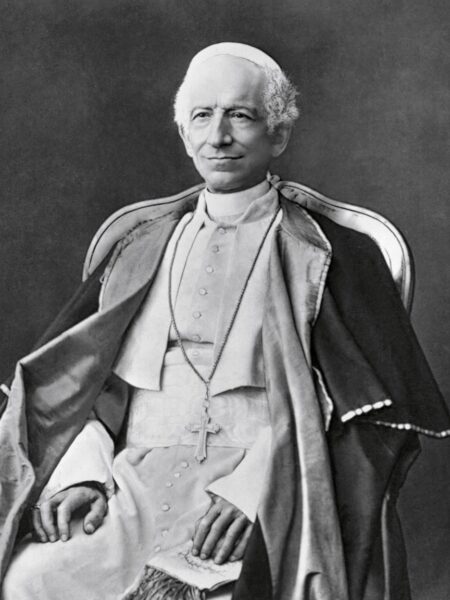
Just as Leo XIII, based on principles of natural law, rejected communism as a solution to the exploitation of workers, today Catholics must reject, as a solution to «surveillance capitalism,» the communism of social life evident in China. In China, the State moderates children’s screen time, not the parents, and at the price of an identification and social control system that is incompatible with religious, economic, and political freedom in a free society.
Everyone I know who is skilled and uses AI affirms a dramatic increase in their productivity, using AI not for entertainment but in the manner of a fiduciary. Apparently, Google has seen a general 10 percent increase in the efficiency of its engineers. For professors like me, the large language model Claude can have the value of a part-time teaching assistant and research assistant combined.
A simple rule, then, for a young person to benefit from the disruption that is sure to come would be: «Through your education, become someone positioned to make good use of AI rather than being replaced by it.» The rule implies becoming, as much as possible, continuously creative, a «content source,» independent in thought and with deep personal resources. The profile of a sociable entrepreneur would serve, or that of the youngest child in a large family.
The achievement of such intermediate goals requires, for most of us, a serious return to the springs of creativity in Western civilization, in communion with others who think similarly.
That is not a bad thing at all. It will require families that are «domestic churches,» parishes that care about mystery and doctrine, real habits of prayer among the Lord’s disciples, and schools that are authentic communities of seekers of the transcendentals of truth, beauty, goodness, and unity.
About the author
Michael Pakaluk, scholar of Aristotle and Ordinarius of the Pontifical Academy of St. Thomas Aquinas, is Professor of Political Economy at the Busch School of Business at the Catholic University of America. He lives in Hyattsville, Maryland, with his wife Catherine, also a professor at the Busch School, and their children. His collection of essays, The Shock of Holiness (Ignatius Press), is now available. His book on Christian friendship, The Company We Keep, is available from Scepter Press. He contributed to Natural Law: Five Views (Zondervan, last May), and his most recent book on the Gospels appeared in March with Regnery Gateway, Be Good Bankers: The Economic Interpretation of Matthew’s Gospel. You can follow him on Substack at Michael Pakaluk.