


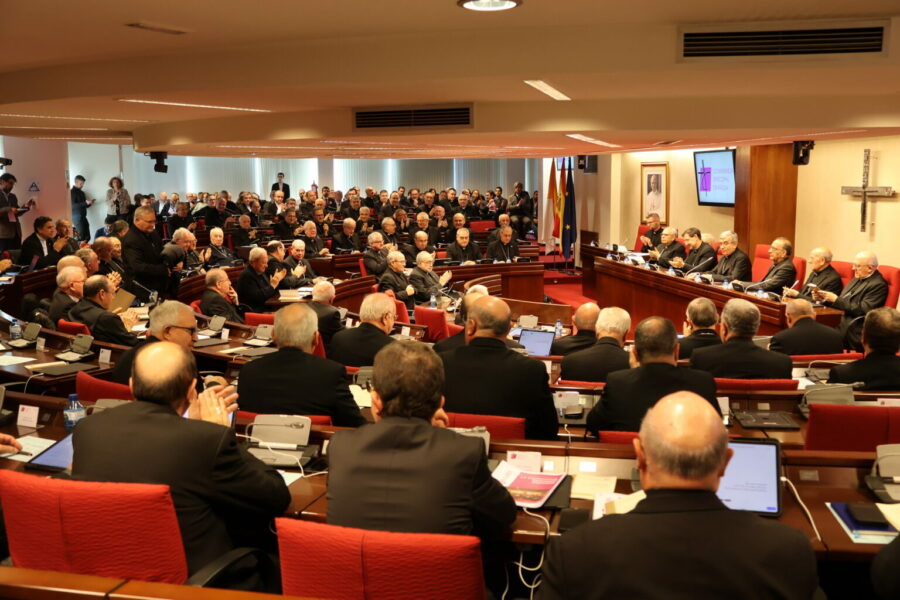
There are silences that are not prudence. They are abandonment. And that of the Spanish Episcopal Conference regarding Noelia’s case falls squarely into that category.
While a 25-year-old young woman, marked by multiple rape, a suicide attempt, an irreversible spinal injury, and a severe psychiatric diagnosis, prepares to die by euthanasia with institutional approval, the Spanish bishops have not said a single word. Not one. Neither on the moral core of the case, nor on its legal implications, nor on the dramatic chain of violence, suffering, and despair that precedes it.
Nothing.
That void is not neutral. It is clamorous.
Because we are not facing an abstract debate or a law discussed in general terms. We are facing a concrete case, with a name, a face, and a story, in which all the elements that Catholic doctrine identifies as maximally problematic converge: extreme suffering, psychological fragility, possible lack of full interior freedom, and a family environment that does not endorse the decision. If there is a moment to speak, it is this one.
But the CEE remains silent.
And while it remains silent, it sends out statements about the end of Ramadan. Cordial congratulations. Careful language. Interreligious dialogue. Everything in order. Everything correct. Everything irrelevant in the face of the essential.
The contrast is too evident to ignore.
It is not about opposing themes, but about prioritizing them. Here there is a human life that is going to be extinguished through a legal procedure, amid open legal doubts, with ongoing criminal processes and indications of irregularities. And the institution that should be the first to raise its voice in defense of life maintains absolute silence.
Not for lack of information. Not for lack of time. By choice.
That silence reveals a drift. A Church that avoids conflict, that measures every word based on its media or political impact, that prioritizes institutional dialogue over uncomfortable truth. A Church that seems to have internalized that there are battles not worth fighting anymore.
But this one is.
Because if one does not speak when a young woman with a history of sexual violence and mental illness ends up on a gurney to receive death, then it is no longer known when to speak. If the State is not denounced for not only allowing but organizing that end, then the discourse on human dignity is reduced to empty rhetoric.
Here there are no diplomatic nuances that hold up.
Either one is on the side of concrete life, even when it is uncomfortable, disordered, or painful, or one opts for a neutrality that in practice legitimizes the outcome.
The Christian tradition has never been neutral in the face of suffering. It has accompanied it, redeemed it, filled it with meaning. It has not eliminated it by suppressing the one who suffers.
That is why the current silence is not just an omission. It is a rupture.
Christ did not remain silent in the face of injustice or human pain. Nor did the martyrs, nor the saints, nor those who understood that truth is not negotiated based on context.
When today the successors of the apostles remain silent in the face of a case like this, they are not being prudent. They are being irrelevant.
And that is the underlying problem.
«Whitewashed tombs» is not an insult. It is a precise description when the appearance of righteousness coexists with the absence of truth in the essential.
Here there is an announced death. And a Church that has decided to say nothing.