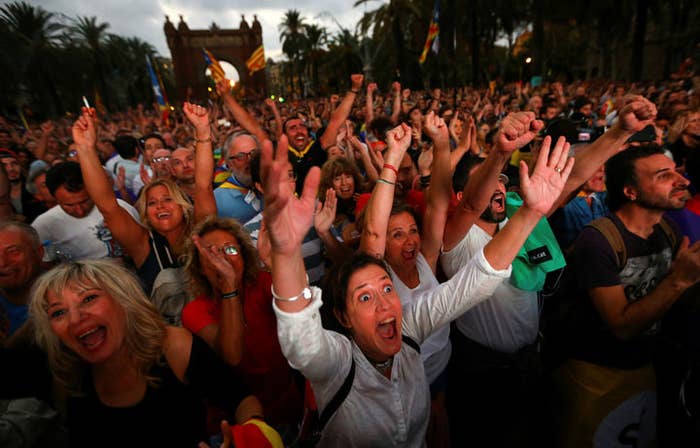
There are images that make history. One of them, turned into a political meme, is that of the lady who, arms raised, was exultantly celebrating in the street the proclamation of Catalan independence by Carles Puigdemont in October 2017, surrounded by a crowd surrendered to euphoria. Just a few seconds later, the joy collapsed: after a grandiloquent rhetoric full of fanfare, came the immediate suspension of what had just been announced. The expression of that woman, frozen in the exact instant when exaltation turns into bewilderment and disappointment, has remained as a perfect metaphor for the distance between words and deeds.
Something similar could now happen among many faithful attached to the traditional Roman rite. The words of Pope Leo XIV to the plenary assembly of French bishops, which speak of a generous integration of the faithful of the Vetus Ordo, deserve to be welcomed with joy. It would be petty to deny it. It would also be unfair to react with automatic cynicism to a message that, at least in its formulation, points in the right direction. In an ecclesial context where this issue has been treated for years with suspicion, hostility, or simple fear, hearing from Rome an appeal to generosity undoubtedly constitutes good news.
But it is wise not to be carried away by naive enthusiasm. Because the concrete reality that these faithful live in many places, and very visibly in Spain, still belies any climate of true integration. The traditional Roman rite is, in fact, cornered, monitored, and in many dioceses practically proscribed. Talking about it in normal clerical environments provokes reactions that range from scandal to fear. The majority of parish priests get upset if a faithful even mentions the possibility of the traditional Mass. There are young priests who do not dare to celebrate some Masses in the ancient rite for fear of being marked by their bishops, sidelined, punished, or condemned to silent marginalization. The situation has reached such a degree of irrationality that sometimes it seems as if one were not talking about a venerable form of the Roman rite, but about a clandestine and suspicious activity.
The image of some bishops when this issue is addressed is revealing. It is not a serene disagreement, nor a reasoned pastoral prudence, nor even an explicable disciplinary reserve. It is, frequently, an unmistakable panic. As if the mere existence of a priest attracted to the liturgical tradition constituted an internal threat that had to be smothered as soon as possible. In not a few cases, the reaction of the diocesan apparatus recalls that of someone who discovers they have a delinquent child. He is not treated as a son of the Church with a legitimate liturgical inclination, but as a problem that must be neutralized before it contaminates others.
That is why the words of Leo XIV are hopeful, yes, but they are not enough on their own. It is not enough to invoke generosity if in practice a regime of suspicion, suffocation, and exclusion is maintained. It is not enough to recognize these faithful in words while forcing them to travel to remote, semi-clandestine chapels or ones tolerated grudgingly, as if they were second-class Catholics. It is not enough to appeal to communion while so many faithful receive slammed doors when they request something as elementary as the possibility of attending the Mass according to the traditional Roman rite with normality.
In Madrid, for example, the recent experience of those who have organized to request this pastoral attention has been one of dry and brutal rejection. They found no listening, no understanding, no true will for integration, but a blunt refusal sheltered in the most closed and aggressive application of Traditionis Custodes. And that is precisely what makes the Pope’s intervention decisive: because it forces us to measure the sincerity of many pastors. Now we will have to see if some take note, if they correct the tone and substance of their actions, if they replace the slammed door with real welcome, or if everything will remain in a beautiful phrase destined to reassure, without altering the underlying situation by a millimeter.
It would be a mistake to respond to the Pope’s words with systematic distrust. But it would be an even greater mistake to confuse a change of tone with a change of course. The faithful do not need vaporous declarations or rhetorical gestures anymore. They need facts. They need legal security. They need to know that they will not be treated as a foreign body within the Church for desiring the liturgy that nourished the faith of countless generations. They need this absurd and revealing persecution to end once and for all, this insistence on presenting as suspicious what for centuries was the very heart of Roman liturgical life.
Moreover, the solution does not require any complex architecture. Repealing Traditionis Custodes and restoring the legal framework of Summorum Pontificum costs nothing. It requires no lengthy theoretical elaborations or laboratory pastoral experiments. It is a simple, clear, and perfectly viable decision. It would suffice to return to the Church a liturgical peace that should never have been broken and to recognize, with facts and not just words, that these faithful are not tolerated intruders, but Catholics with full right to live their faith in continuity with the liturgical tradition of the Church.
There are, therefore, real reasons for joy and hope. The words of Leo XIV are good and deserve to be celebrated. No one gains anything by settling into resentment or preemptive demolition. But recent experience also calls for caution. Christian hope is not political naivety nor sentimental credulity.
I hope it happens this time. I hope we do not find ourselves once again, as in the situation of that woman from the meme, suspended between initial euphoria and subsequent disillusionment. I hope the Pope’s words are the beginning of a real turn and not another fleeting moment of relief before everything stays the same. Because, at this point, the faithful of the Vetus Ordo not only have the right to hear messages of generosity. Above all, they have the right to see them fulfilled.