


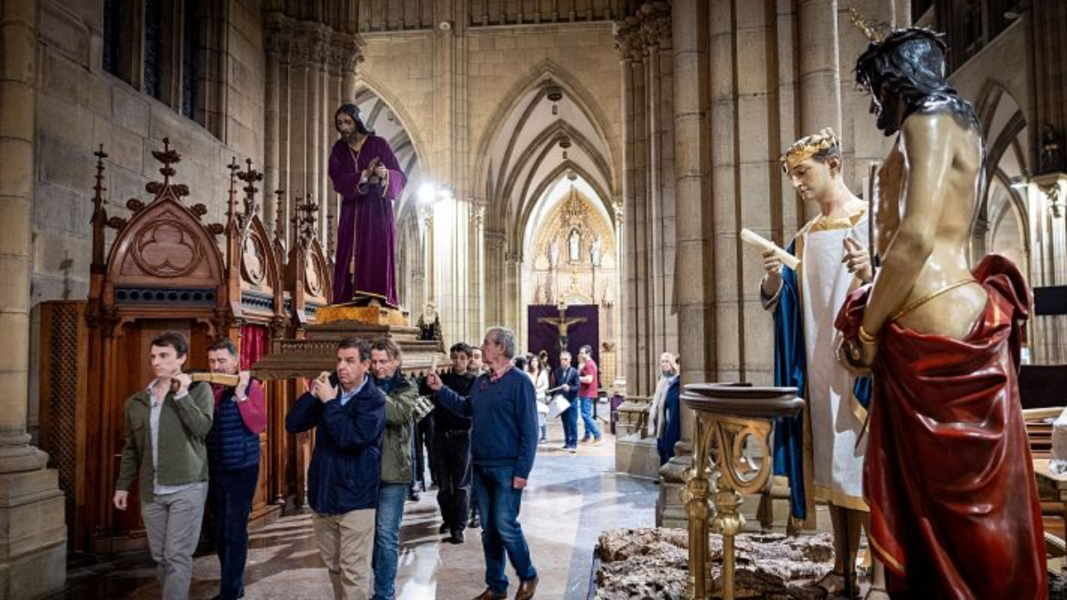
After more than half a century of absence, San Sebastián is preparing to recover the Holy Week processions, a tradition deeply rooted in the city’s religious history and disappeared since 1966. The initiative, driven from the Cathedral of the Good Shepherd with the support of Donostia faithful, seeks to reactivate a public expression of faith with roots dating back to the 16th century and which for decades formed part of the city’s spiritual identity.
In this context, Infovaticana speaks with Don Jon Molina Bengoa, parish priest of the Cathedral of the Good Shepherd, about the origin of this recovery, the role of the faithful, the interest awakened among young people and families, and the future of a tradition that is once again making its way through the streets of San Sebastián.
For decades, the processions disappeared from public life in San Sebastián and seemed to be part of the past. However, in recent months an initiative has emerged that has managed to mobilize numerous faithful. How did this specific impetus to recover the procession arise, and what meaning does it have, from a pastoral point of view, for the Christian community?
It is the faithful who have taken the initiative at all times. The procession initiative did not come from the priests, it did not come from the parish—well, from the parish at least not from the parish priest—but rather it was some lay faithful who, in the spring of last year, expressed their desire to recover the procession and to get involved in everything necessary for it to be possible. So, I think this is very important and has been key to the success of the initiative.
As for the value that the procession taking place may have, I believe it can be an important starting point for many. That is, it can be interpreted as a first proclamation of the Gospel. Perhaps very simple, more visual than conceptual, but also through the images, the music, in short, we can communicate God and the message of the Gospel. This can be a beginning.
The disappearance of the processions in the 1960s was not an isolated phenomenon, but coincided with a profound social, political, and also ecclesial change. In the specific case of San Sebastián, to what extent did that context influence their disappearance, and what has changed today for this manifestation of faith to be reconsidered in public space?
Undoubtedly, the social, political, and religious context had something to do with the disappearance of the processions, at least in this one of ours that left from the Good Shepherd area.
However, the cultural, social, and religious environment has changed. The procession that we would like to take to the streets, far from having that tone that could be attributed to the old procession—of being invasive, excessive, or having a certain triumphalism—ours certainly neither intends nor can have those pretensions. We simply want to take our faith to the streets, knowing that not everyone shares it and that some may even reject it, but manifesting our pride in being Christians and proposing Christianity as a way of life.
In recent years, within the Church there has been frequent insistence on the need to seek new pastoral languages. However, in this case, what seems to be awakening interest is precisely the recovery of a traditional form of piety. How do you explain that this expression, which for a time was relegated, now again summons faithful of different sensitivities?
Undoubtedly, the variety of people, sensitivities, and spiritualities that have joined the nascent confraternity and the preparation of this Holy Week shows that very different people, with legitimate but different sensitivities, have united.
I believe that this form of expressing faith, which for so long has been, I don’t know if undervalued, but certainly underappreciated, is once again taking an important place in the life of the Church. And many are approaching in this way.
One of the aspects that has attracted the most attention is the participation of very diverse profiles, in a society moreover marked by secularization. What kind of response are you finding among the faithful, and what does this reveal about the current situation of faith, especially among the new generations?
Most people… there are all kinds: older people, middle-aged people, but there are also many young people, which has surprised us. There are entire families that have signed up, young families with their children and all their members to the confraternity, and each one participates as they can.
Of course, age is not being a determining factor: young people, older people, everyone has signed up.
This first edition represents, in a certain way, a starting point after decades without a living tradition. From an organizational and symbolic point of view, how is this recovery concretized in terms of images, floats, and the development of the procession?
This year, three floats will process. We have five on display in the church, they have been recovered over time, but three will process: the image of the Nazarene, which is the patron of the confraternity; the Recumbent Christ; and the Virgin of Solitude.
Beyond this first call, the key issue is continuity. In a context where many traditions have weakened, what future prospects do you see for this type of popular piety manifestations in San Sebastián?
Well, it would be too early to say anything sensible, but seeing the enthusiasm with which people have welcomed the initiative, I believe that the processions and these ways of expressing popular piety have a flourishing future ahead. I would dare to say yes.
In fact, some have already approached asking for baptism because they want to be confreres and cannot because they have not been baptized. That is, the fruits are almost immediate.
After so many years without processions, one wonders whether there is a real continuity with the previous tradition or if, in practice, it is being rebuilt almost from scratch. What is the situation in this regard?
Not so much, because there had been no living tradition here for a long time. We have some cases of boys who have approached because their grandfather was already a confrere, but in general everything was very lost.
People have a vague memory of the processions that left, but there was no strong family tradition.
Regarding the configuration of the new confraternity, at a time when the role of the laity within the Church is also being debated, what model have you adopted and what type of participation is being promoted?
Our confraternity is newly founded, or rather refounded, but it is born with the vocation of being mixed. That is, women and men are equally welcome, and in that sense I don’t think we have any problem.
The recovery of this type of traditions also implies important material work, especially regarding devotional heritage. Where does the restoration of the images currently stand, and what difficulties are you encountering?
We have started in a very precarious and poor way. We have restored the images somewhat so that they can go out into the streets, but they still need much more care and restorations than we have been able to do in this first year.
Things will go slowly, because this requires time and economic resources. We have restored several images, but there are still many left to restore.