


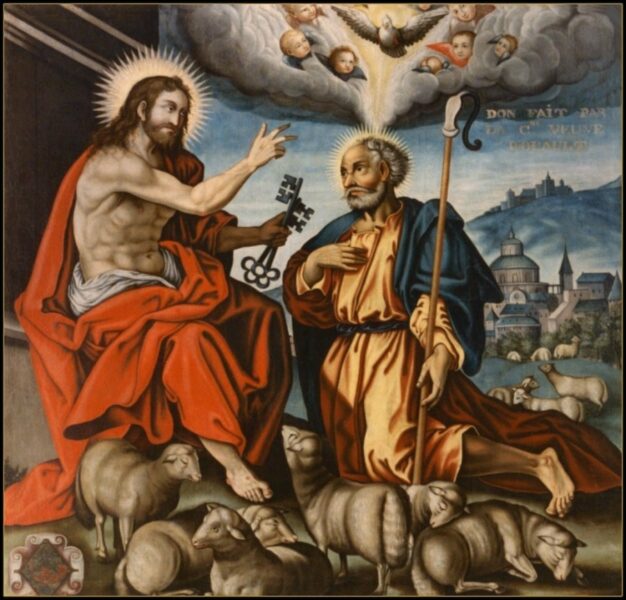
Pope Leo XIV has focused the catechesis of this Wednesday’s general audience, held in St. Peter’s Square, on the hierarchical dimension of the Church, emphasizing its divine origin and foundation in the Apostles, within the framework of his cycle of teachings on the documents of the Second Vatican Council.
In his reflection on the constitution Lumen gentium, the Pontiff recalled that the hierarchical structure is not a human construction, but an institution desired by Christ to ensure unity, the mission, and the faithful transmission of the faith, highlighting the role of the ordained ministry—bishops, priests, and deacons—as service to the People of God.
We leave below the words of Leo XIV:
Dear brothers and sisters, good morning and welcome!
We continue with the catecheses on the documents of the Second Vatican Council, commenting on the Dogmatic Constitution Lumen Gentium on the Church (LG). After presenting it as the people of God, today we will consider its hierarchical form.
The Catholic Church finds its foundation in the apostles, whom Christ wanted as living pillars of his Mystical Body; and it possesses a hierarchical dimension that works in service of the unity, the mission, and the sanctification of all its members. This sacred Order is permanently founded on the apostles (cf. Eph 2:20; Rev 21:14) as authorized witnesses of Jesus’ resurrection (cf. Acts 1:22; 1 Cor 15:7) and sent by the Lord himself on mission to the world (cf. Mk 16:15; Mt 28:19). Just as the apostles are called to faithfully guard the saving teachings of the Master (cf. 2 Tm 1:13-14), they transmit their ministry to men who, until the return of Christ, continue to sanctify, guide, and instruct the Church «thanks to those who succeed them in their pastoral ministry» (CIC, n. 857).
The third chapter of Lumen Gentium, titled The Hierarchical Constitution of the Church, and in Particular of the Episcopate, delves into this apostolic succession founded on the Gospel and Tradition. The Council teaches that the hierarchical structure is not a human construction that serves for the internal organization of the Church as a social body (cf. LG, 8), but a divine institution whose purpose is to perpetuate until the end of time the mission that Christ gave to the apostles.
The fact that this theme is addressed in chapter III, after the first two have contemplated the true and proper essence of the Church (cf. Acta Synodalia III/1, 209-210), does not imply that the hierarchical constitution is a subsequent element with respect to the people of God: as the Decree Ad gentes states, «the Apostles were the seeds of the new Israel and, at the same time, the origin of the sacred Hierarchy» (n. 5), inasmuch as a community of those redeemed by Christ’s Passover, established as a means of salvation for the world.
In order to grasp the Council’s intention, it is appropriate to read well the title of chapter III of Lumen Gentium, which explicates the fundamental structure of the Church, received from God the Father through the Son and brought to fulfillment with the outpouring of the Holy Spirit. The conciliar Fathers did not wish to present the institutional elements of the Church, as the noun «constitution» might suggest if understood in the modern sense. The document focuses instead on the «ministerial or hierarchical priesthood,» which differs «essentially and not only in degree» from the common priesthood of the faithful, and recalls that «they are ordered one to the other, for both in their own way participate in the one priesthood of Christ» (LG, 10). Thus, the Council treats the ministry that is transmitted to men who are invested with sacred power (cf. LG, 18) for service in the Church: it dwells especially on the episcopate (LG, 18-27), and then on the presbyterate (LG, 28) and the diaconate (LG, 29) as degrees of the one sacrament of Holy Orders.
With the adjective «hierarchical,» therefore, the Council wishes to indicate the sacred origin of the apostolic ministry in the action of Jesus, Good Shepherd, as well as its internal relations. Bishops, first of all, and through them, presbyters and deacons, have received charges (in Latin, munera) that lead them to be at the service of «all who belong to the People of God» so that «tending freely and orderly to the same end, they may attain salvation» (LG, 18).
Lumen Gentium recalls several times and effectively the collegial and communional character of this apostolic mission, reaffirming that «the charge that the Lord entrusted to the pastors of his people is a true service, which in Sacred Scripture is properly called diakonia, that is, ministry» (LG, 24). One then understands why St. Paul VI presented the hierarchy as a reality «born of Christ’s charity to carry out, spread, and guarantee the intact and fruitful transmission of the treasure of faith, example, precepts, charisms, left by Christ to his Church» (Disc. 14 Sept. 1964, in Acta Synodalia III/1, 147).
Dear sisters, dear brothers, let us ask the Lord to send to his Church ministers ardent in evangelical charity, dedicated to the good of all the baptized and courageous missionaries in all places in the world.