


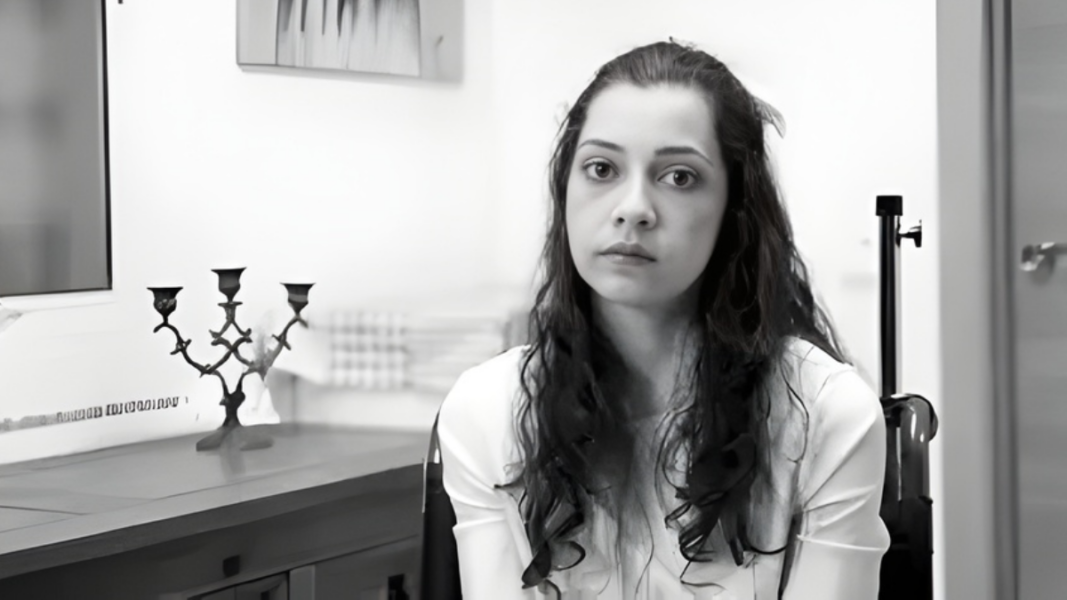
In recent weeks, the debate on euthanasia has been at the center of the public agenda in several countries. France, Canada, or Scotland are discussing its legalization or expansion, while in Spain this practice has been legal since 2021. According to data from the Asociación Federal Derecho a Morir Dignamente, more than 1,000 Spaniards have died by euthanasia up to 2025. However, the theory takes on a concrete face when it becomes a personal story.
This Tuesday, a 25-year-old young woman, Noelia, has given an interview to Antena 3 in which she announces that she has few days left to live: on March 26 she will receive euthanasia. With a subdued tone and sad gaze, she explains that she has fought for two years in the courts to obtain authorization. Her reason, repeated bluntly: “I don’t want to suffer”.
The real drama behind the discourse
Noelia has suffered a serious spinal cord injury since 2022, after a suicide attempt, which left her paralyzed from the waist down and with constant pain. To this situation is added a diagnosis of borderline personality disorder, which according to Antena 3, she had recognized a 67% disability due to mental health problems.
A medical committee authorized her euthanasia request unanimously, and the courts dismissed her father’s appeals, who argued that her mental state should be taken into account. The young woman acknowledges that her family does not share her decision, “no one in my family is in favor because I am a pillar for them”, she explains. However, she insists that she can no longer bear the pain: “I leave them suffering, but what about my suffering?”.
Her mother, although opposed to euthanasia, has stated that she will remain by her side until the end, after describing the process as “horrible” after years of struggle.
To these elements is added a particularly delicate aspect. According to what was published in the media, Noelia declared in court that she had been a victim of multiple sexual assault, a trauma that could be at the origin of her borderline personality disorder. In addition, she had a previous diagnosis of obsessive-compulsive disorder with suicidal ideations.
Her environment maintains that her desire to die does not respond to a fully free decision, but rather would be conditioned by her mental illness, which had already led her to several suicide attempts
Is this true freedom? Can a decision that culminates in one’s own death be called dignity?
The underlying problem: a reduced vision of man
To understand cases like Noelia’s, one must look at the cultural background. We live in a deeply materialistic society, where the only good seems to be pleasure and the only evil, pain. In that framework, suffering becomes incomprehensible and, therefore, unacceptable.
From there arises a utilitarian logic: avoid pain at all costs, even if that implies eliminating one’s own life.
But this vision is insufficient. The human being is not exhausted in his biology or in his capacity to feel. He is a person, capable of knowing, loving, giving himself, and opening himself to God. And for that reason, his life has a value that does not depend on his circumstances.
Paradoxically, it is in suffering where the value of human life is often revealed most clearly. When utility and performance disappear, what remains is the essential: care, self-giving, patience, fidelity.
In that context, life stops being measured by what it produces and begins to be recognized for what it is. For being, not for doing.
Therefore, presenting death as a solution to suffering is not an act of freedom, but a renunciation: the acceptance that there are lives that cease to have value.
A judicial process still open
To this personal reality is added a particularly serious element: the judicial process is not completely closed.
According to ACI Prensa, the European Court of Human Rights has recently rejected the precautionary measures requested to stop the euthanasia, but has not ruled on the merits of the case. This means that the procedure remains open and pending resolution.
In addition, in Spain several criminal proceedings remain active. One of them investigates the doctors who endorsed the euthanasia for possible crimes of documentary falsehood and prevarication. According to the accusation, they would have simulated a non-existent disagreement to force the intervention of the evaluating body.
Another procedure is directed against members of the Guarantee and Evaluation Commission and political officials, questioning their impartiality due to possible links with pro-euthanasia organizations or interests related to organ procurement.
If the euthanasia is finally carried out while judicial processes remain open—both in Spain and in the European sphere—not only will a life be ended, but also any possibility of clarifying the facts will be definitively closed.
From a free act to an administrative act
Noelia’s case is not only an individual decision, but the reflection of a society that, in the face of suffering, offers death as a solution. As St. John Paul II warned, when the elimination of the sufferer is legitimized, the protection of the most vulnerable ends up being weakened.
The novelty of our time is not the existence of suicide—a tragic reality present throughout history—but its progressive assumption by the State. What was previously a personal act—wrong, but assumed in conscience—is now transformed into an institutional procedure, regulated and legitimized by public instances.
The case is particularly disturbing: a young woman marked by suffering and vulnerability, whom the system failed to protect at the time, now receives as a response from the same system the authorization and means to die.