


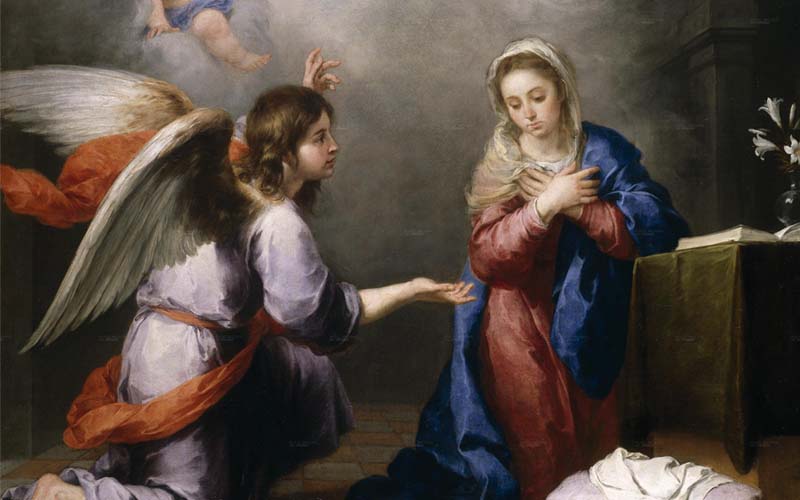
Every March 25, the Church celebrates the solemnity of the Annunciation of the Lord, the moment when the archangel Gabriel announced to the Virgin Mary that she would conceive by the work of the Holy Spirit the Son of God. It is not a secondary episode of the Gospel, but a central event in the history of salvation: the instant in which the Word became flesh and the redemption of the world began.
The account, recorded in the Gospel of Saint Luke (1:26-38), shows a scene of incomparable simplicity and theological depth. God does not burst in with violence nor impose his will: he asks for the consent of a young virgin from Nazareth. And Mary responds with an act of faith and obedience that has marked history: “Let it be done to me according to your word”.
The Mystery of the Incarnation
The Annunciation is, above all, the feast of the Incarnation. In that instant, the eternal Son of God assumes human nature in the womb of Mary. It is not a metaphor or a symbol: it is a real, concrete, historical fact. God enters time.
This mystery reveals the divine logic, radically opposed to worldly mentality. There is no power or ostentation, but humility and silence. The plan of salvation begins in the hidden, in the interior of a house, in the heart of a woman who accepts without fully understanding, but trusting fully.
The Unique Role of the Virgin Mary
The figure of Mary occupies a central place in this solemnity. She is not a mere passive instrument, but a free cooperator in God’s plan. Her “yes” is not automatic or superficial; it is a conscious decision that implies risk, misunderstanding, and sacrifice.
The tradition of the Church has contemplated this instant as decisive. Saint Bernard of Clairvaux describes the scene with singular intensity, presenting all creation as expectant before Mary’s response: “The angel awaits the response; we too […] Respond with a word and receive the Word”. In that wait, the gravity of the moment is expressed: the Incarnation, prepared from ancient times, is consummated with the free consent of the Virgin.
A Lesson Inscribed in the Mystery
The Annunciation also manifests a central truth: God does not act by annulling human freedom, but by counting on it. Mary’s consent is not an accessory detail, but an integral part of the divine design.
Therefore, the patristic tradition has seen in this episode the beginning of a new creation. As Saint Irenaeus taught, “the knot of Eve’s disobedience was untied by Mary’s obedience”. The scene in Nazareth not only announces a birth, but inaugurates a restoration: where the fall began, the redemption also begins.
The “Yes” that Opens Redemption
In that concrete, silent, and hidden instant, the mystery that will mark all history is sealed: the eternal Word enters the world and assumes the human condition.
The Annunciation is not only the announcement of a future fact, but its immediate fulfillment. With Mary’s “fiat,” God dwells among men.