


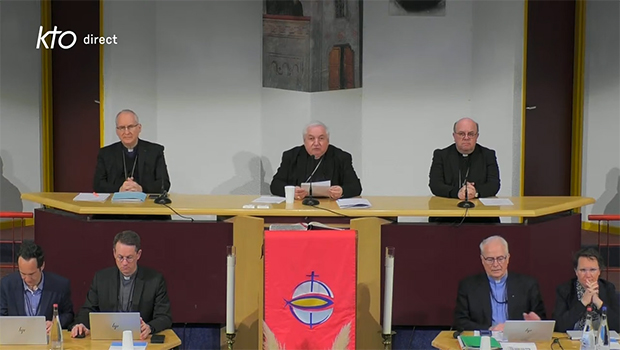
Cardinal Jean-Marc Aveline, president of the French Episcopal Conference and Archbishop of Marseille, has placed the debate on the Traditional Mass at the center of the Spring Plenary Assembly held in Lourdes from March 24 to 26, describing the current situation as a “painful wound” that directly affects the unity of the Church.
The French bishops will address the topic, among others, in a specific conference on “Liturgy and tradition”, in a context marked by tensions surrounding the celebration of the Tridentine Mass.
A “wound” that affects the sacrament of unity
In his opening speech, Aveline did not soften his tone when referring to the liturgical issue. Quoting a letter from Cardinal Pietro Parolin on behalf of the Pope, he stated that it is “worrying that a painful wound continues to open in the Church around the celebration of the Mass, the very sacrament of unity”.
The expression is not minor. For the Archbishop of Marseille, the problem is not disciplinary or peripheral, but touches the very core of ecclesial life.
Listening, but within a defined framework
Aveline nevertheless recognizes that there is a spiritual reality that cannot be ignored. “We all know the urgent need to listen to the spiritual thirst of all the baptized, whatever its manifestation”, he said before the bishops.
However, this openness is immediately delimited. The cardinal emphasized that such listening must be kept “firmly” united to the “great Tradition of the Church”, understood —he specified— in continuity with all the councils, “including, without any doubt, the Second Vatican Council”.
A debate that will continue in the Church
Far from being a closed issue, Aveline made it clear that the topic will remain on the table. “This matter is so important that we should start addressing it together in our assemblies”, he affirmed, also linking this reflection to the works of the consistory convened with Leo XIV and scheduled for next June.
Abuses, education and international context
During the assembly, the French bishops will have to decide the future of the body for reparations to victims of abuses (INIRR), whose mandate ends in August 2026, as well as study the creation of a more stable system.
They will also address the educational field, pointed out as a priority by the Pope, and analyze the international context, especially the escalation of violence in the Middle East, which Aveline described as a “war without mercy”.
The Plenary Assembly, which will extend until Thursday, will also be marked by the remembrance of the martyrs of Algeria, on the threshold of Holy Week.