


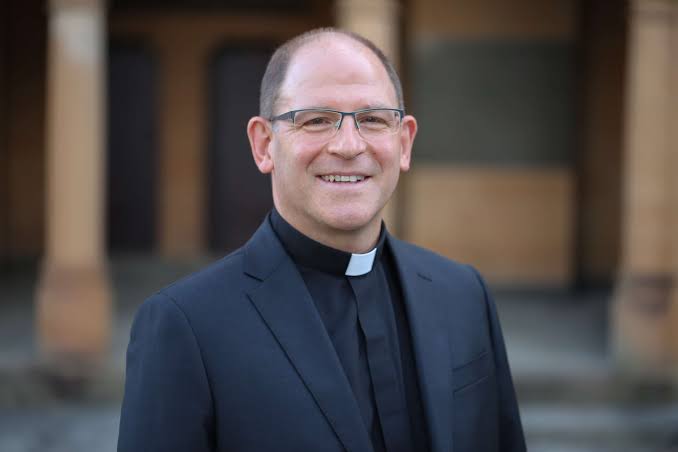
Pope Leo XIV has appointed Monsignor Anthony Randazzo, until now bishop of Broken Bay (Australia), as prefect of the Dicastery for Legislative Texts, and has also granted him the personal title of archbishop.
The appointment, made public by the Holy See, places the Australian prelate at the head of one of the key bodies of the Roman Curia, responsible for the interpretation of canon law and ensuring its correct application in the universal Church.
A canonist with experience in Rome and ecclesiastical courts
Born in Sydney in 1966 into a family of Italian origin, Randazzo was ordained a priest in 1991 for the Archdiocese of Brisbane. From the early years of his ministry, he showed a marked inclination toward canon law, which led him to study at the Pontifical Gregorian University, where he obtained a licentiate and a diploma in jurisprudence.
Upon his return to Australia, he held significant roles in the ecclesiastical judicial field, such as deputy judicial vicar and judge of the regional tribunal, in addition to serving on the national appellate tribunal for Australia and New Zealand. At the same time, he took on responsibilities in clergy formation, including as rector of the Holy Spirit Seminary in Brisbane.
Between 2004 and 2008, he worked in the then Congregation for the Doctrine of the Faith, an experience that allowed him to firsthand knowledge of the workings of the Roman Curia.
A profile with experience in specific ecclesial structures
In 2016, he was appointed auxiliary bishop of Sydney, and in 2019 he became bishop of Broken Bay. Since 2023, he has presided over the Federation of Episcopal Conferences of Oceania.
During this period, he has also served as apostolic administrator of the Personal Ordinariate of Our Lady of the Southern Cross, established to welcome faithful from Anglicanism, which has allowed him to gain experience in particular ecclesial structures within the discipline of the Church.
A key dicastery in the juridical governance of the Church
The Dicastery for Legislative Texts plays a central role in the life of the Church: it interprets canon laws, reviews normative coherence, and advises on the drafting of new provisions.
In this sense, it is not merely a technical body, but a decisive actor in shaping the ecclesial juridical order, with direct implications in areas such as judicial processes, ecclesiastical discipline, or the internal organization of the Church.
An appointment amid juridical tensions
Randazzo’s arrival comes at a particularly delicate moment for the Vatican judicial system. The recent nullity of the trial against Cardinal Angelo Becciu due to serious procedural defects—which will require restarting the process—has highlighted weaknesses in the application of the law.
At the same time, other cases, such as that of the former Jesuit Marko Rupnik, continue to generate unease due to the slowness of procedures and the lack of information to victims, which fuels perceptions of opacity and lack of transparency.
In this context, the Dicastery for Legislative Texts is called to play a key role in strengthening normative clarity, ensuring legal security, and contributing to restoring credibility in Church processes.
Law, reforms, and governance
Randazzo’s appointment is also framed within a broader debate on the role of law in Church governance. Following the Curia reform driven by Praedicate Evangelium, various voices have pointed to the need for competent bodies in legal matters to have real weight in decision-making.
The choice of a technical profile, with solid canonical training and experience in tribunals, points in that direction, at a time when the Holy See faces sensitive reforms, including the development of more precise norms on spiritual and power abuses.