


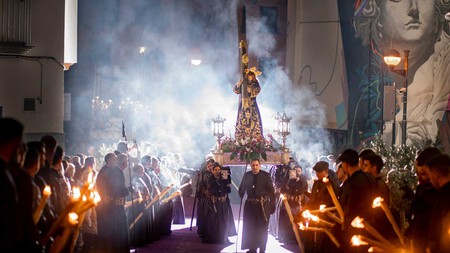
The Government of Spain has initiated the procedure to revoke the National Tourist Interest declaration of the Holy Week of Sagunto (Valencia) following the decision of one of its main brotherhoods to maintain its traditional statutes that only allow male participation. The measure, announced in a joint note from the Ministry of Tourism and the Ministry of Equality, opens a new front between the government’s ideological policies and the religious traditions preserved since the 15th century.
Institutional Pressure After an Internal Vote
The Executive’s decision comes after the Brotherhood of the Immaculate Blood of Our Lord Jesus Christ rejected, by 267 votes to 114, modifying its statutes to allow women to join its governing body. The proposal sought to replace the term “men” with “persons,” altering a tradition that dates back centuries.
As a result of this vote, the Secretary of State for Tourism has decided to initiate proceedings to withdraw the recognition granted in 2004, arguing that the exclusion of women could violate the “citizen participation” requirement stipulated by current regulations.
Imposed Equality Versus Brotherhood Autonomy
The Executive justifies its action based on the 2007 Equality Law and the regulations governing tourist interest festivals, arguing that no discriminatory practice can be tolerated. The Institute of Women maintains that preventing female participation “does not stem from a tradition,” but rather constitutes conduct contrary to fundamental rights.
However, the measure raises questions about the limits of State intervention in religious entities that, as the Valencian Government itself acknowledges, are private in nature and have their own rules and historical roots.
A Precedent Pointing to Other Brotherhoods
This is not an isolated case. The Institute of Women has recently acted against other brotherhoods in Murcia and Castilla-La Mancha for similar situations. Additionally, the Constitutional Court upheld last year the appeal of a woman excluded from a brotherhood in Tenerife, setting a jurisprudential line that reinforces this type of action.
All of this paints a scenario in which religious traditions are subjected to growing legal and political pressure to adapt to the «equality criteria» promoted by the Government.
Ecclesiastical Silence and Political Pressure
The Archdiocese of Valencia has chosen not to comment on the conflict, and in the political sphere, both the central Government and regional authorities have insisted on the need to advance toward “inclusion,” even in the realm of religious traditions. The President of the Valencian Government has called for dialogue, although he has made it clear that the direction must be toward equality.
Tradition Under Ideological Pressure
The possible withdrawal of tourist recognition would not only have symbolic consequences, but also economic and social ones for the city, increasing the pressure on the brotherhood.
The threat of withdrawing public recognition is not a neutral gesture, but a way of conditioning from outside the internal life of an association. What is at stake is not just a specific procession, but the real margin of freedom for religious associations to preserve their statutes, their history, and their own meaning without submitting to an imposed reinterpretation from politics.