


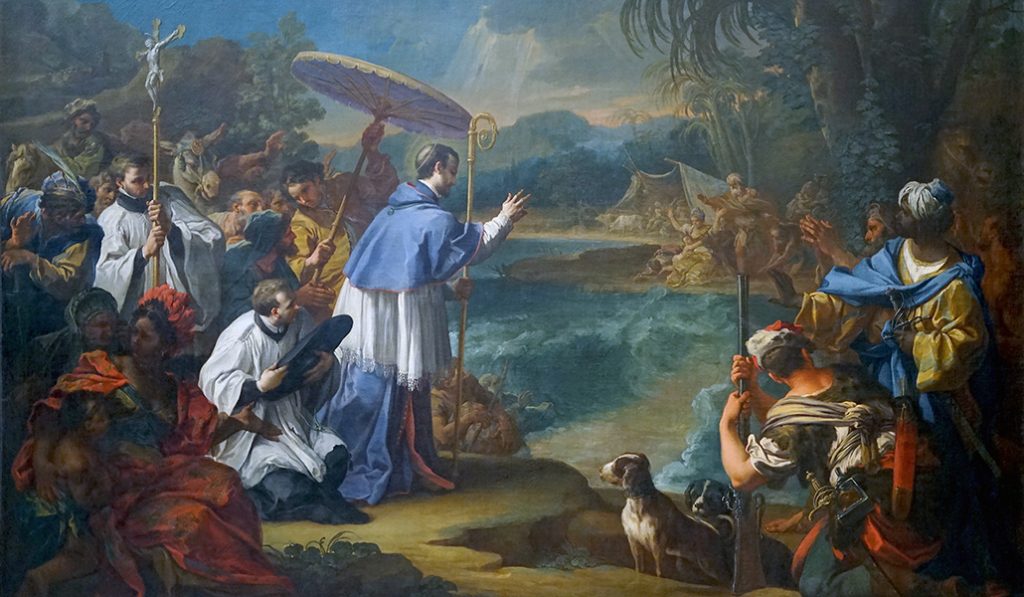
Every March 23, the Church remembers Saint Toribio of Mogrovejo, a decisive figure in the evangelization of the New World and a model of a missionary bishop. His life clearly shows how the Church brought to America an ordered, profound, and authentically Catholic missionary work.
A layman called to be a shepherd
Toribio of Mogrovejo was born in Spain in 1538 and soon distinguished himself as a jurist in Salamanca. His life took a radical turn when, still a layman, he was appointed Archbishop of Lima by Philip II. He received holy orders and was consecrated bishop in 1580, accepting with obedience a mission he had not sought.
He arrived at an immense diocese that encompassed much of South America. It was not a comfortable or established see, but a territory in full ecclesial construction, where the faith had to take root among diverse peoples, with different languages and customs.
A bishop who traveled his diocese
Saint Toribio did not govern from his desk. For years he traveled on foot or on muleback through his vast archdiocese, visiting remote villages, confirming the faithful, correcting abuses, and strengthening Christian life.
It is estimated that he spent much of his episcopate on pastoral visits. It was not a symbolic gesture: it was the essence of the episcopal ministry. The bishop had to know his people, preach, administer sacraments, and ensure that the faith was transmitted intact.
The III Council of Lima: order and doctrine
One of the great milestones of his governance was the III Council of Lima (1582-1583), one of the most important assemblies of the Church in America.
This council applied the reforms of the Council of Trent in the New World and established clear norms for evangelization: formation of the clergy, ecclesiastical discipline, uniform catechesis, and correct administration of the sacraments.
From it emerged official catechisms that were translated into Quechua and Aymara. The Church strove to teach the faith in the language of the peoples, with doctrinal precision and pedagogical clarity.
To evangelize is to teach the truth
Saint Toribio understood that there is no true evangelization without doctrine. For this reason, he promoted the drafting and dissemination of catechisms, insisted on systematic preaching, and required priests to learn indigenous languages.
It was not a cultural concession, but a theological exigency: the faith had to be transmitted without distortions. Teaching poorly was betraying the Gospel.
At the same time, he promoted sacramental life. He insisted that the indigenous people should receive the sacraments with due preparation, without unjust discriminations. Grace was not a privilege of a few, but a universal gift from Christ.
Defense of the faithful and reform of the clergy
As a true shepherd, he defended the weakest against abuses and confronted civil authorities when necessary. But his reform was not only social: it was, above all, spiritual.
He founded the seminary of Lima to train well-prepared priests, in accordance with the Tridentine spirit. He knew that without good priests there is no solid Church. Evangelization does not depend only on enthusiasm, but on doctrinal fidelity and the holiness of the clergy.
He also convened numerous synods to maintain discipline and correct deviations. His action was constant: to teach, correct, order, and sanctify.
A time of saints
The fruitfulness of that Church is reflected in the saints who emerged in his surroundings: Saint Rose of Lima, Saint Martin de Porres, or Saint Francis Solano. Saint Toribio confirmed and accompanied them, as a true spiritual father.
Death on mission
He died on March 23, 1606, far from the comfort of his see, during a pastoral visit. Until the end, he lived as he had governed: dedicated to his people.
He was canonized in 1726, and the Church recognizes him today as Patron of the Latin American Episcopate, a permanent model of a shepherd.
A lesson for today
His example recalls a truth that today seems, in some cases, distant: the Church evangelizes when it teaches with clarity, celebrates with fidelity, and lives with coherence.
In the face of doctrinal confusion and pastoral weakening in our days, Saint Toribio continues to point the way: bishops who teach, priests who form, and faithful who live the faith without discounts.