


In 1850, Maximin Giraud, one of the two children who claimed to have witnessed the apparitions of the Virgin in La Salette four years earlier, walked for two days from the alpine village of Corps to the village of Ars to meet with an old priest: Saint John Mary Vianney. He was fifteen years old. He was seeking guidance on his vocation. Only the two of them know what was discussed in that meeting, but everything suggests that Maximin told the Curé of Ars the details of those visions, which at that time had not yet been written down or formally sent to Rome.
Something in that conversation caused a profound shock in Vianney, enough for him to avoid publicly supporting the apparitions from then on and even to harbor serious doubts about their authenticity. That initial bewilderment could be understood more clearly more than a century later, when in 1999 the complete texts that Pius IX had received from the visionary children, Maximin and Mélanie, came to light. There appear, without subsequent softenings, direct statements of a harshness that breaks any comfortable scheme.
The exact content of that conversation between Maximin and Vianney in 1850 is not known. There is no record or reliable direct testimony that allows it to be reconstructed. Any attempt at explanation moves in the realm of speculation. But there is a very plausible hypothesis: that the young man transmitted the rawest content of the secrets, and that was what provoked Vianney’s first reaction.
The Harshness of La Salette
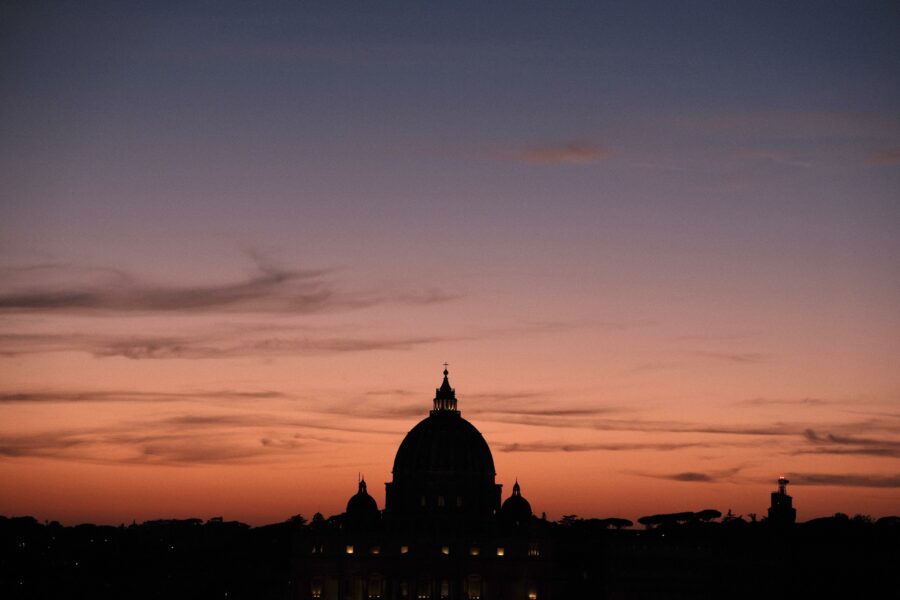
The words of the Virgin, which for more than a century were preferred to be kept in the Vatican Library, are very harsh: Rome will lose the faith; Rome will be the seat of the Antichrist; priests are sewers of impurity; bishops, silent dogs incapable of defending the truth. They are not soft metaphors or ambiguous warnings. They are an announcement of the internal corruption of the Church.
The mistake is to interpret that picture as a demoralizing sign of definitive collapse. It is not. The words of the Virgin only describe the battlefield. They are proof that the struggle is where it has always been anticipated for us. Christ is left practically alone on Calvary: the Virgin, John, and a few women. The rest hide and leave the Lord agonizing alone. If measured in human terms, it is a defeat. More than ninety percent of the apostles hid like rats. What do we expect from their successors? And yet, that is where the victory begins.
All those who hid later knew how to shine even to martyrdom. Curiously, only to John, who was there at his feet, did the Lord not reserve that destiny.
The world is not neutral. There is a real struggle between good and evil, and not in the abstract. The devil operates truly. And what is at stake is not an idea, but something very concrete: the salvation or damnation of each soul. From there, the logic is direct: if what is at stake is salvation and if the sacraments are the main channel, then the most sensitive point where the battle is fought is the priest and his institutional structure. If that point is corrupted, if the enemy occupies that space, the very place through which grace passes is contaminated.
Read calmly, the message of La Salette is not hopeless. It is not formulated to paralyze, but to warn. It points out where the real risk is and, therefore, where vigilance should be placed. From that framework, it is understood that the denunciation of evil in the Church is not an exercise in fatalism, but a call to take seriously what is truly at stake.
In the last years of his life, almost on the threshold of death, Saint John Mary Vianney rectified and began to publicly affirm and endorse the apparitions and the message of La Salette. For a long time he had maintained serious distrust, at times convinced that it might be an invention. However, in the end, his position changed.
In a priest like Vianney, whose life was marked by an intense relationship with the supernatural, it makes no sense to interpret that final step as a simple intellectual adjustment. It is more coherent to read it as the result of a more attuned, cleaner gaze, capable of recognizing without scandal what had previously generated doubts for him.
In the raw battle for the good of the Church, there is no collapse or insurmountable contradiction. There is siege, there is corruption, there is real darkness. But none of that invalidates the Church or interrupts the action of grace. If the combat is played out in souls and in the sacraments, there is no room for alternative theories. It is fought there. In the concrete. In fidelity without shortcuts: life of grace, service to neighbor, confession, liturgy, prayer, and hope.