


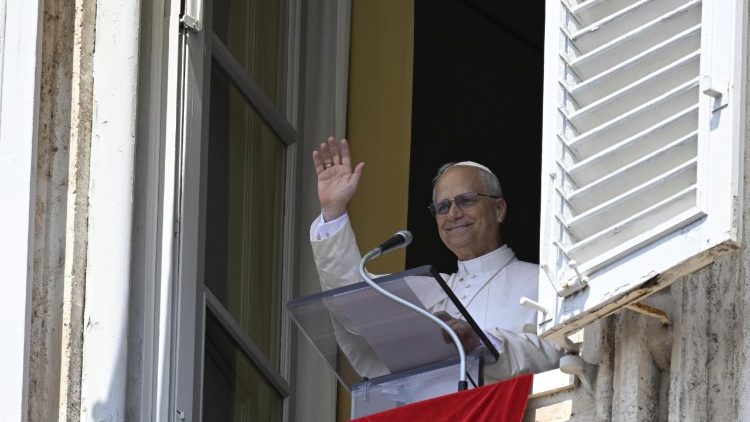
In the context of the Angelus prayer this Sunday, the fifth of Lent, Pope Leo XIV centered his reflection on the Gospel of the resurrection of Lazarus, emphasizing the Christian meaning of victory over death and eternal life. Addressing the faithful gathered in St. Peter’s Square, the Pontiff warned about a society that seeks to fill its inner void with passing goods, and recalled that only in Christ—»resurrection and life»—does man find an answer to his desire for the infinite. On the eve of Holy Week, the Pope called for abandoning selfishness, materialism, and superficiality to welcome the grace that renews man and opens him to hope.
Here below are the words of Leo XIV:
Dear brothers and sisters, good morning!
On this fifth Sunday of Lent, the liturgy proclaims the Gospel of the Resurrection of Lazarus (cf. Jn 11,1-45).
In the Lenten journey, this is a sign that speaks of Christ’s victory over death and the gift of eternal life that we receive in Baptism (cf. Catechism of the Catholic Church,1265). Today, Jesus also says to us, just as to Martha, the sister of Lazarus: «I am the Resurrection and the Life. Whoever believes in me, even if he dies, will live: and everyone who lives and believes in me, will never die» (Jn 11,25-26).
The liturgy thus invites us to relive, in the light of the imminent celebration of Holy Week, the events of the Lord’s Passion—the entry into Jerusalem, the Last Supper, the trial, the crucifixion, the burial—to perceive their most authentic meaning and open ourselves to the gift of the grace they contain.
In fact, it is in the Risen Christ, who conquers death and lives in us through the grace of Baptism, that these events find their culmination, for our salvation and fullness of life.
His grace illuminates this world, which seems to be in a constant search for novelties and changes, even at the expense of sacrificing important things—time, energies, values, affections—as if fame, material goods, entertainment, or passing relationships could satisfy our heart or make us immortal. It is the symptom of a need for the infinite that each of us carries within, but whose answer cannot be placed in the ephemeral. Nothing created can quench our inner thirst, because we are made for God, and we do not find peace until we rest in Him (cf. Confessions, I,1.1).
The account of the resurrection of Lazarus invites us, then, to listen to that deep need and, with the strength of the Holy Spirit, to free our hearts from habits, conditionings, and ways of thinking that, like large stones, enclose us in the tomb of selfishness, materialism, violence, and superficiality. In these places there is no life, but only disorientation, dissatisfaction, and loneliness.
Jesus also shouts to us: «Come out!» (Jn 11,43), encouraging us to come out, renewed by his grace, from those narrow spaces, to walk in the light of love, as new men and women, capable of hoping and loving according to the model of his infinite charity, without calculations and without limits.
May the Virgin Mary help us to live these holy days in this way: with her faith, with her trust, with her fidelity, so that in us too the luminous experience of the encounter with her Risen Son may be renewed every day.