


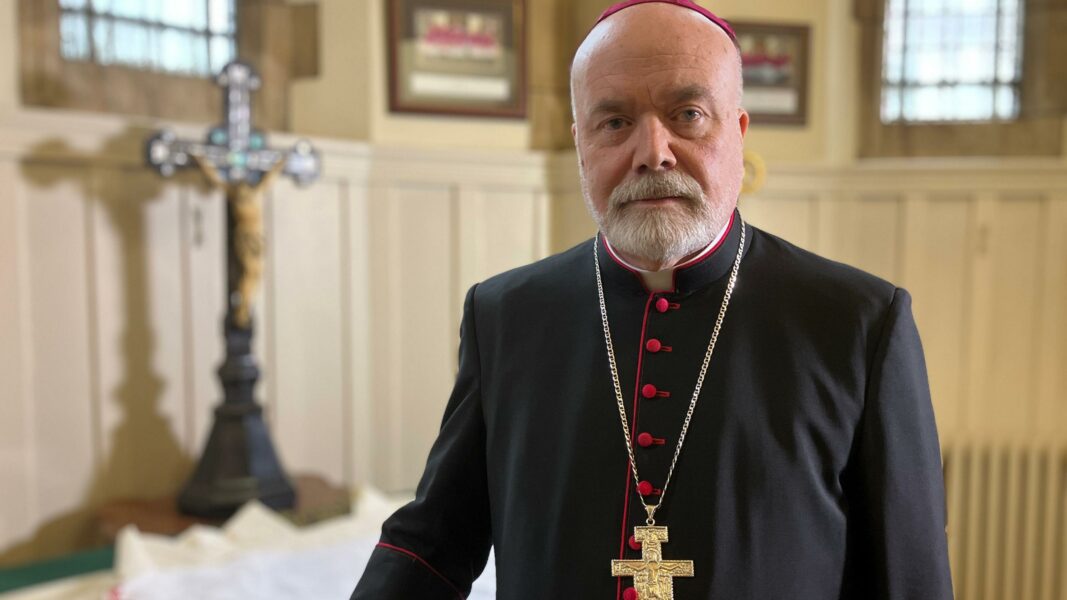
The recent episcopal movements in England published in the Holy See Bulletin, and analyzed by The Pillar, point to a possible unification process between the English dioceses of Leeds, Middlesbrough, and Hallam, in a context of ecclesial reorganization.
Three Dioceses Under the Same Leadership
The appointment of the Bishop of Leeds, Marcus Stock, as apostolic administrator of Middlesbrough first and then of Hallam has opened the door to a possible territorial reconfiguration. These are three geographically close dioceses, with historical ties and a comparable pastoral reality.
This type of decision is rarely casual. When the same bishop temporarily assumes several neighboring dioceses, it is usually the first step toward deeper integration.
Union or Merger? Two Possible Scenarios
The process could develop in two ways. The first is the so-called union in persona episcopi, in which several dioceses retain their legal identity but come under the governance of a single bishop.
The second option would be a full merger, resulting in a single diocese. Some local consultations are already openly talking about “amalgamation,” while others propose more gradual formulas.
For the moment, there is no definitive decision, but the fact that consultations have been initiated indicates that the process is in an active phase of discernment.
Hallam and Middlesbrough, Vulnerable Dioceses
Among the three dioceses, Hallam appears as the weakest in demographic terms, with one of the smallest Catholic populations in England. Middlesbrough, although older, also presents relatively limited dimensions.
These factors make them natural candidates for reorganization, especially in a context where the Church seeks to optimize resources and structures.
Leeds as the Axis of Reorganization
The Diocese of Leeds, more consolidated, is shaping up as the nucleus around which this eventual unification could be articulated. The figure of its bishop as administrator of the neighboring dioceses reinforces this hypothesis.
If the process advances, it is not ruled out that in the future a single structure will be configured that integrates the three territories, following models already applied in other European countries.
A Broader Phenomenon in the Church
The possible unification of these dioceses would not be an isolated case. In recent decades, the Holy See has promoted similar processes in various regions of Europe, especially in areas affected by the decline in religious practice and demographic changes.
Although the number of faithful is not the only criterion, it does constitute a relevant factor when rethinking ecclesial structures inherited from different historical contexts.
A Process Still Open
For now, the situation remains in a phase of study and consultation. The ecclesiastical authorities will have to evaluate not only numerical data, but also historical, pastoral, and geographical factors.
What seems clear is that the Church in England could be facing a reorganization process of greater scope, in which the case of Leeds, Middlesbrough, and Hallam would be only the first step.