


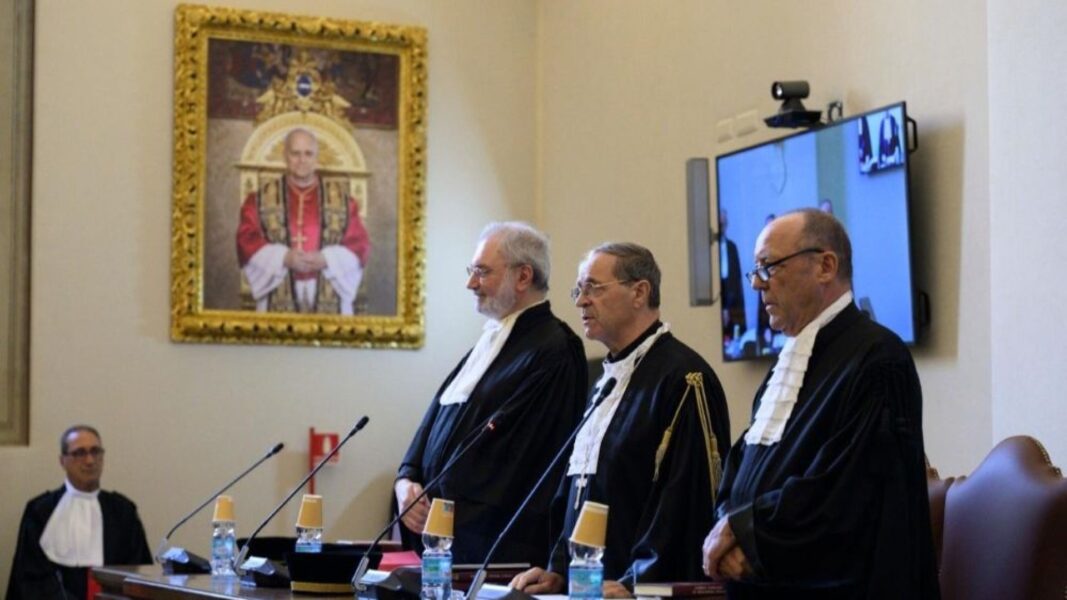
The trial over the London property scandal has opened a new crack in the Vatican judicial system: a direct confrontation between the Promoter of Justice and the Court of Appeal that threatens to further exacerbate doubts about the transparency of the procedure.
A Showdown Between the Promoter and the Court of Appeal
According to Il Messaggero, in the Vatican, an unprecedented clash is shaping up between the prosecuting body and the appeal judges reviewing the Becciu case. The origin of the conflict lies in the order issued on March 17, which declared the relative nullity of the first-instance trial and required the process to be redone.
The Court not only ordered the trial to be repeated but also the full deposit of all documents from the investigative phase before April 30. However, this requirement may not be met.
The Promoter Reserves the Right to Challenge the Judicial Order
The element that has ignited the tension is the Promoter of Justice’s decision to “reserve the right to challenge” the Court’s order. In practice, this opens the door to a blockade scenario: the Promoter could fail to present all the required documentation, or limit himself to delivering only a part, as already happened during the first phase of the process.
This precedent is particularly significant. At that time, the then Promoter, Alessandro Diddi, refused to deliver the entirety of the relevant conversations, relying on investigative secrecy, even when the court itself requested it.
Hidden Chats at the Center of the Controversy
The core of the conflict revolves around a series of partially hidden messages—covered with “omissis”—that, according to the defenses, could demonstrate the existence of irregular maneuvers against Cardinal Angelo Becciu.
The appeal judges have expressly acknowledged that the evidentiary material was never delivered in its entirety, but only partially and with censored parts. These conversations would include delicate exchanges between the consultant Immacolata Chaouqui and Genoveffa Ciferri, linked to the main prosecution witness, Monsignor Alberto Perlasca.
Some already known fragments have fueled suspicions. In one of them, it reads: “If it is discovered that we were all in agreement, it’s the end,” a statement that has increased doubts about the cleanliness of the process.
Doubts About Respect for Due Process
The Court of Appeal has been unequivocal: in the first-instance trial, a “relative nullity never remedied” occurred that affected a fundamental act of the process. Among the most delicate points is also the existence of a pontifical rescript that granted broad powers to the Promoter and which was not communicated to the defenses, limiting their ability to defend.
This aspect has been one of the most criticized by jurists and canonists, who have even questioned whether basic guarantees of a fair trial were respected in the Vatican.
A Setback for Institutional Defenses
The Court’s decision also contradicts the theses defended by the lawyers of the Secretariat of State and the APSA, including the former Italian ministers Giovanni Maria Flick and Paola Severino. Both had argued that the process was conducted with total regularity and that no rights violations occurred.
However, the judges have chosen to side with the defenses of the accused, marking a significant shift in the interpretation of the case.
Uncertainty Ahead of the Next Steps
With the calendar set—first hearings scheduled for June 22—all eyes are now on the next decision of the tribunal presided over by Archbishop Arellano Cedillo.
If the Promoter decides not to fully comply with the document deposit order, the institutional confrontation could escalate, deepening the credibility crisis surrounding this process from its beginnings.